- Apr 18, 2008
- 16,019
- 1
- 31,734
- Disclosures
- I'm highly opinionated and extremely self-assured

TalkBass has been independent since 1998. Add your voice.
Create a free account to reply to discussions, view embedded media, and browse with fewer display ads.
Join free Log in
Want zero display ads or expanded classifieds tools? Compare plans.



Remove the strings. Problem solved.Paint over the dots.
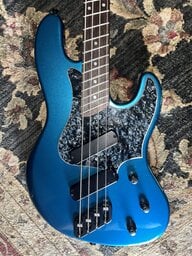
Actually, you shouldn’t feel embarrassed…. You have a perfect example of the dingwall there where it runs right through the dots and is perfectly spaced on both sides at the edge of the fretboard. When you buy a 19 mm bridge, this means centre to centre of each string…. people here maybe over complicating things. You could also put into account that maybe the dots aren’t perfectly centred… so many variables.Well, I feel a little embarrassed now. Thanks for educating me on this! I thought that the strings were spaced center-to-center. Now I have one less thing to obsess over


I like how the bass kinda matches the floor.Yea, that bothered me too so when I put this together, I made sure the A string went right down the middle.
What you all are discussing is the difference between what we call mechanical center vs optical center.A simple solution could be fret markers that aren’t dots. Blocks, parallellograms Rick-style sharkfins etc.
Nut and bridge are different things. The nut is often spaced proportional to string width but bridge spacing is string center-to-center with very rare exceptions.When you buy a 19 mm bridge, this means centre to centre of each string…. people here maybe over complicating things.


Ha ha ha! Yeah, paint over the dots. Or go a 5er with rectangle markers.Paint over the dots.
Won't work. He'll just complain about how the strings aren't centered over the rectangles.

Actually they are centered based on the middle of the string. The B looks closer because its much thickerYour strings are not centered on the neck. The gaps between the neck edges and B and G strings are asymmetrical, i.e. the B string sits closer to the edge than the G string. Some people like that, some don't.

I’m well aquainted with the principle, having worked with typography most of my adult life.What you all are discussing is the difference between what we call mechanical center vs optical center.
Mechanical center: Measure the width. Divide by two. Put the thing at the halfway point.
Optical center: Do the above. See how it actually looks in context with everything else going on. Scooch the thing to the left or right until it looks good, because the dot's relationship with the left and right edges of the neck do not stand out to your eye as much as the dot's relationship to the objects closest to it -- in this case, the D string.

A bridge too far…

I found that both B and G string no crazy close to fretboard edge like most SR5 too.I'm looking at a photo of the StingRay Special 5 I stupidly sold. Looks like it's set up with equal-center spacing rather than equal gap spacing, which explains why the A-string is nicely aligned with the dots.
View attachment 7376287