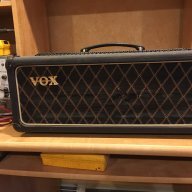
Funny, I've been looking in the other direction, a 100w tube power amp for my preamp pedal. I'm less concerned about weight obviously.

TalkBass has been independent since 1998. Add your voice.
Create a free account to reply to discussions, view embedded media, and browse with fewer display ads.
Join free Log in
Want zero display ads or expanded classifieds tools? Compare plans.

Funny, I've been looking in the other direction, a 100w tube power amp for my preamp pedal. I'm less concerned about weight obviously.
Funny, I've been looking in the other direction, a 100w tube power amp for my preamp pedal. I'm less concerned about weight obviously.


Uh, I don't think so! 16 lbs and Dimensions: 14 x 2.75 x 9 in. -- that would be like the Big Hulk riding a tiny unicycle! Doesn't fit on a pedal board, and @ $1,200, WAY too expensive!
Funny, I've been looking in the other direction, a 100w tube power amp for my preamp pedal. I'm less concerned about weight obviously.
p.s., how does one know if they can or cannot bypass the preamp on a particular amp?
Sounds like a DIY would be cool to do

This makes sense as well as the fact that it's, not home made without certification, and it won't burn your house down...I started a thread like this when I was looking for an amp last year. This was my rationale for buying the Mesa D350. It's small, loud, and if I didn't like the preamp, I could always run something into the aux input. Turns out I like the preamp.

I there's an "FX return" on the amp, you can plug you external preamp directly to it, it bypasses the preamp.
but not on all amps, right?
my markbass the EQ is still active when i use a preamp into the effects return.
but not on all amps, right?

With the proliferation of high quality preamp pedals and small class D amps I'm really surprised there's not an option for smaller class D power amps for bass without the need for a built in preamp and thus even smaller and hopefully cheaper.
Something just like the Seymour Duncan power stage 700 but without even the eq or baked in guitar amp sim would be the closest example.

MarkBass often does it differently, and also use a parallel loop which unless converted to serial is not going to work for this application.I didn't know Markbass does that, I believe the standard behaviour is that the FX loop is between the preamp and the power amp.
This makes sense as well as the fact that it's, not home made without certification, and it won't burn your house down...
Nobody is discouraging DIY, what they are commenting on is that lack of some of the most basic safety approaches in much of what we see. Things that are genuinely dangerous in real world circumstances.Fact is some people are capable of building amps at home and have done so for generations.
No need to throw all the apples in the same barrel, Fact is certified electrical gear out there has burned down a lot of houses.
I don't understand the anti DIY sentiments on TB.
Almost like there was manufacturers reps around here discouraging it or something.
This is one reason I stopped playing Markbass.but not on all amps, right?
my markbass the EQ is still active when i use a preamp into the effects return.




