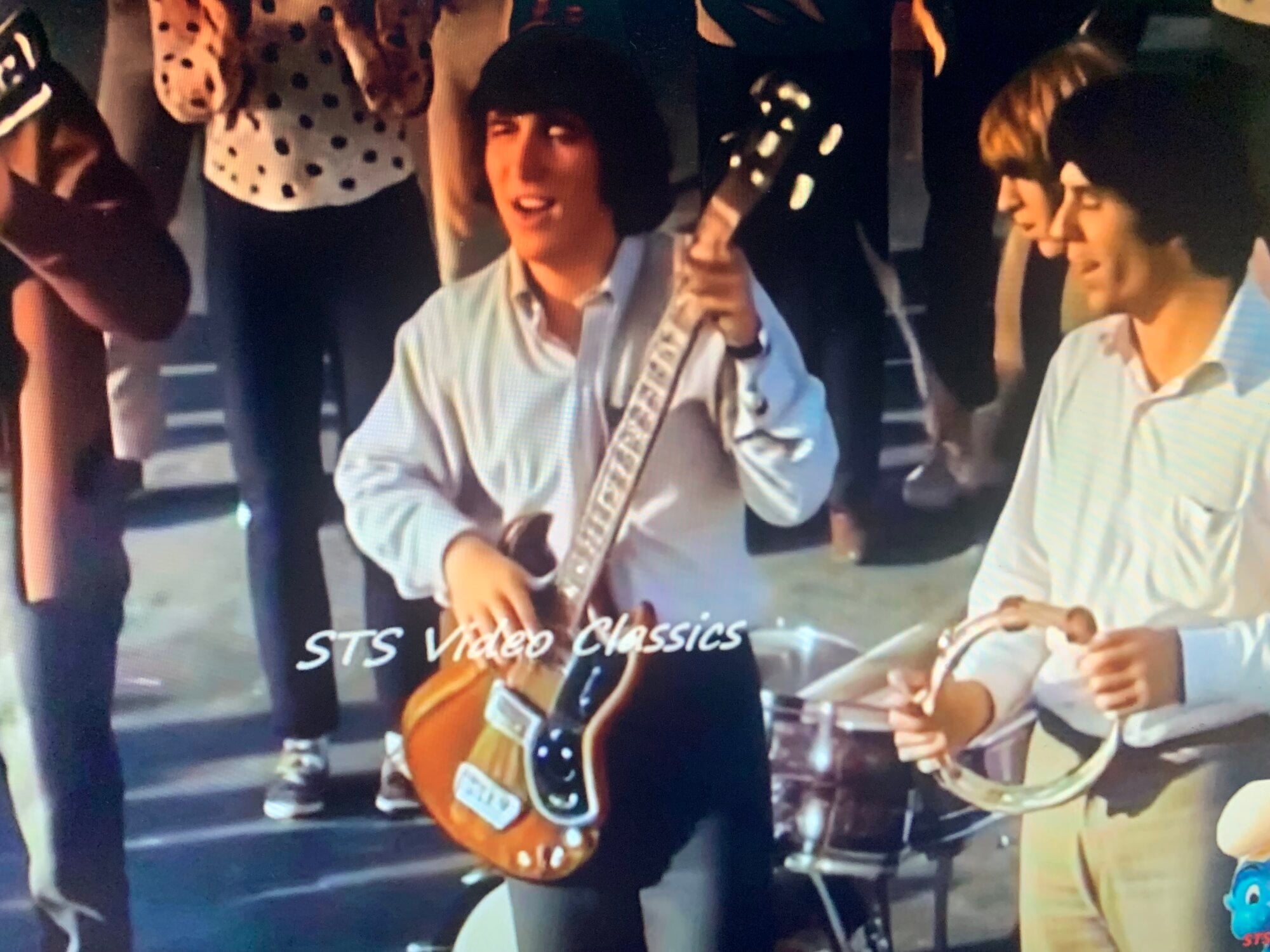
Old film and hard to see details but this could be one of those EB0 's with a built in Fuzz tone?

TalkBass has been independent since 1998. Add your voice.
Create a free account to reply to discussions, view embedded media, and browse with fewer display ads.
Join free Log in
Want zero display ads or expanded classifieds tools? Compare plans.

Old film and hard to see details but this could be one of those EB0 's with a built in Fuzz tone?
View attachment 7323642

It’s just a still shot from that video. The reason it looks so weird is because: that clip is from the old Dick Clark show, “Where The Action Is”, a daily rock/pop showcase of the mid-60’s that was done in black and white and otherwise had low production values. They would often tape bands utilizing the coastline of Los Angeles as a backdrop, surrounded with dancing go-go girls , a trickle-down from the ‘Beach Movies’ of the period.The first photo posted is AI, right?


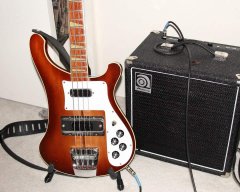
Yes, it's a Gibson EB-0F "Fuzztone". It's an EB-0 with a built-in, battery powered (and obviously switchable) Maestro FZ-1 fuzz. The Maestro FZ-1 was also sold separately as a pedal, and has earned it's place in rock history as the fuzz used by Keith Richards on Satisfaction. As a side note, the currently made EHX Satisfaction fuzz pedal is actually NOT based on the FZ-1, but on another fuzz pedal, the Jordan Boss Tone. I guess EHX's marketing department earned their paycheck that day...
The FZ-1 is not a particularly great sounding fuzz for bass. Very "farty". The EB-0F is a very cool little bass, but the fuzz is mostly a gimmick. It's the kind of tone you will probably never find any real use for on bass. The FZ-1 can be very cool with guitars though, which makes it a bit strange that Gibson never release a "Fuzztone" guitar...
There's also the Epiphone Newport "Fuzztone", which is a Newport bass with the same, built-in FZ-1. The Newport is basically a Gibson EB-0 with a different body shape. Back in the day, Gibson had some kind of exclusive contract with certain dealers, so to be able to sell more guitars through OTHER dealers they used the Epiphone brand to sell basically the same instruments with a slightly different body shape and an Epiphone logo on the headstock. The quality of the instruments was exactly the same, not like today when Epiphones are lower budget models.
Just to be clear: I'm NOT in any way referring to the currently made Epiphone Newport "reissue". The "reissue" isn't even remotely the same quality as the old Newports. The "reissue" is cheaply made and severely flawed. The most critical flaw is the string spacing. For some reason they decided to use a bridge with a (more or less) Fender strings spacing, which means the E-string or the G-string or both end up outside the magnetic field of the neck pickup. The result is an anemic sounding E- or G-string (or both). Also, the pickup isn't even remotely the same specs as a vintage sidewinder/mudbucker, the wood is some kind of super-light, porous, low quality "mahogany"-substitute, and the overall build quality isn't even remotely the same as vintage, US-made Gibson/Epiphone.
Of course, the "mudbucker" tone of even a GOOD, vintage EB-0/Newport isn't for everyone. Personally I love the tone of a GOOD quality mucbucker bass (which rules out any recent Epi "reissues") but most bass players don't.

They must have fixed this in later batches then, because every single one I've tested was utterly USELESS. Or to be more precise, the neck pickup was useless due to the incorrect string spacing. The overall build quality was also extremely poor. And "Mahogany" neck/body... (according to Epiphone's specs). That's just a lie. At least most other guitar manufacturers who use cheaper mahogany substitutes are honest and specify the real name of the wood, typically Kaya or Sapele (which to be fair can be very nice woods for guitars). I'm not sure what these Newport "reissues" are made of though. The ones I've been inside had extremely light, "flaky" wood that chipped very easily.Nothing you said about the Newport reissues is remotely true. The spacing is fine and the string volume is punchy and even across the board.
That's correct I just took a photo off my screen for the still.It’s just a still shot from that video. The reason it looks so weird is because: that clip is from the old Dick Clark show, “Where The Action Is”, a daily rock/pop showcase of the mid-60’s that was done in black and white and otherwise had low production values. They would often tape bands utilizing the coastline of Los Angeles as a backdrop, surrounded with dancing go-go girls , a trickle-down from the ‘Beach Movies’ of the period.
Then, it seems like any surviving video is not always of the best quality, and to top it off, whoever posts this stuff often takes it on themselves to “colorize” the video, something that I’m personally opposed to. I’m sure some computer program is used to process it, but I don’t think the actual screen content(the “action”…sorry)is manipulated.
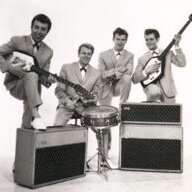
He also was seen with a Vox Clubman Bass -Kinda looks that way…
View attachment 7323648View attachment 7323649
But in actual live performances, Ron Meagher preferred a Jazz Bass…
View attachment 7323650
On another lip-synch/mime TV appearance, he had the Gibson, maybe it was part of an overall band endorsement deal where, in order for the guitarists to get the models they wanted, he had to be seen on the tube with the EB-0…
View attachment 7323651
There was certainly no distorted bass(or guitar) on their records, it was all classic jangle pop.
Mine is from the very first run they released. Other than a little fret sprout that had to be addressed, it’s been a perfect bass. There are plenty of other owners on this site that would attest to the same. You do you though.They must have fixed this in later batches then, because every single one I've tested was utterly USELESS. Or to be more precise, the neck pickup was useless due to the incorrect string spacing. The overall build quality was also extremely poor. And "Mahogany" neck/body... (according to Epiphone's specs). That's just a lie. At least most other guitar manufacturers who use cheaper mahogany substitutes are honest and specify the real name of the wood, typically Kaya or Sapele (which to be fair can be very nice woods for guitars). I'm not sure what these Newport "reissues" are made of though. The ones I've been inside had extremely light, "flaky" wood that chipped very easily.
It's not the first time Epiphone mess up their basses either. A couple of years ago it was the Embassy Pro where a HUGE batch from 2018 had the bridge installed in the wrong position, making the basses impossible to intonate. This was fixed in later batches, but Epiphone kept selling the faulty ones even after they were made aware of the problem. That' despicable.

The Germanium transistors might be a bit difficult (but not impossible) to find, but apart from that I don't see why it should be irreparable??? It's a very basic circuit.A guitarist/electrical engineer friend of mine has one of these with the built in fuzz (that doesn’t work) and he says it’s absolutely irreparable!

It’s just a still shot from that video. The reason it looks so weird is because: that clip is from the old Dick Clark show, “Where The Action Is”, a daily rock/pop showcase of the mid-60’s that was done in black and white and otherwise had low production values. They would often tape bands utilizing the coastline of Los Angeles as a backdrop, surrounded with dancing go-go girls , a trickle-down from the ‘Beach Movies’ of the period.
Then, it seems like any surviving video is not always of the best quality, and to top it off, whoever posts this stuff often takes it on themselves to “colorize” the video, something that I’m personally opposed to. I’m sure some computer program is used to process it, but I don’t think the actual screen content(the “action”…sorry)is manipulated.
The first photo posted is AI, right?
No, it's just the 60s...
The actual reason is because:It’s just a still shot from that video. The reason it looks so weird is because: that clip is from the old Dick Clark show, “Where The Action Is”, a daily rock/pop showcase of the mid-60’s that was done in black and white and otherwise had low production values. They would often tape bands utilizing the coastline of Los Angeles as a backdrop, surrounded with dancing go-go girls , a trickle-down from the ‘Beach Movies’ of the period.
Then, it seems like any surviving video is not always of the best quality, and to top it off, whoever posts this stuff often takes it on themselves to “colorize” the video, something that I’m personally opposed to. I’m sure some computer program is used to process it, but I don’t think the actual screen content(the “action”…sorry)is manipulated.
The band’s moment of glory was 1965, and there certainly was videotape existing and in use by then. The format was in development by the early 50’s, and its earliest use occurred by the end of the decade, on into the 60’s, primarily for shows with budget restrictions or in need of quick production turnaround. Yes, there were kinescopes to film record shows that otherwise were broadcasted live, but that faded away before the 60’s.The actual reason is because:
The method of recording old television shows by placing a film camera in front of a live broadcast television monitor was called a kinescope. The final recording was also referred to as a kinescope or kinescope recording.
They didn't have video tape back then, so this is how they would copy a show to keep record of it.