• TalkBass has been independent since 1998. Add your voice.
    Create a free account to reply to discussions, view embedded media, and browse with fewer display ads.
    Join freeLog in
    Want zero display ads or expanded classifieds tools? Compare plans.

Is this normal?

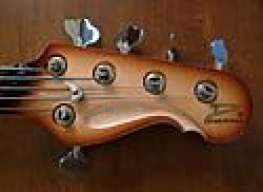
**Edit: it is. I was hoping it was the cause of an issue, which I recorded in post #55**So I just discovered after years that on my Dimension the low E goes at an angle to the right behind the nut. None of my other basses do this, and online pics of other Dimensions don't either. I'm wondering if this is why I've battled with strange overtones and dullness on the low E starting at about the 3rd fret, even after extensive trouble shooting like witness points, pickup height, etc.
dimension-jpg.jpg
 
Last edited:
Doubt it. If the gage of string you are using is bigger than the bass was laid out for it will push it over a little. It is more apparent on the tuner that is closest to the nut. Should not be an issues since the tone of the string is just the free length between the nut and bridge.
Yeah it does it regardless of guage. These are 96
 
Last edited:
Have you tried different strings and noticed any difference? Sometimes certain strings just ride better on a certain bass. The only other thing that could be the culprit is one of your frets could have something going on. It's amazing how sensitive strings are to a change in frets or any impurity or imperfection. Your bass looks immaculate but you never know.
 
yeah like I said above I've tried about 1000 things, sadly. Strings pictured were put on last night. The closest I get is cutting around 400-500ish hz, but I dont necessarily want to do that always. I love the bass though so I hope I can figure out something.
 
Last edited:
Strange overtones can be caused by having pickups too close to the strings.
Yeah, I get this a lot because I raise the neck pickup a lot, where the physical string vibration amplitude is large. My general procedure is to raise them until I get that "chorusing" effect, and then lower them back down until they don't. And about a half turn for breathing room for hard-hit notes. Sometimes I play rough. :D
 
Looking at the pictures, I'm going to say the offset looks like it's caused by the thicker outer winding being long enough that it starts to wrap around the tuner shaft. A different string set with a (slightly) shorter winding might not do that. That said, I agree with others that it's mostly likely not the cause of the overtones you're talking about. Three things that come to mind:

1) Pickup is too close to that string (already mentioned)
2) Bad or twisted string
3) Tapered core at the bridge end having too much "taper" past the bridge saddle. Ideally, if you have taper-core strings, the taper should start as close to where the string breaks over the saddle as possible, at least in my experience.
 
Looking at the pictures, I'm going to say the offset looks like it's caused by the thicker outer winding being long enough that it starts to wrap around the tuner shaft. A different string set with a (slightly) shorter winding might not do that. That said, I agree with others that it's mostly likely not the cause of the overtones you're talking about. Three things that come to mind:

1) Pickup is too close to that string (already mentioned)
2) Bad or twisted string
3) Tapered core at the bridge end having too much "taper" past the bridge saddle. Ideally, if you have taper-core strings, the taper should start as close to where the string breaks over the saddle as possible, at least in my experience.
I'd be inclined to think number 2 or 3, but I checked and rechecked for twisting and it happens regardless of string. I have wondered if I can find a string brand that has a longer "thinner" part before the main string thickness reaches the post if that would help. Anyone know of any particular brands that have a longer thinner section than usual?
 
Due to my OCD I've been upset by the same issue a number of times. All strings gotta run parallel! The problem can be remedied to an extent, or even completely, if one takes care that the last part of the E string to touch the peg (the last few millimetres that are on a tangent to the peg shaft) do tuck under the previous wounds of the string and not on top of them (seen horizontally). If done so, the E string is brought as close as possible to the axis of the peg and runs almost parallel to the rest of the strings. To achieve that, while tuning/tightening the string, when almost done, turn the peg so as to release tension and try push/tuck the last bit of the string to touch the shaft of the peg. Here's a pic of my Pbass freshly strung with La Bella 760FS flats (.105 E string).

straight cat strings.JPG
 
  • Like
Reactions: westrock