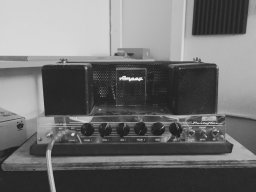
Anyway, "smart" is not buying something that's already crazy expensive, hoping it will get even MORE crazy expensive, those people likely already missed the boat. Smart is buying something that's underrated but well regarded by people familiar with it, that comes up at a great price even for now. That's always been my strategy and I've broken even or made money way more often than not. If you have to ASK whether it might be worth it, it's definitely not. It should be blindingly obvious that it's such a great deal that you'd be an idiot to pass it up. Like, I bought a guitar tube combo that only 100 were ever made in that color scheme out of a total production of about 1000. For about $400. Now, as a 60w 1x12 tube combo that sounds pretty dang good, it's inherent value is at LEAST $300. So I would have to try pretty hard to lose money on it. It wasn't even what I went to buy, but the guy was a gear hoarder/seller and happened to have that piece and I asked about it and we made a package deal with something else. The deal presented itself, and even though it wasn't exactly what I was looking for, I recognized what it was and what it was likely worth (and the try out and actual purchase were a couple days apart as well so I had time to research). So I went for it. Some older bass stuff from the 90s are phenomenal deals right now. Everyone's already trying to squeeze every penny out of 60s Fenders (and 70s Fenders, and 80s Fenders).
Collecting for profit is a long game. You have to know when something is at it's absolute bottom, and is likely to go up soon enough that you can sell it before you die (if your goal is to make money). Jumping on a bandwagon is always going to be a losing proposition unless you manage to identify it REALLY early. The people who bought Minimoogs in like 1989 for a few hundred bucks and still have them now, they're worth about 10x what they paid for them. Which doesn't make ANY sense. We have really damn good software emulations of basically all the big analog synths from the 60s, 70s, and 80s. Many of which you can get for free. I have free vst versions of Minimoog, EMS Synthi-A, Oberheim OBXa, Roland Juno, Roland JX8P, ARP 2600, Wasp, etc... Now, I wish I had been able to pull the trigger on the OBXa or OB8 I found at guitar center back around 2002 for $800, because now they are $4k or more. But if I buy one now, just hoping it will go up to $8k, I'm an idiot and would almost certainly lose money. So if I bought one, it would be to have and enjoy because I like that kind of stuff. Because technologically I could have something too close to tell the difference for free (plus the associated costs of a good laptop and decent interface, etc...), and something's gotta give there. MOST people faced with spending $8k on ONE big heavy semi-reliable 40 year old synth vs a free piece of software that essentially weighs 5 pounds and can never break (just get a new laptop), would go with the latter.
So no, buying an expensive vintage instrument is not always or even mostly a wise move financially. 50s and 60s instruments have likely topped out or come close. Because even though their numbers will gradually dwindle (they're not getting abused by teenagers any more, so most of the ones out there will probably stick around a while), their cache has a lot to do with the nostalgia of people who were young when they were new, and who currently are in the moneyed classes in large numbers. Once that generation dies off, there's not likely to be as big an attachment to it, and prices will likely deflate, because the NEW moneyed classes will be looking more at 70s and 80s stuff from when THEY were young. And on and on it goes.