
I watched my SR5 sit up on the wall in Guitar Center as the price went to "clearance". It had the same issue or "feature" as some have put it. I bought it and had "my guy" cut me a new nut and set it up exactly as I wanted, for less than any SR on the market at the time. I guess everyone is different, but i kept pulling the g off the board on certain runs. But with the new nut I haven't a single complaint...

Enjoy the benefits of a premium membership!
Upgrade Account
-
TalkBass has been independent since 1998. Add your voice.
Create a free account to reply to discussions, view embedded media, and browse with fewer display ads.
Join free Log in
Want zero display ads or expanded classifieds tools? Compare plans.
You are using an out of date browser. It may not display this or other websites correctly.
You should upgrade or use an alternative browser.
You should upgrade or use an alternative browser.
Is this string spacing normal for a EBMM Stingray Special 5?
- Thread starter Michael Rosen
- Start date
More options
Who Replied?

Do you want a fretless?every time I see a post by you I think "damn, I love that gold stingray!"

Doug Parent
Supporting Member
Not string spacing in general no, thats not even mentioned in the OP.You are correct, of course, but I believe the narrow spacing is what is making some folks call it an issue.
Oh, well. Fun with semantics…
The spacing of the MMs definitely took some getting used to. That was a long time ago, though. I can go back and forth between my Lull and my Stingray pretty easily now.
Now, he says….


great information.We have discussed this issue for decades. I gigged an SR5 from about 2002 until about 2011. This issue was discussed at that time, and has been since. My recollection is that the SR5 was the first commonly / popularly used quality production 5. At the time, many of the other production 5’s suffered from the floppy B string syndrome.
Since that time, many builders went to the 19mm spacing and much wider necks, I believe specifically in response to player complaints about the SR5.
I never had an issue with the SR5 calibrations; which do require accurate technique. The positive aspect is that the neck feels more familiar girth-wise to the 4 bangers; as opposed to an aircraft carrier landing deck. Each to their own. I’ve always thought Fender, in their post 2000 designs, and Ken Smith got the metrics trade-offs “right” at 18mm; but, that design space is otherwise kind of a black hole in between narrower and wider designs.
Anyhow, we have choices. Pick your poison.
I think Micguy pointed out that there are no floppy-B basses, only floppy B-strings.
Well, Yeah! I actually have a MM fretless, but whatcha got?Do you want a fretless?
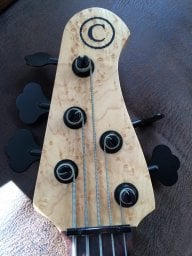
Tried two 5HH basses over the years. On had horrible G-splitch. The other was better, but ultimate deal breaker was the tight 17.5MM at the bridge. That one was on heavy side and had a gorgeous slab of ebony board - I loved the way it sounded, and wish it could have worked.

Well, there ya go.Not string spacing in general no, thats not even mentioned in the OP.
MM should recall every 5-string Stingray ever made, refund or compensate the owners, and burn them all over the apparent and well-known DEFECTIVE G-string spacing.
Is that what you guys want to hear?

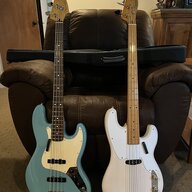
Good point, Lakland would be one of those options.It's been an issue for me on several occasions. To my way of thinking if you have to change your mechanics to suit a design feature (flaw?) then it's a non starter. Too many other viable options out there.

Jazzdogg
Less barking, more wagging!
How are these measurements made? From the edge of one string to the edge of the adjacent string, or center-to-center?We have discussed this issue for decades. I gigged an SR5 from about 2002 until about 2011. This issue was discussed at that time, and has been since. My recollection is that the SR5 was the first commonly / popularly used quality production 5. At the time, many of the other production 5’s suffered from the floppy B string syndrome.
Since that time, many builders went to the 19mm spacing and much wider necks, I believe specifically in response to player complaints about the SR5.
I never had an issue with the SR5 calibrations; which do require accurate technique. The positive aspect is that the neck feels more familiar girth-wise to the 4 bangers; as opposed to an aircraft carrier landing deck. Each to their own. I’ve always thought Fender, in their post 2000 designs, and Ken Smith got the metrics trade-offs “right” at 18mm; but, that design space is otherwise kind of a black hole in between narrower and wider designs.
Anyhow, we have choices. Pick your poison.easurements made

I occasionally falls off the edge on the G string on my L2500 as well.
If you love the tone, you would have to adapt to that.
If you love the tone, you would have to adapt to that.

C - CHow are these measurements made? From the edge of one string to the edge of the adjacent string, or center-to-center?
So, 19mm spacing results in 4 x 19mm = 76mm, C - C from the B to the G. 18mm is 72mm, or almost a half cm. It adds up.
This is just how EBMM makes their necks. The G string is close to the edge and you do have to be a little careful that you don’t pull it off the edge. Honestly it will help your technique. I don’t have a problem with it, and they also changed the angle of the fret beveling on the specials to make it harder for the string to slip off. It’s a lot easier to pull the G string off the edge of the fretboard on my 2000 Stingray 5; my Stingray Special 5 is much better.
Jazzdogg
Less barking, more wagging!
I must be really strange. I have never measured the string spacing on any of my basses, nor have I ever measured the height of the strings above the fingerboard or frets. In sixty years of playing, those details never entered my mind. I just play.

I must be really strange. I have never measured the string spacing on any of my basses, nor have I ever measured the height of the strings above the fingerboard or frets. In sixty years of playing, those details never entered my mind. I just play.


The same was true for me until….I must be really strange. I have never measured the string spacing on any of my basses, nor have I ever measured the height of the strings above the fingerboard or frets. In sixty years of playing, those details never entered my mind. I just play.
My second Sadowsky Metro 5 string. I had previously gigged an M5 for several years, but sold it because…I can’t remember what. So, on my second one, which followed my SR5, I put quite some effort into personalizing the bass, with Pat Wilkins’ and the NYC Shop’s help; got it out on gigs, and was immediately not comfortable with it. Not the spacing itself, no problem there. The neck was nearly as wide as my Tobias 6; and just plain felt clunky.
So, I started measuring. Which pretty quickly answered the situation.
Each to their own. I’m good at 18mm, and don’t mind tight neck calibrations.
Jazzdogg
Less barking, more wagging!
I hear you. After several decades doubling on double bass, virtually all electric basses, although different from one another, seem relatively small and easy. But, when I go for several months without playing a double bass, I start noticing differences between electric basses that weren't previously on my radar.The same was true for me until….
My second Sadowsky Metro 5 string. I had previously gigged an M5 for several years, but sold it because…I can’t remember what. So, on my second one, which followed my SR5, I put quite some effort into personalizing the bass, with Pat Wilkins’ and the NYC Shop’s help; got it out on gigs, and was immediately not comfortable with it. Not the spacing itself, no problem there. The neck was nearly as wide as my Tobias 6; and just plain felt clunky.
So, I started measuring. Which pretty quickly answered the situation.
Each to their own. I’m good at 18mm, and don’t mind tight neck calibrations.

NoIs this also an issue with 4 string variants?
PS: It is also not a issue with thousands of very content Stingray 5 owners
Last edited:
Doug Parent
Supporting Member
Totally feel you on this, sold every Sadowsky for the same reason. Always wondered why he settled on 19mm when 18mm seems to have worked quite well for Fender.The same was true for me until….
My second Sadowsky Metro 5 string. I had previously gigged an M5 for several years, but sold it because…I can’t remember what. So, on my second one, which followed my SR5, I put quite some effort into personalizing the bass, with Pat Wilkins’ and the NYC Shop’s help; got it out on gigs, and was immediately not comfortable with it. Not the spacing itself, no problem there. The neck was nearly as wide as my Tobias 6; and just plain felt clunky.
So, I started measuring. Which pretty quickly answered the situation.
Each to their own. I’m good at 18mm, and don’t mind tight neck calibrations.

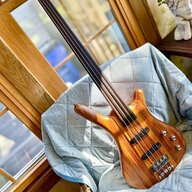
The SUB Ray 5's corrected that issue by narrowing the string spacing a bit, and they are very inexpensive. Maybe check one out? I think the single pickup version can be found new for around 250-300, used probably 200 or less. I have the HH version and it's a lot of bass for the buck.

The great Fender Jazz bass master himself didn't seem to have any G string issues.


