• TalkBass has been independent since 1998. Add your voice.
    Create a free account to reply to discussions, view embedded media, and browse with fewer display ads.
    Join freeLog in
    Want zero display ads or expanded classifieds tools? Compare plans.

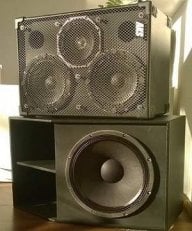
Isobaric Cabs - will they be loud enough?

My own measurements on experimental isobarics indicate that there is more going on than an effective doubling of box volume would account for. Perhaps Orange has found something similar and is taking advantage of it to good effect.

Don't know any other advantage then lowered even order harmonic distortion and that advantage is the most for systems where there's equal pressure at both sides of the driver like in an open-baffle subwoofer. The same goes for other push-pull concepts.

 
Don't know any other advantage then lowered even order harmonic distortion and that advantage is the most for systems where there's equal pressure at both sides of the driver like in an open-baffle subwoofer. The same goes for other push-pull concepts.

I measured significantly lower F3 and higher rolloff below F3 than current theory predicts. Also made a few subjective observations that imo are inconsistent with merely halving Vas.
 
Interesting, was that isobaric with cone-to-cone and the smallest possible air volume between the drivers?

Nope, the cabinet that I did the measurements on had the woofers mounted sort of back-to-back, as access to the inner woofer was via a removeable back panel. The outer woofer was offset high on the front baffle and the inner was offset low on the internal baffle, such that their magnets both just barely fit, one above the other, without bumping.

The cabinet I did the measurements on was a prototype for the lower half of a modified Strathern "ribbon" (more correctly "planar dynamic") system. I submitted an article on the sytem to SpeakerBuilder Magazine, but they already had a modified Strathern article in the pipeline, so mine was rejected.

I built several different configuration isobarics, and the cone-to-cone "clamshell" was not my favorite. I preferred a roughly 1:3 ratio of isochamber to innermost chamber volume.
 
I built several different configuration isobarics, and the cone-to-cone "clamshell" was not my favorite. I preferred a roughly 1:3 ratio of isochamber to innermost chamber volume.

My "theory" in this case would be that the "clampshell" will do the halving of the Vas as predicted but when you increase the volume between the two drivers the connection between both gets "looser". This will give a lower F3 and a steeper roll-off below F3 because the front driver "sees" less pressure/load at it's back then it would normally have below F3, in other words the output of the front driver and port go out of phase faster. Of course this will only be the case with ported Isobaric systems. My gut feeling though, tells me that the larger the coupling volume the more "sluggish" the whole system will act.....
That'll be the part one can play with to get different results.
One of the most famous examples of the non-clamshell designs back in the ol' days will be the Dynaudio Compound 5.

The only thing is that you need a powerfull simulation tool to predict the behavior of the "new" (combined) driver or you need to build several cabs with different volume ratios and measure what gives the desired performance.
 
My son has an Orange rig with a Tiny terror, 2 x 12 isobaric and a 15 cab. Have to say I have seen him play live a few times including out doors and I am very impressed by the sound. We A, B'd his rig and mine (GK Fusion 550 head and a GK 2 X 12) and his definitely had the punch and the old school sound. I would go as far as to say it out performed mine, in fairness he had the extra cab and ran at 4 ohms still gotta say it sounds great.
 
Funny you mentioned it - I had the chance to run my Fusion 550 with the newly acquired Orange SP212 and it killed! I think that the modern aggressive voicing of Fusion coupled with overall old-school vibe of Orange resulted in best of both worlds. And it was loud - I would expect that Fusion + a couple of SP212's would be enough for everything.
 
There,s some voodoo going on in that sp212 box it shouldn,t do what it does but it does.
I keep looking round when I,m gigging and wonder how it does it in a small box.
I,ve walked out 20 feet or so in front of it and sounds great.I,ve had a lot of people saying that my rig sounds amazing and they think it,s in the PA but it,s not.
I did an open air festival and I heard it through the monitors and asked the sound guy what he had done.He said it was flat through the desk and what you heard through the monitors is what your getting from the amp and it sounded amazing.
I,m a convert.
 
One of the most famous examples of the non-clamshell designs back in the ol' days will be the Dynaudio Compound 5.

If I'm not mistaken, the Compound 5 evolved into the Consequence, which is still in production. I was fortunate enough to sell a pair of my home audio speakers to a Consequence owner, who sold his Consequences and kept mine. But there's no way my speaker is in the same league as the Consequence in the bottom octave.

The only thing is that you need a powerfull simulation tool to predict the behavior of the "new" (combined) driver or you need to build several cabs with different volume ratios and measure what gives the desired performance.

For sealed isobarics, I just use a couple of fudge factors which get me in the ballpark, and "in the ballpark" is generally close enough for a sealed box. Haven't built any vented isobarics yet - they would probably be a lot less forgiving of my fudge factors.
 
I'm beginning to be rather intrigues by these ISO's.

The theory says one thing.

However, the real-world reviews of these Orange SP cabs seems to be universally positive. There must be more to it than I am seeing. I think I need to run to GC to see if I can demo one of these...
 
If I'm not mistaken, the Compound 5 evolved into the Consequence, which is still in production. I was fortunate enough to sell a pair of my home audio speakers to a Consequence owner, who sold his Consequences and kept mine. But there's no way my speaker is in the same league as the Consequence in the bottom octave.

True, and the Consequence series is still in production.
Cool that he sold his Dynaudio's and keeping yours.

For sealed isobarics, I just use a couple of fudge factors which get me in the ballpark, and "in the ballpark" is generally close enough for a sealed box. Haven't built any vented isobarics yet - they would probably be a lot less forgiving of my fudge factors.

Sealed Isobaric/compounds are much more forgiving, but it intrigues me that it has a steeper roll-off below F3...
 
The theory says one thing.

However, the real-world reviews of these Orange SP cabs seems to be universally positive. There must be more to it than I am seeing. I think I need to run to GC to see if I can demo one of these...

While nothing in our measurements indicated that the Orange cabs were breaking any laws of physics, I must admit that in use, they did seem uniquely compelling. They are not going to appeal to everyone, but if you want deep, full tone in a smaller package, and you are not put off by their unavoidable trade-offs, you just may dig them.

Here's Link Removed.
 
While nothing in our measurements indicated that the Orange cabs were breaking any laws of physics, I must admit that in use, they did seem uniquely compelling. They are not going to appeal to everyone, but if you want deep, full tone in a smaller package, and you are not put off by their unavoidable trade-offs, you just may dig them.

Here's Link Removed.

Just read the review and saw the pics and measurements.
Nothing special here, normal compound construction but it's missing the cone-cone or magnet-magnet oriëntation which reduces even order harmonic distortion (if you want to build "small" you skip this part). Both cabs show a rather typical tuning of slightly above 50hz. Mid/high extension looks better on the 212, but that's only on-axis.

Good stuff Tom, nice to see you use Clio for measuring. I also see you use "step" for the frequency response, how did you measure the cabs? cabs standing on the floor and in-room?
 
Just read the review and saw the pics and measurements.
Nothing special here, normal compound construction but it's missing the cone-cone or magnet-magnet oriëntation which reduces even order harmonic distortion (if you want to build "small" you skip this part). Both cabs show a rather typical tuning of slightly above 50hz. Mid/high extension looks better on the 212, but that's only on-axis.

Good stuff Tom, nice to see you use Clio for measuring. I also see you use "step" for the frequency response, how did you measure the cabs? cabs standing on the floor and in-room?

Thanks! Per the Clio recommendations, the cabs are elevated, not sitting on the floor. The stepped response definitely yields the most accurate results, in our experience.
 
Thanks! Per the Clio recommendations, the cabs are elevated, not sitting on the floor. The stepped response definitely yields the most accurate results, in our experience.

True.
Thats what I would do too for capturing the whole range.
You put the mic on 1mtr distance? How big is the room if I may ask?

When desiging cross-overs I use MLS, gives me a more "detailed" look of what's happening.
 
True.
Thats what I would do too for capturing the whole range. You put the mic on 1mtr distance? How big is the room if I may ask?

Yes, 1w/1m. The room is about the size of 4-6 basketball courts.

When desiging cross-overs I use MLS, gives me a more "detailed" look of what's happening.

That would definitely make sense for what you are doing. I like the idea that Clio gives us a "combined" or "overall" look from one point of measurement.
 
Big enough :cool:
And I guess you place the cab pretty high, somewhere in the middle between floor and ceiling.

Not that high. Clio takes a measurement before every test to calculate the time of the first reflection, and then only measures what reaches the mic before the reflection arrives.
 
Not that high. Clio takes a measurement before every test to calculate the time of the first reflection, and then only measures what reaches the mic before the reflection arrives.

That's what MLS normally does, or does Clio have some kind of option to do that with the stepped response too (gate?)?
I use Hobbybox, in there I set the marker just before the 1st reflection.

Btw. this thread is going into the wrong direction now (just slightly) :D