It's a great idea, but the market for them is probably small enough it will remain a custom build, or a guitar tech project if you find a bass that you think would suit that tuning best and have it converted.

TalkBass has been independent since 1998. Add your voice.
Create a free account to reply to discussions, view embedded media, and browse with fewer display ads.
Join free Log in
Want zero display ads or expanded classifieds tools? Compare plans.
I had it built by a factory in China, there's a thread about the process here: The Music Zoo / Aliexpress (china) custom bass guitar builds. Not sure if it's an especially viable option anymore if you're in the US.Ooh that's nice - who made that?

I mean, I've owned B-G 5 strings with super thin necks; Ibanez SRs and USA Peavey Millenniums are both 19.5mm at the first fret and 21.5mm at the twelfth, the same as what I went for on my E-C bass. I think if you go any thinner than that you'll probably have stability issues.Yeah it’s not a gimmick. A B string is far thicker than a C so if you know the bass is built for a C then you don’t need as chunky a neck. Personal preference but nothing wrong with that when there are so many options out there.


I had it built by a factory in China, there's a thread about the process here: The Music Zoo / Aliexpress (china) custom bass guitar builds. Not sure if it's an especially viable option anymore if you're in the US.
Another option could be IYV in Vietnam. They do custom builds and there's a Facebook group where people have discussed their experiences: Log in to Facebook.Thanks, I'll have a look. Might be the only way to get my hands on a medium scale 5/6 string with extended range without having to sell several organs!
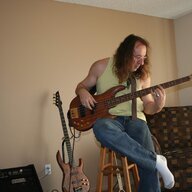
I had a Fender Dimension which I strung E-C because I had another 5 string strung conventionally. It played great with new strings, and no need to change the nut. I finally sold it because I got tired of changing basses and started playing 6 string basses which surprised the heck out of me because my hands are smaller than average, but if you find the right bass it was certainly doable. I ended up with two 6s, one fretted, one fretless. I still have five string basses, but they are all tuned conventionally now.I recently set up my EBMM BFR Crescendo this way . No need for a new nut, just a new set of strings. Plays like butter and sings like a choir of angels . Chords chime with clarity and the E strings is full and rich.
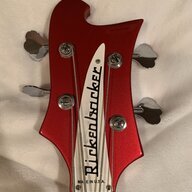
I remember this bass! As a Rickenbacker guy, I wish Ibanez didn't discontinue it. The 33" scale length is perfect for me. I would consider tuning one from D1 to A#2 if they still made them. The problem is that strings for that tuning are hard to find unless you buy singles.The Ibanez BTB33, known as the Vola, was designed to be strung E to C.

BTB33
The BTB33 is a five string BTB series solid body electric bass model introduced by Ibanez for 2015. It was produced in Indonesia as part of the Ibanez Bass Workshop line and was succeeded by the BTB845V in 2018. The BTB33 is the first shorter, mid-scale addition to the Ibanez Bass Workshop range...ibanez.fandom.com

Yeah it’s not a gimmick. A B string is far thicker than a C so if you know the bass is built for a C then you don’t need as chunky a neck. Personal preference but nothing wrong with that when there are so many options out there.
While the B string is a lot thicker than the C string, most of the times it acually has less tension than the other strings (check out some tension charts...for example Daddario EXL1706: .130 B string = 14.608 KG vs .032 C string = 17.179 KG). Its a misconception many people have though. But for most standard string sets the B String is actually the one with the least tension.
I guess the neck made for E-C tuning and chordal playing in this case is just what Janek prefers in terms of radius, neck shape, scale length. But this is very personal. Some like a totally flat fingerboard for chording (like classical guitars) some prefer a more rounded fingerboard with a pronounced radius. In terms of stability a well built neck should be able to take both, a B-G or E-C tuning.
Some builders like LeFay build a slight "curve" into the fingerboard (they call it "B Bow") that becomes progressively bigger towards the thicker strings. Its to compensate for the bigger oscillation of the thicker strings. It might have a positive effect in therms of feel however I have played 6 string basses with a flat radius that set up absolutely beautiful on all strings as well.
I think most important is just finding a neck that's comfortable to you rather than thinking about what specs work for the tuning, as @groooooove stated previously.The fact that most of you all are saying the B-G setup is easily configured for E-C, without the neck feeling too chunky or needing a new nut is good to hear. Opens up the possibilities greatly. I am seeing more companies making double P style basses.

Oh yeah, that's the thing people forget about all the time. Acoustic guitar strings are fairly thin at say 12-54 and 25.5 inch scale but the tension is quite a lot higher than a bass at 45-100 and 34 inch scale. Why? Because the scale length and string gauge while important are secondary to the tension the strings are at the given pitch.While the B string is a lot thicker than the C string, most of the times it acually has less tension than the other strings (check out some tension charts...for example Daddario EXL1706: .130 B string = 14.608 KG vs .032 C string = 17.179 KG). Its a misconception many people have though. But for most standard string sets the B String is actually the one with the least tension.
I guess the neck made for E-C tuning and chordal playing in this case is just what Janek prefers in terms of radius, neck shape, scale length. But this is very personal. Some like a totally flat fingerboard for chording (like classical guitars) some prefer a more rounded fingerboard with a pronounced radius. In terms of stability a well built neck should be able to take both, a B-G or E-C tuning.
Some builders like LeFay build a slight "curve" into the fingerboard (they call it "B Bow") that becomes progressively bigger towards the thicker strings. Its to compensate for the bigger oscillation of the thicker strings. It might have a positive effect in therms of feel however I have played 6 string basses with a flat radius that set up absolutely beautiful on all strings as well.

Hard to go wrong with LaBella.I have started playing my 5 string basses in the high C option. I think it is great but I'm concerned about finding the high C strings to purchase. I play jazz so I'm hoping to find tapewound single C strings. Although the D'Addario Chrome Flatwound strings work pretty well too. Any suggestions for where to buy single C strings?
D'Addario's website if you want Chromes or another one of their strings.I have started playing my 5 string basses in the high C option. I think it is great but I'm concerned about finding the high C strings to purchase. I play jazz so I'm hoping to find tapewound single C strings. Although the D'Addario Chrome Flatwound strings work pretty well too. Any suggestions for where to buy single C strings?