
• TalkBass has been independent since 1998. Add your voice.
    Create a free account to reply to discussions, view embedded media, and browse with fewer display ads.
    Join freeLog in
    Want zero display ads or expanded classifieds tools? Compare plans.

jazz VBT with series/parallel switch

Dec 16, 2009
473
136
hi all,
i've done a bit of reading but haven't found much on this particular configuration. i have 2 specific questions.

- when a jazz bass is operated in series mode, are the 2 pickups running in series with each other or is a single pickup running in a series mode with the other pickup silent?

- what are the wiring options (push/pull, toggle switches, etc) for wiring a jazz as VBT with series/parallel option. (diagrams would be appreciated)
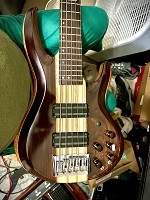
 
Both pickups are working wired in series. However because they are opposite polarity that act as a humbucker cancelling noise. You get a bigger fatter tone with slight high end loss as you would with most humbuckers and it would be quiet noise wise. P bass pickups are wired this way. They are basically 2 single coil pickups wired in series but the difference is 1/2 of the P pickup is for the E and A an the other 1/2 is for the D and G strings.
 
Jazz basses have single coil pickups. There is no such thing as "a single pickup running in series," or anything else of that sort. Two pickups; grand total of two coils.

You can use mini toggles, full toggles, push/pull switches, rotary toggles, push-button switches, slide switches, or whatever else you want, as long as the switching pattern is correct. Note that there are three choices in wiring a series/parallel switch with a blend pot. Two of those choices call for a DPDT On/On scheme, while the third calls for a 3PDT On/On scheme. If you choose the 3PDT-based scheme, push/pulls, and some slide switches are no longer an option.
 
A lot of people with 2004 series Jazz Basses didn't like them because they sounded thin low output in one mode. The reason being the S1 switch was mis wired. I bought one, didnt like it, took it back bought another same deal but I liked its look and feel so much I kept it and download the wiring diagram from Fender and found I needed to move a jumper wire over one place on the S1 switch. I fixed several others over time and loved the Big fat sounding tone in series mode. Can't understand how Fender let so many out the door like that. My last Fender American special Jazz bass I bought an S1 switch to put on it.
 
Another problem with the S1 was the type of switch- the push button affair in the standard looking knob. I like my Stew Mac push pull volume pot on my SCN equipped Fretless jazz much better , as well as the tone in series.

Not sure what the problem was there. Just like a standard push/push pot and switch you could tell which position it was in by feel. Series mode it was lower then the surrounding knob and parallel mode it was even with the top and you could certainly tell the difference tone wise.
 
... Note that there are three choices in wiring a series/parallel switch with a blend pot. Two of those choices call for a DPDT On/On scheme, while the third calls for a 3PDT On/On scheme. If you choose the 3PDT-based scheme, push/pulls, and some slide switches are no longer an option.

great. so something likeInvalid Link Removedcould function as my volume-push/pull switch, right? i didn't see a wiring diagram for this switch on the stew mac site.
 
great. so something likeInvalid Link Removedcould function as my volume-push/pull switch, right? i didn't see a wiring diagram for this switch on the stew mac site.

Yes.

You're not going to find diagrams for these setups on any standard wiring scheme database, because these are unconventional schemes. I have diagrams for both DPDT-based options, however, but you will have to choose which route to go.

The first option is standard series/parallel switching. This will allow you to use any blend pot you prefer, but it will function as a volume pot, when in series mode. The second option prevents this, with a DPDT switch wired to shunt the inputs of the blend pot together, in series mode. This requires the use of an ungrounded M/N taper blend, however, as the blend cannot be allowed to set output impedance, or place a series resistance between more than one input and the output. Ungrounded M/N blends work wonderfully for many people, but some people get hung up on wanting something else.
 
hi all,
i've done a bit of reading but haven't found much on this particular configuration. i have 2 specific questions.

- when a jazz bass is operated in series mode, are the 2 pickups running in series with each other or is a single pickup running in a series mode with the other pickup silent?

- what are the wiring options (push/pull, toggle switches, etc) for wiring a jazz as VBT with series/parallel option. (diagrams would be appreciated)


Please see my post -
Passive schematics - V-B-T, series - parallel and cap switching

for some wiring options.
 
  • Like
Reactions: ELynx
Please see my post -
Passive schematics - V-B-T, series - parallel and cap switching

for some wiring options.

That only covers the standard series/parallel switching, which is impractical. Arguably, the better choice for a DPDT-based scheme is this: (Note that it requires an M/N taper. A/C will NOT work.)
8295530903_ab5566168c_o.png
 
sweet. thanks for all the replies. if i choose the option requiring an ungrounded blend pot, do i also have to take care not to ground the body of the pot? in other words, some chamber shielding schemes have the pot body/shaft grounded via contact to chamber shielding. do i have to avoid this?
 
sweet. thanks for all the replies. if i choose the option requiring an ungrounded blend pot, do i also have to take care not to ground the body of the pot? in other words, some chamber shielding schemes have the pot body/shaft grounded via contact to chamber shielding. do i have to avoid this?
The pot chassis still has to be grounded. The term "ungrounded" refers to the fact that there is no connection between the pot's wafers and ground. That does not mean that you isolate the chassis from ground, as that would make the bass noisy.