• TalkBass has been independent since 1998. Add your voice.
    Create a free account to reply to discussions, view embedded media, and browse with fewer display ads.
    Join freeLog in
    Want zero display ads or expanded classifieds tools? Compare plans.

John Paul Jones ROUND tone

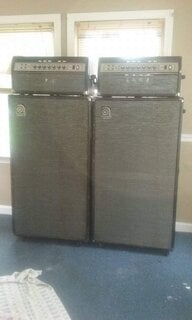
He used those old Acoustics in the early days because they were about the only amps going that really projected your sound, they were about the only thing going for big and loud until SVT's came along and blew them off the face of the earth a year or two later. That being said they are cool amps but I only tried one once years ago and didn't really like it as they only sound good when you are way out in front of them, up close they have no balls at all, they project the sound out into the audience which is why they were good for big stages.

The Acoustic amps appeared as his backline some time in 1969 and were only replaced, I think, in about 1977 or so. Prior to that I assume he was using either the Rickenbacker Transonic amps the band had very early on, Arbiter Power 100s (as seen in the Danmarks radio footage, maybe?) or whatever was available on the gig. For example I presume he's using the WEM amps seen in the Supershow footage from 1969.

Having said that he could have used anything in the studio. I think he used a Fender amp on Heartbreaker, and there is certainly some dirt and a tremolo effect on the recording.
 
  • Like
Reactions: Pbassmanca
The Acoustic amps appeared as his backline some time in 1969 and were only replaced, I think, in about 1977 or so. Prior to that I assume he was using either the Rickenbacker Transonic amps the band had very early on, Arbiter Power 100s (as seen in the Danmarks radio footage, maybe?) or whatever was available on the gig. For example I presume he's using the WEM amps seen in the Supershow footage from 1969.

Having said that he could have used anything in the studio. I think he used a Fender amp on Heartbreaker, and there is certainly some dirt and a tremolo effect on the recording.

Yeah, you basically sum it up nicely. Much of this is also covered in that 1977 interview that @JTE and I reference. 1977 he switched to the GK predecessor to the 400/800 RB amps. Don't know about the cabs.

There was a Leslie cab used on Heartbreaker, in the studio.
 
The Acoustic amps appeared as his backline some time in 1969 and were only replaced, I think, in about 1977 or so. Prior to that I assume he was using either the Rickenbacker Transonic amps the band had very early on, Arbiter Power 100s (as seen in the Danmarks radio footage, maybe?) or whatever was available on the gig. For example I presume he's using the WEM amps seen in the Supershow footage from 1969.

Having said that he could have used anything in the studio. I think he used a Fender amp on Heartbreaker, and there is certainly some dirt and a tremolo effect on the recording.
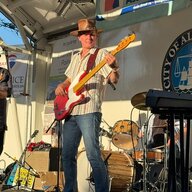
I saw them in 1969 in a place called The Boston Tea Party and he used the triangular Transonics, maybe the whole band did, don't remember, they sounded good though and best of all it only cost me 2 bucks!
 
There is an octave up guitar recorded with the bass or something an octave up

The octave up in Whole Lotta Love is JPJ. He is playing two strings, so when he riding that E, he is playing the open E string, as well as the octave on the A string 7th fret. He is also hitting a double string on the little riff. When he hits the D note, he is playing the A string 5th fret along with the open D string. He describes this in a you tube video and shows how he did it. Guitar is also playing the same riff, so if Page is playing his open E string, along with an E power chord on the A string 7th, then there are at least 4 different octaves going there.
 
If Jones has actually contradicted himself over the years, it's surprising, because he was an experienced session player, and those people tend to meticulously keep track of what combinations of gear (including strings) they've used on every project.
Also, it would be interesting if he used foam mutes at all, if his move to roundwounds was to get more sustain.
It's all very puzzling...
:thumbsdown: :)
 
With JPJ's cool Jamerson influence, I've always wondered how their rhythm section would've sounded with a jazz drummer like Mitch Mitchell or Ginger Baker-- more nimble, subtle and grooving, I'll bet.
(I know, I know-- then they wouldn't have been the mighty Zep! But I might have appreciated them more.) :bag:
 
Last edited:
If Jones has actually contradicted himself over the years, it's surprising, because he was an experienced session player, and those people tend to meticulously keep track of what combinations of gear (including strings) they've used on every project.
Also, it would be interesting if he used foam mutes at all, if his move to roundwounds was to get more sustain.
It's all very puzzling...
:thumbsdown: :)

See my post #36 - photo of him with the string mutes in place.
Also a video, which seems not to be there any more where he is seen playing, and has a HUGE piece of foam stuff under the strings.

I would also guess that when things changed to rounds (around that time), players were not changing strings very often... they of course would have been in the habit of not changing strings at all with flats. So when rounds came on the market, likely they were left on for a long time. So maybe the sound is a very dead set of rounds.

Of course IMO, Zep I and II are flats.
 
See my post #36 - photo of him with the string mutes in place.
Also a video, which seems not to be there any more where he is seen playing, and has a HUGE piece of foam stuff under the strings.

I would also guess that when things changed to rounds (around that time), players were not changing strings very often... they of course would have been in the habit of not changing strings at all with flats. So when rounds came on the market, likely they were left on for a long time. So maybe the sound is a very dead set of rounds.

Of course IMO, Zep I and II are flats.
I wasn't doubting that he used foam mutes, but wondering why he would if more sustain was what he wanted when he switched to rounds.
 
  • Like
Reactions: hennessybass
I seem to remember reading in Guitar Player magazine a long time ago that recording techniques of the 60's and 70's required mixing down to single or 4tracks rounding out the bass with each mix down.
They had 8 tracks to work with, at least just the first two albums, so that information is irrelevant. 16 tracks came in pretty fast after that. If anyone was still using 4 tracks by 1970, they were way behind.
 
JPJ used flats and most of the time rolls the tone off. Maybe at 15% tone from zero and that's it. Could be wrong but listening to the Led Zep early records that's what it sounds like except on songs like Black Dog or Immigrant song which uses the Precision.
 
  • Like
Reactions: FunkHead