Here’s an illustration as to the purpose of tab notation. This is traditional Koto sheet music:
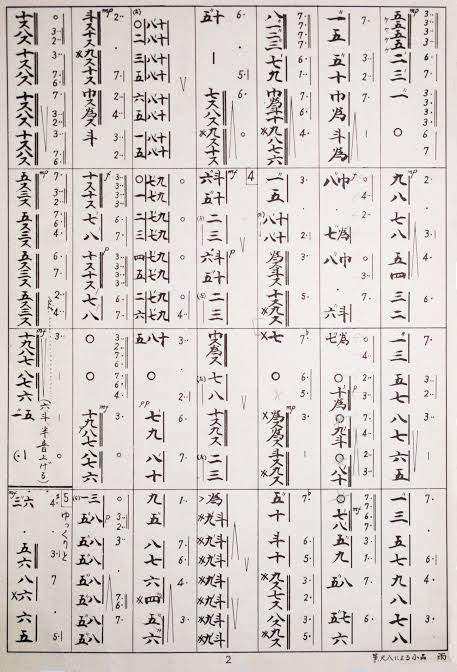
They use numbers (the Chinese characters, or “kanji” as we call in Japan) to refer to which string and where to play it. Very similar to tab notation. However, because of how the koto is physically, you can’t really sight-read with that instrument. People memorize the music. So with tabs, ultimately, it’s a tool to memorize the song you’re trying to learn. I think with many, if not most non-classical Westerm music, people would play by memory anyways. That’s what I had to learn to do for the last 6 years, play songs by memory. But I’ve also been learning pieces by Bach on bass and I’d have learn those by memory if I want to play it even half-decently.
They use numbers (the Chinese characters, or “kanji” as we call in Japan) to refer to which string and where to play it. Very similar to tab notation. However, because of how the koto is physically, you can’t really sight-read with that instrument. People memorize the music. So with tabs, ultimately, it’s a tool to memorize the song you’re trying to learn. I think with many, if not most non-classical Westerm music, people would play by memory anyways. That’s what I had to learn to do for the last 6 years, play songs by memory. But I’ve also been learning pieces by Bach on bass and I’d have learn those by memory if I want to play it even half-decently.
Last edited: