• TalkBass has been independent since 1998. Add your voice.
    Create a free account to reply to discussions, view embedded media, and browse with fewer display ads.
    Join freeLog in
    Want zero display ads or expanded classifieds tools? Compare plans.

Just opened up my 210MBE...

Would one of you very knowledgable gentlemen care to offer any ideas on why, in the MB combo line, the MB115 is the least "boomy" and has the most mids, followed by the slightly boomier MB212 and then "king-boom" MB210? I know none of them is lined or braced....any thoughts would be welcome! Thanks.

Could be a lot of different things from enclosure dimensions to port tuning to something related to the drivers' behavior in a small box. Could be the sound levels are just not as high too?
 
Would one of you very knowledgable gentlemen care to offer any ideas on why, in the MB combo line, the MB115 is the least "boomy" and has the most mids, followed by the slightly boomier MB212 and then "king-boom" MB210? I know none of them is lined or braced....any thoughts would be welcome! Thanks.
It all comes down to the drivers used and how well the cabs were designed around them. Usually boom is caused by a cab too small for the drivers used, resulting in a midbass response bump.
 
I'll give my unknowledgeable gent guess [permission to scoff granted]:

I wonder if it's interactions between reflections, the drivers and the port. Maybe for the 210s waves come back and combine because the distances and angles happen to be right[wrong]. Seems like we are talking about a tuned system here if there is a sweet spot for the perceived boom to be greatest at a certain freq. Then I also guess the amount of boom could also be dependent on the tone one trying to get dial in, interactions between harmonics and the cabinets tuned-ness etc.

Seems like a piece of foam is not going to cut major dB itself - but perhaps just cutting a little actually attenuates this tuned reaction by more dB. Bracing for sure shifts the resonance of each panel upwards. I did perceive this with my mods. I can play through my scales without ringing off a note or two. Maybe if I had it dialed in for a deeper bass sound all of those waves would be overpowering, defeating, cancelling the resonance and I would not have heard it in the first place.

Edit: Urgh - I posted my note before seeing the folks above who actually are knowledgeable... [consider this self-scoffing]
 
Would one of you very knowledgable gentlemen care to offer any ideas on why, in the MB combo line, the MB115 is the least "boomy" and has the most mids, followed by the slightly boomier MB212 and then "king-boom" MB210? I know none of them is lined or braced....any thoughts would be welcome! Thanks.

A layman's guess: the MB115 has a comparatively higher speaker to baffle surface area ratio which results in a more rigid baffle?
 
Would this be what I want to use to line my cabinet, or should I specifically go with the egg-crate stuff? http://www.amazon.com/Carpenter-Mem...5-9255906?ie=UTF8&qid=1289067603&sr=8-2-fkmr0

41m8Uxd1TBL._AA300_.jpg
 
As an Amazon Associate, TalkBass may receive commissions from qualifying purchases made via links on this site.
Nuttin' wrong at all. Just a characteristic of that head, me thinks. Sounds like most amps sound when their 'bass' control is pegged!

Which kind of begs to wonder if it's worth voiding the entire amps warranty (if we're talking about the combo). The standalone cab makes a little more sense for this type of thing, but what's to stop a novice ear from dissecting their cab on the basis of something they think they hear? Not sticking up for Mr. Big (Bob Gallien) here, but I think that may be the basis behind his recommendations to not baffle the cab. Of course, he hasn't been here to say otherwise either.
 
From Bob's response, it sounds like the cabs are designed and built the way GK designed them to be. You might not like the sound, but that's a preference thing.

+1. These cabs arent for everyone. If you want a heavier cab with more bracing and different tone, then go get one. Im pretty sure these werent designed to be top end cabs. It all depends on peoples preferences, ear, and expectations. Thats why theres way more than only 1 option. There are thousands of cabs out there. If someone doesnt like the sound, thats perfectly acceptable and their opinion, but that doesnt mean that the cabinet is wrong.

Im willing to bet that the people here at TB are not the majority of the bass players that shop at GC. We are the minority.

This cab is not the top of the line, and has to hit a price point. Not saying there is anything wrong with adding to the cab, but I don't think it's a mistake GK made. That's all.

+2. These are designed to be lightweight easily portable cabs and they hit a low pricepoint. Dont compare it to a cab which costs much more.

I went to GC today and knocked on a few cabinets. Compared to a heavy 410, the MB210 has some knock. The most hollow sounding was the lower rear, and it is pretty high pitch. However, for what it is, I still think it's great.

I don't think a lack of bracing or insulation is pure cost-cutting; I think it's a design compromise. It's a worse-is-better paradigm. Say you can get 100% of the performance for 100% of the cost, but you can achieve 80% performance for 30% cost. At that point decisions are not strictly cutting things to save end-all money. You're cutting things to meet a price point, but you're still factoring in everything else. The overall design is still alive, you aren't just trimming with inconsiderate wild abandon.

The product is built exactly as designed- and what was it designed to be? IMO: an overachieving little combo when compared to its peers. Good job, GK.

+3. GK knew what they were doing in designing these cabs. This isnt the first time GK made bass cabs......

Im also well aware there are guys on here who know WAY much more about designing cabs than I do and that I completely 100% agree that there could be things GK could have done differently in these cabs to make them sound better.

Also, could anyone actually tell from just playing through the MB combo or cabinet that it didnt have any damping material in it? Or did people only jump on it once they found out it didnt? I dont recall reading any "My cab doesnt sound like its damped" threads.

With that said, someone tell me a better sounding 210 cabinet which is rated at 400 watts or higher and weighs less than 30 lbs under 300 bucks?
 
For a mass manufacturer of a cab that size for proper DAMPING it would probably cost less than $1 in materials and less than a minute in labor, per cab. And it doesn't CHANGE the tone so much as it maximizes it. As I said earlier in the thread, I haven't seen a cab yet that didn't benefit from this.

As for the bracing: well, if you have a rattle-prone design you need it AT any price point. What's the deal here: we want cheap cabs to rattle? C'mon now, that's just stupid. Like the damping above, it doesn't cost much and it doesn't take much to solve this probelm if the design and assembly process is halfways intelligent.

Making excuses for GK and say they know better than people/companies who make cheap cabs that DON'T rattle, and might even have at least some damping? Gimme a break.
 
For a mass manufacturer of a cab that size for proper DAMPING it would probably cost less than $1 in materials and less than a minute in labor, per cab. And it doesn't CHANGE the tone so much as it maximizes it. As I said earlier in the thread, I haven't seen a cab yet that didn't benefit from this.

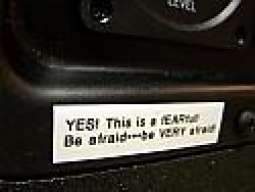
While I really do appreciate and understand the reasons why damping material is typically added to an enclosure (and although I was aware of it beforehand, going through the fEarful build process has reinforced this understanding), I do want to say that I have spoken with Bob Gallien personally on this topic, and believe me, his decision not to add dampening material was not an economic one. He did a lot of A/B testing using a variety of dampening materials, and in all of their listening tests, they preferred the un-damped cab.

I'm not trying to defend the science/engineering behind this decision, but I must say, Bob Gallien tends to do things his own way, and in general, I think his results have been pretty darned impressive. Either way, I just want to make it clear that this is not an economic decision. The actual manufacturing cost of adding dampening material would be inconsequential.

Tom.
 
I hope to have the results of my Avatar B212 re-stuff posted this weekend. I made some basic recordings of "before" and will use the same amp/bass/distance to mic settings with the "after" recordings. Cab is apart right now but work is also "all apart" right which is why I'm working 14-hour days and can't get my project finished! :( FYI. See you this weekend!

Mike
 
I do want to say that I have spoken with Bob Gallien personally on this topic, and believe me, his decision not to add dampening material

Tom, you are a big boy now. You run a beautiful publication that's already ahead of the competition on the technical savvy side. So it's time to say DAMPING instead of DAMPENING. Dampening is when you spill beverages in you cab or your pet lifts its leg by the cab to ah you know ; }

Next thing I know budding piano players will think one of the brass things down on the floor is called a DAMPENING pedal. It's bad enough enduring OHMAGE every day.