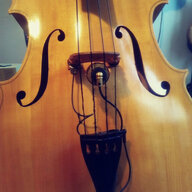
I think an SVT with a couple 810s would be a match made in heaven w/ the Krivo!

Enjoy the benefits of a premium membership!
Upgrade Account
-
TalkBass has been independent since 1998. Add your voice.
Create a free account to reply to discussions, view embedded media, and browse with fewer display ads.
Join free Log in
Want zero display ads or expanded classifieds tools? Compare plans.
You are using an out of date browser. It may not display this or other websites correctly.
You should upgrade or use an alternative browser.
You should upgrade or use an alternative browser.
Double Bass K&K Bass Max and Playing Loud
- Thread starter sargebaker
- Start date
More options
Who Replied?

- May 2, 2004
- 2,862
- 244
- 38
- Disclosures
- owner/builder, ISLAND Instrument Mfg.
How do they not work? They're steel core.The LaBella 7710 strings DO NOT work with Krivo. I told Gollihur that the info was wrong on the website, but don't know if he fixed it.
I have the 7720 "orchestral" strings on which I believe are kinda-sorta their take on spirocores... I had (and still have in a drawer) the 7710 - and preferred them - but took them off because I'm learning the bow which is kicking my butt enough as is, I didn't need my strings adding an extra difficulty level.

How do they not work? They're steel core.
I have the 7720 "orchestral" strings on which I believe are kinda-sorta their take on spirocores... I had (and still have in a drawer) the 7710 - and preferred them - but took them off because I'm learning the bow which is kicking my butt enough as is, I didn't need my strings adding an extra difficulty level.
Since they have that “synthetic” outer wrap it can interfere with a magnetic pickup sensing the excursion of the strings back and forth over the pole piece. I know black nylon tape strings aren’t ideal for some pickups. Check with Sam

I am using D’Addario Helicore Orchestral mediums on A, D, and G, with a Jargar Dolce E. My last bass had the medium E which was a better match. Gollihur will sell the strings individually, so this set would be affordable. With these and the Krivo, you have thumpers, great for blues/roots
I don't know how they don't work other than putting them on my bass plugging in the Krivo and turning the amp up and got no sound, switched cables-nothing...reported it to Gollihur. I questioned my findings, checked again-no sound; took the black LaBellas off and moved on.

I use a full circle on my DB and just played a fairly loud gig yesterday and yeah, you can get feedback. I’ve used a Krivo on my Eminence EUB and no feedback. You do need to use metal strings, no synthetic core or the KrivoI spoke briefly with a well respected builder here in the city as well as with a player (who admittedly doesn't play in a sludge trio) but the both kinda said "get a full circle it doesn't feedback" - I'm skeptical about that one....
Won’t work. My vote would be a Krivo and an fdek hpf

The black nylon 7710 are not the same as the 7720 which are all metal, in case there was confusion.
How do they not work? They're steel core.
I have the 7720 "orchestral" strings on which I believe are kinda-sorta their take on spirocores... I had (and still have in a drawer) the 7710 - and preferred them - but took them off because I'm learning the bow which is kicking my butt enough as is, I didn't need my strings adding an extra difficulty level.
So, just to clarify for the good of the order, you were trying to play arco on a set of nylon tape wound Labella 7710’s . Does rosin even adhere to those strings? Sorry for the confusion , I read it like you had the nylon wrapped 7710’s on the bass, not the steel 7720’s
Last edited:
- May 2, 2004
- 2,862
- 244
- 38
- Disclosures
- owner/builder, ISLAND Instrument Mfg.
So, just to clarify for the good of the order, you were trying to play arco on a set of nylon tape wound Labella 7710’s . Does rosin even adhere to those strings? Sorry for the confusion , I read it like you had the nylon wrapped 7710’s on the bass, not the steel 7720’s
Separate things (pickup/volume/feedback issue and strings) but:
I had the black nylon 7710 on my bass initially. You can bow with them. It's probably not even as difficult as it's made out to be. I am just getting started on the DB though and didn't want to have to work extra to get a sound with the bow so I swapped them for the 7720 strings.

IMHO there is no easy solution or silver bullet, other than giving up and playing some sort of slab. It takes the right equipment, knowledge, and skill to get an upright bass loud. A little luck can be helpful as well.
I have never used a magnetic pickup, but I do believe they will provide the highest gain before feedback. They will not necessarily provide the most authentic upright tone, but if you need loud, this type of pickup may be your best option. Why? A contact pickup senses the string vibrations indirectly; I.E through the bridge or even through the bass's body. So any resonances the bass has will be strong in the signal. A magnetic pickup senses the vibrations of the strings directly. It also senses resonances in the bass, but indirectly through the bridge, nut and strings.
Consider the bass, pickup, amp, and speaker a system. The acoustic in the room form a feedback loop between the bass and the speakers. The louder you need to play the stronger this feedback loop is. As you turn up, the feedback loop will tend to excite any resonances in the system. This can result in feedback and also the amp may pump the strings, which modifies the decay characteristics of your sound.
Because the signal coming from the amp is delayed by the propagation time between the bass and cab, you also get comb filtering. Some frequencies will come together in phase and sum, and some frequencies will come together out of phase and cancel. This causes peaks and dips in the frequency response. The frequency of the peaks and dips is dependent on distance between the bass and amp, the wavelength of the sound, and the absolute polarity of the pickup. Switching the polarity of your signal can help, but basically this is just shifting were the comb filtering peaks and dips occur. The polarity modifies the phase of all frequencies by 180 degrees. So if switching the polarity shifts a comb filtering peak away from a resonant peak in the system, you get improved gain before feedback.
There are two EQ strategies that can help. The first EQ strategy is to use deep narrow cuts for the most dominant feedback frequencies. Unfortunately, most acoustic preamps only give you 1 notch filter, and you need more notches to get an upright bass loud. In my experience the point of diminishing returns often occurs somewhere between 4 and 6 notches. When you hit the limit, adding more notches degrades the sound more than it helps. Essentially the notch does not improve gain before feedback, and it also takes away some of the tone mojo.
Most of the so-called parametric pedals I know of are poorly suited for notch filtering. The reason is because the bandwidth of the filters is fixed and way too wide. Technically this means they are semi-parametric. One pedal that should work fairly well for notching is the (discontinued) Empress ParaEQ or similar peddle. The Empress filters have a three-way toggle so you can select wide, medium, and narrow bandwidth.
The second EQ strategy is to use broadband EQ cuts that are not very deep. Here are some problems where you would choose this strategy: 1. Sometimes you get a range of closely space frequencies on the verge of feedback. If you apply a deep cut to all of these frequencies, it can kill your tone. 2. Or there may be range of notes where the amp is pumping the strings so they ring continuously when you hold your finger down. 3. Another possibility is you may have a range of frequencies that stand out too much, so the tone is uneven/unatural.
Gentle broadband cuts can mitigate all three of these problems. You might try using some gentle boost and moving the frequency center to find the offending frequencies. Try to center the filter in the problem area, and then adjust for a gentle cut to taste.
As you turn up, it is frequently necessary to deepen broadband cuts to keep the problems in balance. And at some point as you increase the volume, you reach a limit where the bass becomes so unstable that EQ is no longer effective.
If you are in a smallish room, you may have better results if you only feed the signal to your amp. Putting the bass in the mains and monitors will tend to cause multiple feedback loops with different propagation paths. This means a more complex set of problems because each progradation path will have a unique comb filtering signature with the peaks and dips at different frequencies. By all means experiment, in some instance you may be better off putting the bass into extra speakers, but often this will make matters worse.
In a bigger room, it's generally better to put the bass in the PA and run your stage volume as low as you can. Your amp is close so it will still usually have the most interaction with your bass. The exception will be if the subs are placed under a hallow stage. Since the bass is mechanically coupled to the stage, the resonance of the stage also becomes a significant factor. This sort of situation is about the only time where I have had feedback below 100hz. If your bass frequently has a tendency towards feedback below 100hz, try rolling up a towel and placing it between the tail piece and the front panel of the bass.
High Pass Filters (HPF). If you really need max volume, I believe an HPF will be beneficial. I would qualify my volume requirements as medium and with the few exceptions I mentioned in the previous paragraph, I rarely needed an HPF. In fact, I sometimes used pretty aggressive boosts below 100hz without any feedback problems.
I have never used a magnetic pickup, but I do believe they will provide the highest gain before feedback. They will not necessarily provide the most authentic upright tone, but if you need loud, this type of pickup may be your best option. Why? A contact pickup senses the string vibrations indirectly; I.E through the bridge or even through the bass's body. So any resonances the bass has will be strong in the signal. A magnetic pickup senses the vibrations of the strings directly. It also senses resonances in the bass, but indirectly through the bridge, nut and strings.
Consider the bass, pickup, amp, and speaker a system. The acoustic in the room form a feedback loop between the bass and the speakers. The louder you need to play the stronger this feedback loop is. As you turn up, the feedback loop will tend to excite any resonances in the system. This can result in feedback and also the amp may pump the strings, which modifies the decay characteristics of your sound.
Because the signal coming from the amp is delayed by the propagation time between the bass and cab, you also get comb filtering. Some frequencies will come together in phase and sum, and some frequencies will come together out of phase and cancel. This causes peaks and dips in the frequency response. The frequency of the peaks and dips is dependent on distance between the bass and amp, the wavelength of the sound, and the absolute polarity of the pickup. Switching the polarity of your signal can help, but basically this is just shifting were the comb filtering peaks and dips occur. The polarity modifies the phase of all frequencies by 180 degrees. So if switching the polarity shifts a comb filtering peak away from a resonant peak in the system, you get improved gain before feedback.
There are two EQ strategies that can help. The first EQ strategy is to use deep narrow cuts for the most dominant feedback frequencies. Unfortunately, most acoustic preamps only give you 1 notch filter, and you need more notches to get an upright bass loud. In my experience the point of diminishing returns often occurs somewhere between 4 and 6 notches. When you hit the limit, adding more notches degrades the sound more than it helps. Essentially the notch does not improve gain before feedback, and it also takes away some of the tone mojo.
Most of the so-called parametric pedals I know of are poorly suited for notch filtering. The reason is because the bandwidth of the filters is fixed and way too wide. Technically this means they are semi-parametric. One pedal that should work fairly well for notching is the (discontinued) Empress ParaEQ or similar peddle. The Empress filters have a three-way toggle so you can select wide, medium, and narrow bandwidth.
The second EQ strategy is to use broadband EQ cuts that are not very deep. Here are some problems where you would choose this strategy: 1. Sometimes you get a range of closely space frequencies on the verge of feedback. If you apply a deep cut to all of these frequencies, it can kill your tone. 2. Or there may be range of notes where the amp is pumping the strings so they ring continuously when you hold your finger down. 3. Another possibility is you may have a range of frequencies that stand out too much, so the tone is uneven/unatural.
Gentle broadband cuts can mitigate all three of these problems. You might try using some gentle boost and moving the frequency center to find the offending frequencies. Try to center the filter in the problem area, and then adjust for a gentle cut to taste.
As you turn up, it is frequently necessary to deepen broadband cuts to keep the problems in balance. And at some point as you increase the volume, you reach a limit where the bass becomes so unstable that EQ is no longer effective.
Bass position in relation to various sound sources.
The problems I have discussed will be different for each sound source producing the basses signal. The bass can also respond to reflected sound that has bounced around the room. I have had good luck elevating my cab to about waist level and tilting it back to aim at my head. This gives my a very clear sound and allows me to reduce how much SPL I am pumping into the room. Also less energy is directed into the basses body. If you want a deep thumpy, sound, you probably won't like this approach. If you want a deep thumpy, sound, put the amp on the floor, but you will need to accept you may have significantly less gain before feedback. If you are in a smallish room, you may have better results if you only feed the signal to your amp. Putting the bass in the mains and monitors will tend to cause multiple feedback loops with different propagation paths. This means a more complex set of problems because each progradation path will have a unique comb filtering signature with the peaks and dips at different frequencies. By all means experiment, in some instance you may be better off putting the bass into extra speakers, but often this will make matters worse.
In a bigger room, it's generally better to put the bass in the PA and run your stage volume as low as you can. Your amp is close so it will still usually have the most interaction with your bass. The exception will be if the subs are placed under a hallow stage. Since the bass is mechanically coupled to the stage, the resonance of the stage also becomes a significant factor. This sort of situation is about the only time where I have had feedback below 100hz. If your bass frequently has a tendency towards feedback below 100hz, try rolling up a towel and placing it between the tail piece and the front panel of the bass.
High Pass Filters (HPF). If you really need max volume, I believe an HPF will be beneficial. I would qualify my volume requirements as medium and with the few exceptions I mentioned in the previous paragraph, I rarely needed an HPF. In fact, I sometimes used pretty aggressive boosts below 100hz without any feedback problems.
Not to sound too woo-woo, but for me, playing upright is as much about feel as it is about specific timbre. I don't play the same on bass guitar and some songs just "feel" better on upright. Plus sometimes it's about the bow. If a mag pickup gets me in the mix without a headache, I don't think I'm going to be bothered that It's not the "right", or the same timbre of my bass acoustically. Not to mention, when I hear recordings of NHOP playing with a mag pickup, there's still no mistaking it for anything other than an upright.
I don't know why I didn't think of this earlier, but there's a PA in my workshop and one of my shopmates did his studies in sound recording. I'm going to bring my bass in and see if he can give me a crash course in EQing and see how loud we can get the sucker. I know the room changes everything, but it's a start.
I don't think anyone is telling you to not try a magnetic pickup, only trying to help you understand it's pluses and minuses. It's up to you to decide if magnetic pickup is right for you.

WOW!
I’m always amazed by the knowledgeable and thoughtful responses Wasnex takes the time to write.
My hat’s off.
I’m always amazed by the knowledgeable and thoughtful responses Wasnex takes the time to write.
My hat’s off.
Well we gave it our best college effort but we couldn't seem to get the bass to sit in the mix with the Fishman going into either a bass amp or a mixer. Either feedback or just a really bad sound where I can't hear half the notes the notes. I think I'm ready to give the Krivo a shot.
I think it's worth a shot
 .
.I have never had a need to try it with upright, but some players tape or use plugs for the F holes. Pretty sure I have seen a rock-a-billy band where the bassist taped up his sound F holes.
I actually do have experience with sound hole plugs for acoustic guitar, and it made a significant improvement. So I would expect it to be helpful with upright as well.
A down side is the hassle and potential damage to the instrument.
Here is an example of custom plugs from a UK vendor. F Hole Covers | F-its Feedback blockers|Double bass feedback|
Also a company called Blast Cult makes upright basses that are designed specifically for loud amplification. They are not cheap, and I have seen mixed reviews. [Invalid or Expired Link Removed]
There are also some smaller body hybrid acoustic electric upright basses like the Eminence and Kolstein Bussetto. I don't have any practical experience with either, but they may suit your needs.
[Invalid or Expired Link Removed]
[Invalid or Expired Link Removed]
Eminence® Electric Upright Bass – The Acoustic Bass Shop
Sorry for the shotgun blast
 .
.
Last edited:
- May 2, 2004
- 2,862
- 244
- 38
- Disclosures
- owner/builder, ISLAND Instrument Mfg.
Seconded. Wow. Thank you @Wasnex
That should probably get a sticky!
That should probably get a sticky!
I’m surprised to hear that the 7710’s don’t work with the Krivo, but I’ve been surprised with what works and what doesn’t fairly often. Pretty much no DB string have been designed with a magnetic pickup in mind, and as a result string-to-string balance has been a persistent issue when trying strings.
The best options I’ve tried with this pickup were Perpetuals, Spiro Weich, and Superflexible Solo. While I haven’t tried these personally, I would also bet a few bucks that Spiro Mittel would be great. Spiro solos were ok, but the G string was lower output to the rest of the set. The Eurosonic white tapewounds work very well. The Eurosonic black tapewounds have reduced output on the E and A, IME.
Generally I think this pickup sounds very “double bass” in the lower registers but once you get to the transition area / thumb position it starts to “mwahhh” a little bit like you would expect with a fretless BG. It gets MUCH louder before feedback than any piezo I have tried. It can also push FOH subs in a way I haven’t experienced with any piezo. FWIW I only use it on my EUB for bigger shows with loud drummers. My hybrid with a full circle gets all my jazz/folk gigs.
Another factor with the Krivo is that it doesn’t really work for arco. I can’t get an even string to string balance in the lower strings, no matter what set I’ve used (I’ve tried waaaaay to many) and the tone is very low output and nasal, compared to the thick pizz sound. If you go this route, I would keep a piezo on the bass and go for a two channel preamp you can switch over for arco passages. I did this with a Radial Bassbone OB and was very satisfied with the results.
DISCLAIMER: I endorse the Krivo pickup, and while I haven’t received any compensation from them I did get a replacement pickup at cost once (wanted the upgraded mounting system.)
The best options I’ve tried with this pickup were Perpetuals, Spiro Weich, and Superflexible Solo. While I haven’t tried these personally, I would also bet a few bucks that Spiro Mittel would be great. Spiro solos were ok, but the G string was lower output to the rest of the set. The Eurosonic white tapewounds work very well. The Eurosonic black tapewounds have reduced output on the E and A, IME.
Generally I think this pickup sounds very “double bass” in the lower registers but once you get to the transition area / thumb position it starts to “mwahhh” a little bit like you would expect with a fretless BG. It gets MUCH louder before feedback than any piezo I have tried. It can also push FOH subs in a way I haven’t experienced with any piezo. FWIW I only use it on my EUB for bigger shows with loud drummers. My hybrid with a full circle gets all my jazz/folk gigs.
Another factor with the Krivo is that it doesn’t really work for arco. I can’t get an even string to string balance in the lower strings, no matter what set I’ve used (I’ve tried waaaaay to many) and the tone is very low output and nasal, compared to the thick pizz sound. If you go this route, I would keep a piezo on the bass and go for a two channel preamp you can switch over for arco passages. I did this with a Radial Bassbone OB and was very satisfied with the results.
DISCLAIMER: I endorse the Krivo pickup, and while I haven’t received any compensation from them I did get a replacement pickup at cost once (wanted the upgraded mounting system.)
@Wasnex - I have an Eminence in addition to a full-size (well, 3/4) DB. The Eminence can definitely get louder without feedback, as the body is less prone to resonate. With a magnetic pickup it can get stupid loud. Right now I am using it with a Realist Lifeline as the bass is wearing Evah Weichs which don't work with the Krivo. Even with the Lifeline, I can get much louder with the Eminence. And at higher volumes, it sounds just as good as the DB - its actually a bit easier to eq the Eminence since its less resonant.I think it's worth a shot
I have never had a need to try it with upright, but some players tape or use plugs for the F holes. Pretty sure I have seen a rock-a-billy band where the bassist taped up his sound F holes.
I actually do have experience with sound hole plugs for acoustic guitar, and it made a significant improvement. So I would expect it to be helpful with upright as well.
A down side is the hassle and potential damage to the instrument.
Here is an example of custom plugs from a UK vendor. F Hole Covers | F-its Feedback blockers|Double bass feedback|
Also a company called Blast Cult makes upright basses that are designed specifically for loud amplification. They are not cheap, and I have seen mixed reviews. [Invalid or Expired Link Removed]
There are also some smaller body hybrid acoustic electric upright basses like the Eminence and Kolstein Bussetto. I don't have any practical experience with either, but they may suit your needs.
[Invalid or Expired Link Removed]
[Invalid or Expired Link Removed]
Eminence® Electric Upright Bass – The Acoustic Bass Shop
Sorry for the shotgun blast
I concur with HateyMcAmp- Krivo is not good for arco. I even did a review quite a while ago on Gollihur's website mentioning this. I, too, have a second pickup (Lifeline) that handles any amplified arco duties I might embark upon. I think Wasnex is a physics prof!
- May 2, 2004
- 2,862
- 244
- 38
- Disclosures
- owner/builder, ISLAND Instrument Mfg.
I watched your demo! It didn't sound that bad* to me... It's also a sludge rock trio so I doubt anybody will call me on crummy bow tone lol. I am considering keeping the BassMax and getting a switcher and having the option to switch to it for arco. I'm NOT having trouble sitting in the mix with the bow and the bassmaxI concur with HateyMcAmp- Krivo is not good for arco. I even did a review quite a while ago on Gollihur's website mentioning this. I, too, have a second pickup (Lifeline) that handles any amplified arco duties I might embark upon. I think Wasnex is a physics prof!
One thing I added to the Krivo is the Realist Docking Station. It's a simple volume knob, but very effective two-fold 1) the obvious...volume control; and, 2) it's a strain relief on the pickup's wiring. I like the switcher idea. All the best in your tone journey.
The thing I keep wanting to mention is the placement of the pickup and the adjustment of the pole pieces. If the pickup is too close to the strings you can bump into them and the sound is obnoxious. When the pickup is well placed, the strings output can be relatively balanced by rising and/or lowering the pole pieces for each string. The pole pieces may not line up directly under all the strings, so position-compromising is in order. I played a gig last night in a huge warehouse type venue and wished I had brought my second 2x10 cabinet. I had to really thump the strings to get a solid response in this cavernous room. Playing this way caused the D string to lose some sound because of over excursion. In 99% of the gigs I play, I don't need to be that loud -or- we have a PA and soundperson provided. I guess the point I'm eluding to is that it's nice to be able to actually adjust the pickup and not simply rely on the placement of a pickup (like our wing and bridge foot piezos). I'm going into my man cave right now to see if I can simulate last night's issue at low volume and make some pickup adjustments!
The thing I keep wanting to mention is the placement of the pickup and the adjustment of the pole pieces. If the pickup is too close to the strings you can bump into them and the sound is obnoxious. When the pickup is well placed, the strings output can be relatively balanced by rising and/or lowering the pole pieces for each string. The pole pieces may not line up directly under all the strings, so position-compromising is in order. I played a gig last night in a huge warehouse type venue and wished I had brought my second 2x10 cabinet. I had to really thump the strings to get a solid response in this cavernous room. Playing this way caused the D string to lose some sound because of over excursion. In 99% of the gigs I play, I don't need to be that loud -or- we have a PA and soundperson provided. I guess the point I'm eluding to is that it's nice to be able to actually adjust the pickup and not simply rely on the placement of a pickup (like our wing and bridge foot piezos). I'm going into my man cave right now to see if I can simulate last night's issue at low volume and make some pickup adjustments!
Hey Sam one thing that I have found that helps is to use a boost pedal, but for arco actually with the level a bit less than without the boost. I'm using the Eminence now in a band where I do some arco stuff and there's no room for my DB so I've found that when I grab the bow, hitting the boot pedal thats acttually set to lower gain works out pretty wellOne thing I added to the Krivo is the Realist Docking Station. It's a simple volume knob, but very effective two-fold 1) the obvious...volume control; and, 2) it's a strain relief on the pickup's wiring. I like the switcher idea. All the best in your tone journey.
The thing I keep wanting to mention is the placement of the pickup and the adjustment of the pole pieces. If the pickup is too close to the strings you can bump into them and the sound is obnoxious. When the pickup is well placed, the strings output can be relatively balanced by rising and/or lowering the pole pieces for each string. The pole pieces may not line up directly under all the strings, so position-compromising is in order. I played a gig last night in a huge warehouse type venue and wished I had brought my second 2x10 cabinet. I had to really thump the strings to get a solid response in this cavernous room. Playing this way caused the D string to lose some sound because of over excursion. In 99% of the gigs I play, I don't need to be that loud -or- we have a PA and soundperson provided. I guess the point I'm eluding to is that it's nice to be able to actually adjust the pickup and not simply rely on the placement of a pickup (like our wing and bridge foot piezos). I'm going into my man cave right now to see if I can simulate last night's issue at low volume and make some pickup adjustments!


