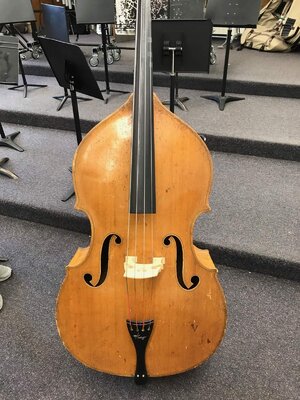
Now I am trying to fire up new old 61 kay S1 with at least g and d guts.

TalkBass has been independent since 1998. Add your voice.
Create a free account to reply to discussions, view embedded media, and browse with fewer display ads.
Join free Log in
Want zero display ads or expanded classifieds tools? Compare plans.
Now I am trying to fire up new old 61 kay S1 with at least g and d guts.

Can anyone help me identify this Kay Bass from the pictures below?

1947 Kay Swingmaster. If your student's looking to get rid of it, lemme know.I am an instrumental music teacher and recently had a student "inherit" an upright bass. Can anyone help me identify this Kay Bass from the pictures below? Any info would be helpful.
1947 Kay Swingmaster. If your student's looking to get rid of it, lemme know.
Thanks for the advice! I am definitely not a strings person. I do have some friends that are really good bass players but don't teach lessons. I'll have my student get it looked at.Better get that bridge foot up on the bass bar ASAP, if the bar hasn't popped already. If you're completely new at bass, best to find a luthier and have it gone over. It looks neglected and frankly in peril.
Real market value is exactly what a given buyer is willing to pay for it at a given time and place, with location as the biggest variable. I see similar basses priced up to $4,500 and going for anywhere from 1,100 to 3,000 in playable condition.
I've added your bass to the Kay Bass and Cello Registry at Kaybass.com.

Or an Engelhardt...We all start with Kay. And then end up with Kunis
I'm using gut g and d and rock a billy's for the e and a. The bass just doesn't warm up.
Have you had a luthier set it up? Could just be it needs some tlc on the soundpost placement and whatnot. FWIW I know I thought I liked the gut strings when I started, but the first time I played on a set of spiro mittels it was like a whole new animal.I could use some advice. I have a 61 S1 kay and can't seem to get a real warm tone from. Im using gut g and d and rock a billy's for the e and a. The bass just doesn't warm up.
Suggestion appreciated
Thanks
I could use some advice. I have a 61 S1 kay and can't seem to get a real warm tone from
I think changing out my E and A might be an option. Any suggestions to match up to my g and d? I play mostly jazz tunes.
Thanks
How do these compare to Rotosound strings, if you've had this experience?Kolstein Heritage strings

I'll not weigh in on the strings. That's a personal choice.I could use some advice. I have a 61 S1 kay and can't seem to get a real warm tone from. Im using gut g and d and rock a billy's for the e and a. The bass just doesn't warm up.
Suggestion appreciated
Thanks