• TalkBass has been independent since 1998. Add your voice.
    Create a free account to reply to discussions, view embedded media, and browse with fewer display ads.
    Join freeLog in
    Want zero display ads or expanded classifieds tools? Compare plans.

Double Bass King Mortone Project

JBarz

On indefinite internet sabbatical
Supporting Member
Mar 6, 2015
1,970
3,274
Got super lucky this morning and landed a top-off King for $500 + $300 freight and taxes off the ‘bay.
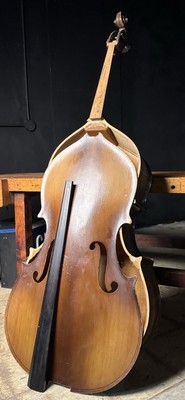

Looking forward to restoration. I’ve never carved a bass bar before, so that should be fun. I really needed a new bass project because the quiet alone time is like much needed therapy for me with 4 kids on summer break, lol.

I’m a King Super 20 saxophone man through and through, and have been dreaming about converting one of these to a 5-string, so I’m tempted to for personal use. …. BUT it seems a shame to deface those tuners or jack with a perfectly good neck, so I’ll probably just make it a 42” 4-string in standard tuning for resale unless the instrument just begs to be mine.

Should be here in a couple weeks from NY. Anyone wanna wager the neck breaks off in transit?
 
As an eBay Associate, TalkBass may earn a commission from qualifying purchases.
Almost certainly, unless it’s wrapped in freight blankets and plastic wrap and ratchet-strapped to the wall of the cargo box. The neck sets on those things are as weak as Kays. I’ve done that job. It’s finicky, but a decent first project. You’ll want gut on that. Trust me. Feel free to ask for advice. I pop in every few days.
 
  • Like
Reactions: JBarz
The bass arrived in pretty phenomenal condition, considering the age. The neck, surprisingly still in tact and attached!
image.jpg
image.jpg
image.jpg
image.jpg


Looks light some light delamination around the bass bar side f hole. I think it’s fixable with just hide glue and sandbags, but I might need to go visit James’ vaccum press… the fingerboard is still thick and unworn, and fits back in place on the neck like a glove. Not crazy about the rhomburg bevel, but this fingerboard is too nice not to use…
image.jpg
It would be pretty easy to put this thing back together as is with its 43.5” scale length, causing me to reconsider the 42” scale length modification, let alone the idea of a five string conversion.
image.jpg

Im going to have to meditate on this. I certainly can’t hang with 43.5”, personally, but that’s not to say the next owner might prefer it …

Anyone have a spare original tailpiece for one of these for sale in their parts bin?
 
Last edited:
  • Like
Reactions: Don Hergert
43 3/8" scale plus an E flat heel....that'll give you quite a workout playing in first position with a horn section for three sets!

Keep in mind that those King & Am std. neck joints have their own issues and are not any stronger than an old Kay.

If you change your mind, drive a few hours east and I'll buy it from you and put it back together well.

Lookey lookey what I have in my spare parts bin: an all original lightweight maple King tailpiece with a clean original decal!

IMG_0562.JPG


IMG_0561.JPG
 
Last edited:
Does that pegbox have the crossgrain dowels in the cheeks underneath the tuning machines from the factory issue scroll graft?
Not that I can tell, but I haven’t taken off the tuners yet. The neck came off easy and clean enough this morning.
image.jpg
image.jpg


Traeger book talks about making a couple 8” cuts here to lose the extra neck length…. Could get a much cleaner cut with a circular saw, but will probably use flat Japanese pull-saw so I can go slow and meticulous and plane after. Anyone want to talk me off the ledge?
image.jpg


James, I definitely want that tailpiece, for sure! You rock as always…
 
Here is what the factory doweled scroll grafts look like:

DSCN0947.JPG


Western cedar, eastern, yellow, red, aromatic, density? It varies tremendously. Do you have access to someone with a Lucci meter to measure the speed of sound through the boards? Nice spruce bassbars are only around $20. It is an old plywood King, so anything will have modest results. You can always make one with what you have on hand and if it fails in a year, repeat the process and make another from fancy spruce.

While the necks can be spliced, I generally only consider that when they are damaged. An original unbroken neck is rare and nice to keep alive. If you do decide, it takes a tremendous amount of skill to do it by hand. I have a 1000 lb machine that I build specifically for double bass neck work that I use. The results are excellent, and very time efficient. Here is an old one that was damaged and "repaired" twice by other folks, so in the end I wound up doing a double splice with a spacer and then a boatload of carbon fiber. The angle is a little shallow because of all the prior issues and breaks:

DSCN5251.JPG


DSCN7000.JPG


I might be able to trade you a different King scroll prepped for a scroll graft, that way you could make a complete new neck joint with a big German style mortise with an enlarged tenon, rather than the whimpy dovetail, plus a ton of material for a nice removable neck system. The factory neck may fail if you try that on the dovetail end (ask me how I know....:()

Is that a fuzzy stack of old Mcintosh stereo equipment in the back photo?

Come by for a visit, bring the top and neck. In a productive day we could get the top on the press, splice the neck shorter, and get a nice red spruce bassbar fit. It will likely take an overnight to let the glue set before transport.
 
Last edited:
Interesting. Thanks as always for helping light my way here. You’re probably right that this one warrants the trip out East to visit you, but then I’m less inclined to just throw it back together to sell it but instead maybe trade in my Kay (or heck, maybe this sterero gear if you’re into it) and get you to turn this into a custom five-string removable neck monster for my own use. It might not be until fall that I get a chance to pop away from the crew for a minute, but it’s a long overdue hang, for sure.

I sat down with the neck for a couple hours after the kids went to bed last night, took a whole lot of measurements and drew some more detailed potential cut lines. I think you’re 100% right - it would be some sort of minor miracle that I don’t goof up this exacting neck work.

For now, I’m resigning this project officially to the ‘back-burner’ until I know for sure what direction I want to take it. Thanks again, I’ll keep you posted as soon as I know which way the wind blows.
 
Last edited:
That’s ‘50s. I had a ‘39 that was my first restoration and a ‘35 that was stupid clean except for a loose bass bar. I don’t remember measuring the former but the latter was actually 42” with no modifications, believe it or not. Both played fine with gut strings. Just put it back together the right way and play it.

If the delamination is confined to the edges, you can fix it with thin glue and plastic clothespins as clamps.
 
Can you measure that neck for me? The distance from the nut to the end where it joins the body is what I'm after.

If it is a longer ~43 3/8 scale from the factory, it will be approx. 18 1/2 -19". If it is the shorter scale, it will be approx. 17". That will help you determine the starting point and if it currently sits with a D heel or an E flat.

There is a LOT of variation in King & American Standard necks from the factory on all dimensions; so much that I believe they had some issues with the shaper jigs that did not always align properly.
 
It’s 18.5”… definitely outside my skill set to cut down the neck, regardless of how ambitious or cocky I might be. Pretty much given up the idea of making this a 5-string, too — seems silly to cut the corners off a perfectly good square peg to make it fit a round hole, so to speak….
 
Through the magic of the internet and the US postal service, this neck is enroute to (our hero) James for shortening (thank you thank you!).

The delamination cleaned up surprisingly easy. I used little clamps sparingly, but I probably could have gotten away with using nothing but the glue and 15 minutes of “finger clamps”, tbh. Super clean.

Need to source bridge, endpin collar, sound post, nut, and saddle.

Thinking 5th tuned Spiro low C and G with plain gut D and A. Debating if I want to go ahead and plane out the rhomburg bevel now or try to live with it. I’m hardly … cough… “consistently excellent” with the with my planning chops, so probably best to string it up as is and see if I can live with it…

Having a 4-string in the fleet again will hopefully force me to work on my walking time and feel opposed to always working up solo arrangements of standards…

Questions:

Are the adjustable saddles that Gollihur’s sells one of those situations where you’re more likely to notice on a nicer carved bass (opposed to the old ply)? I’ve never experimented with saddle height… snake oil or game changer?
 
Last edited:
Saddle height has an influence on top pressure.

I put an adjustable (Moser HVU) on my bass to reduce the pressure because of a slightly sunken top that I thought happened because of the high pressure (5-string Spiros). But it rather might have happened because the top shrinked horizontally over the last decades which pulled the top down. Still useable, might not go lower, but to be a bit safer I installed the saddle (myself).

It can help if the top pressure doesn’t allow the top to resonate freely.
But if pressure is not the problem, a raised saddle will mostly reduce volume (and probably move wolf tones). That’s what happened with my instrument.
I use the middle position now, but I can go back to the lowest and even lower to the original saddle if needed (but then I need to glue it in).
It is nice that it is easily reversible and was not very expensive.
 
  • Like
Reactions: JBarz

Latest posts