• TalkBass has been independent since 1998. Add your voice.
    Create a free account to reply to discussions, view embedded media, and browse with fewer display ads.
    Join freeLog in
    Want zero display ads or expanded classifieds tools? Compare plans.

Klos: comparable to Modulus?

I owned a first gen Modulus Flea decades ago that I never should have gotten rid of.

I recently bought a used Klos five string. The build quality and playability are really great. I’m really NOT loving the Fishman pickups and the preamp. I’ve spent some time with it and learned to get some different sounds, and have played some gigs with no big problems, but there is just not enough midrange content for rock music. The bass is immense, it’s a great package for reggae or EDM type music, and it’s passable for funk/slapping, but there is just no way to get around baked in “scoop” to achieve a nice vintage tone.

The positive aspects of the bass make it worthwhile to swap the electronics, if it comes to that. I play a lot of outdoor gigs in the summer, and the seasonal humidity changes around here are brutal. A bass that navigates those situations with no change in playability is a valuable commodity. I’ll probably be pickup shopping in the spring, when my gig schedule picks up…
 
In today's economy, new players keep appearing while old ones fade away. Status is no longer making composite necks, while Moses only makes consumer level loudspeakers.
I say kudos to Klos, for their composite acoustic instruments and retrofit necks. For an all-composite electric bass I've got better options in China, since I can order from a local boutique shop such as BQW.
 
Thanks everyone for sharing your experience and opinions. Sounds like there are a healthy variety of opinions on Klos but mostly positive. I am happy there is still a company out there offering composite necks and full on instruments below the $3k mark.

I wish they had a more conventional headstock but I'm happy to hear the necks are stable and light.
 
Thanks everyone for sharing your experience and opinions. Sounds like there are a healthy variety of opinions on Klos but mostly positive. I am happy there is still a company out there offering composite necks and full on instruments below the $3k mark.

I wish they had a more conventional headstock but I'm happy to hear the necks are stable and light.
I was happy to hear about Klos entering the neck business. I had contacted Staus only to learn no more Fender necks. Klos appears to have switched both their production and Fender replacement headstocks to a MM-type, 3+1 design. I had a J-type replacement and now the short scale 4string build. Both have the 3+1 stocks and are truly 1.5” nut width, slim profile fast play necks.
 
not to start any silly semantic sparring, but the term "plastic" Is a little misleading. I don't know about KLOS, but the Modulus necks and the ones we use now are made from what is called graphite/epoxy composite. The graphite fibers are definitely not plastic, but long strands of crystalline carbon chains. Epoxy is considered a 'thermosetting polymer,' which loosely is under the plastic umbrella. It forms hard permanent molecular links. It cannot be melted and reformed. The plastic we normally think of is considered "thermoplastic." It can usually be melted.

Key Differences Between Epoxy and Common Plastics
While both are synthetic polymers, they belong to two different chemical families:
  • Thermosets (Epoxy): These undergo an irreversible chemical reaction (curing) when a resin and hardener are mixed. Once cured, the molecular structure is permanently "cross-linked" into a rigid 3D network. Because of this, epoxy cannot be melted or reshaped once it has set.
  • Thermoplastics (Common Plastics): Materials like PET, PVC, and polyethylene consist of linear chains. They can be melted, cooled, and remolded multiple times, making them easier to recycle but less resistant to high heat.
 
The problem is, NOBODY KNOWS

…yet. Klos hasn’t been around long enough for any useful data — or even anecdotes — to have been gathered.

Whereas most of the issues you hear about Modulus necks refer to basses that are 20+ years old. Klos has been an extant company for what, 5 years?

We won’t know the answer to your question for at least a decade.
I saw their booth at NAMM. I don’t know if they had any basses on display though. If they did, I definitely failed to play it. And I own a Modulus. I must apologize. I have failed you.
 
I love CF (I have 2 classic CF basses, and one with a CF neck) but from neither of these brands. I have questions as I have no direct experience of either.

Have the Gould bass necks changed in composition over the years, and if so how (if anyone knows details)?
 
I owned a modulus VJ and a Zon Sonus back in the day. Right now I own 2 Klos Apollos. I bought the 1st one about 3 years ago. It's the older style small 2+2 headstock that is currently spec'ed on their "standard" model. The 2nd one is their "custom" model purchased about 6 months ago with the newer 3+1 headstock . Both are superb basses. Although a long-term road test will require a few more years, I can happily say the quality of the necks and overall builds is excellent and on par with the Zon and Modulus I used to own. These necks are also lighter, making the basses lighter overall, with excellent balance. Both necks are super stable, which is particularly sweet up here where humidity varies VERY widely with the seasons. My wooden necks all require seasonal truss rod tweaks in early winter and late spring, but not these.-IMHO there is no quality difference between the 2 necks. The tuners on the "custom" neck are a bit smoother. When they initially came out, a big part of the marketing was that the necks can be easily & rapidly removed because there are perfectly machined/engineered tapped inserts in the body, making it a great bass to travel with. This is all true. The neck pops off in a minute with a provided mini Philips screwdriver and there's no need to readjust anything when it's reattached. . That was the prime reason I bought the 1st one. For that reason the headstock was minimized in length and weight. As soon as I received the bass I realized (and posted on TB) that it was easily good enough to be a #1, even for a picky bassist. As time passed the marketing shifted away from emphasizing the travel-friendliness as much. The instruments stand on their overall merits. That said, I suspect the esthetics of the smaller headstock turned some people off, plus they got into producing fender replacement necks, hence the current "custom" neck with the 3+1 headstock. I prefer passive basses so I can't comment on the Klos preamp, but the ones I have produce excellent, flexible tone with zero noise. Back when I owned the Zon & Modulus those models were available with many custom features (different pup options, many cool finishes, scale lengths, bridges, etc) which is not the case for Klos. That has nothing to do with quality, however. Both Modulus and Zon were born in an excellent economy when the 'net was young and more folks were flush. The current reality is far removed from those days and the barriers to success of a small business selling a discretionary item in a widely populated field are enormous. I am glad the guys at Klos have had the perseverance to stay with it.
I have had zero issues with my 2 Apollos, but have had numerous questions / unusual shipping needs, etc and their service has been rapid, courteous and accurate. I have no affiliation with them. I am simply a thoroughly satisfied customer and I recommend them highly. Mine are both currently set up BEAD, one with Labella low tension flats and the other with DR Pure Blues
I too had two Sonus's and right now have a Modulus VJ. Haven't had a chance to check out the Klos yet though.
 
I have had a Stienberger XM, Moses Jazz. Zon Sonus, Peavy Gbass, Modulus Quantum, Modulus VJ, Status Empathy, and still have a Status Stealth and Tbass.

Curious about Klos. But so far Ststus are the best I have played. For me.

I have a Q5 and a Status P bass neck and I have to say that the Status is pretty amazing. Have always wanted to own a full Status instrument but have yet procure ones
 
One difference with Klos is there carbon fibre manufacturing is done in China, but final finish and assembly done in the USA. This doesn't bother me personally but it is a point of difference between GGould and Modulus.
WOW!!!! I did not know that, I thought that they were produced out of there factory in Utah. What about the bodies are they made in China as well?
 
I've owned the KLŌS bass for 5 months and a day as of today, and used it during 8 gigs and a number of band practices, and I practice with it almost every day. It shows virtually no wear on the stainless steel frets, the neck is still stable as ever, and it's still light as a feather. I'm still very happy with this purchase. The only mod is the addition of a thumb rest.
 
  • Like
Reactions: rok51 and Joshua
I just learned about these guys. Glad to see there's a new player in the Carbon Fiber game

I learned about them maybe a month ago, and I am still astonished at how under-the-radar they've been on TB. There seem to be only three of us on this entire forum who've mentioned the company. You would think -- given how so many threads here are lamenting the demise of Status or Moses, or the mismanagement of Modulus, etc. -- that a new player in the carbon fiber bass neck business would be huge news!
 
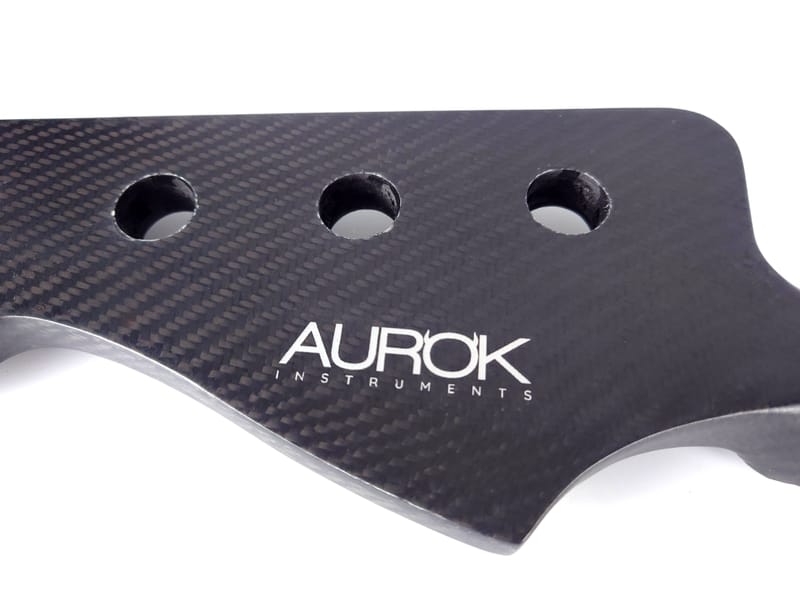
So reading the Aurok website, they make a hollow neck shell, attach insert the truss rod and attach the fretboard. Then inject epoxy to fill the voids. Apparently make for ~1.5kg neck so fairly heavy.

Klos use a foam core (which is pretty common for composite construction) so should be lighter. I imagine there would be a difference in tone / resonance between the two construction techniques.

I don't know enough about Status, Gould, Modulus to say how these build techniques compare to their ones.
 
So reading the Aurok website, they make a hollow neck shell, attach insert the truss rod and attach the fretboard. Then inject epoxy to fill the voids. Apparently make for ~1.5kg neck so fairly heavy.

Klos use a foam core (which is pretty common for composite construction) so should be lighter. I imagine there would be a difference in tone / resonance between the two construction techniques.

I don't know enough about Status, Gould, Modulus to say how these build techniques compare to their ones.
“Currently our solid core SR5 necks weigh 1.3kg and the four string headed necks are around 1.1kg. We are in the process of introducing a proprietary lightweight resin core fill which reduces the weight of the core by 25%. This should bring the weight of a four string headed neck down to less than 1kg.”

From what I can tell a typical wooden neck is .8kg, for reference
 
  • Like
Reactions: mikewalker