• TalkBass has been independent since 1998. Add your voice.
    Create a free account to reply to discussions, view embedded media, and browse with fewer display ads.
    Join freeLog in
    Want zero display ads or expanded classifieds tools? Compare plans.

Kubicki club, part 2

I believe he sarcastically stated “I’ll never do that again”
Lefty was a pest and squeaky wheel until Phil decided to grant his wish.
I imagine Phil never made any permanent jigs or equipment to facilitate it.

So we now have a new saying... "as rare as a left-handed Ex-Factor" ;)
 
  • Like
Reactions: zuma
upload_2023-5-19_15-6-17.jpeg

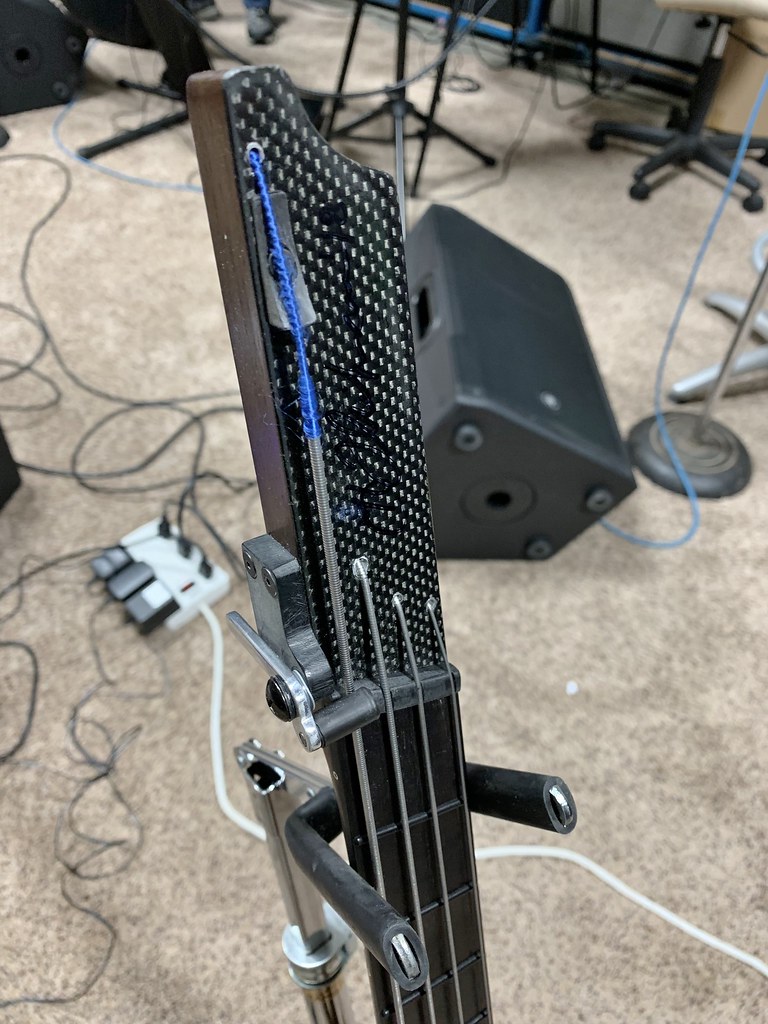
I may have posted this here before, but all here's my version of Phil's Drop-D and on a standard headed bass that I call the XD (X-tended D). I also wanted a system that required only one simple movement - the black button can move the capo on or off the string quickly with ones thumb only. It's a prototype - I initially had plans to create a carbon-fibe neck with something like this imbedded into it. It would take a lot of refinement, but it works.

upload_2023-5-19_15-2-0.jpeg

open D - (capo above string)
upload_2023-5-19_15-7-45.jpeg

capo engaged -
upload_2023-5-19_15-8-4.jpeg
 
Last edited:
It's been a while since I needed a gig bag for a Kubicki. The best I've found is a Carvin/Kiesel SC8N, though there haven't been any for sale used for quite some time and I can't get Kiesel's web site to show accessories. Besides, last I checked those were running over $200. Any one stumble upon another great bag to use or does my cheap ass settle for a $50 Sire M-Series bag? Seems idiotic, I know, to cheap out on a cocoon for my ExFactor. Oh yeah, that '92 from the classifieds is marvelous... it may just become my #1... Honeymoon taken into account.
 
Anything in particular you're looking for?
The Carvin SC8N is my favorite bag for the Kubicki. Its not any longer than it has to be and has fairly firm bolsters all the way around, isn't extra large inside to allow a lot of shifting, and a neck cradle. The Sire is really good for the money in that it is bolstered rather than a plain envelope, and also has a nice neck cradle. The only real drawback is that the padding isn't as thick and firm as the Carvin. I wouldn't be alarmed if the Sire were to fall over if leaned against the wall whereas I wouldn't be alarmed if the Carvin fell out of the back of my truck at 20mph.... though I always carry mine in the interior....but you get the picture.
 
View attachment 5067925
I may have posted this here before, but all here's my version of Phil's Drop-D and on a standard headed bass that I call the XD (X-tended D). I also wanted a system that required only one simple movement - the black button can move the capo on or off the string quickly with ones thumb only. It's a prototype - I initially had plans to create a carbon-fibe neck with something like this imbedded into it. It would take a lot of refinement, but it works.

View attachment 5067922
open D - (capo above string)
View attachment 5067928
capo engaged -
View attachment 5067930

Very cool! Harry Fleishman did something similar on a custom "Flamenco" multi-scale 4-string he built for me a few years ago.

50571058202_9047a3d838_b.jpg

50570922531_525e1a3748_b.jpg
 
The capo pivots up and out of the way. The low note is a D. Harry said we could add a fret for E flat, if I wanted.
I actually make use of the low Eb. It's not a bad option.

They are still made. Since 1979.
I used those for years until I started playing Kubickis. They take up very little real estate compared to some I've seen.
 
  • Like
Reactions: tombowlus and JIO
Dig the cool old Hamilton hanger stands..... though not all that useful with a headless.

True as to the lack of usefulness for the headless, LOL! I started using Hamiltons with my Thunderbird, and I have around 8 of those stands. They work great on most basses, but yes, the headless Fleishman needs something else.
 
Help! What am I doing wrong when changing strings and I run out of tuning range before I get to pitch? Am I not getting the string deep enough in hole? I usually start with the hole straight up. If I start it more forward, toward the bridge pickup, would that take up more of the string slack? These are strings from Kubicki and confirmed 9" past the saddles. Taking up all slack that I can and then putting the string on the saddle.
 
I have trouble too. Rarely am I able to get enough clicks on all of the wheels on the 1st try. Make sure you have the tuner knob backed off all the way.... but don't force it past where it stops. Insert the string in the hole. It doesn't matter which hole or which position it's in since you're going to rotate the wheel by hand as far as it will go. Get as many clicks as you can out of it before lifting the string up onto the saddle, and for Gods sake don't try to pry it with anything to get that last click. I use a shop towel or gloves to protect my thumbs. If tuning up with the knob just barely gets it to pitch before running out of rotation at this point I let the string stretch a bit, back off of the knob, and then try to get that last click. It can be frustrating, but with a little patience you'll get the hang of going through this ritual without too much fuss
 
@zuma There s video lurkin on Youtube that explains perfectly how to replace kubicki strings
The key is get the length of string down and when you replace the strings, measure the old to the new; perfect length always.
Take your new string and make an S shape (double crimp), inserting into hole on tuning wheel. Ratchet till you can't go anymore without hurting yourself. Than take the string off the saddle (to the right or left) and do a couple more. Pull said string back on saddle and tune.
I do a max 2-3 wraps on the wheel. If you have too much, undo it and cut it shorter. "waste" one set of strings getting the perfect length and from there all your subsequent strings are mint.
 
Last edited:
I guess part of it is that I do the S crimp, but I have no idea why I’m doing that and what the internals of the tuning wheel look like that an S crimp would make any difference, if that makes any sense. How do the internals of the tuner clamp down on the string, if it does at all?