• TalkBass has been independent since 1998. Add your voice.
    Create a free account to reply to discussions, view embedded media, and browse with fewer display ads.
    Join freeLog in
    Want zero display ads or expanded classifieds tools? Compare plans.

Kubicki club?

Status
Not open for further replies.
Fender's manual describes the changes to the circuit: The second active position is mid-variable via a tiny screw on the board. It's not something that's easy to change on-the-fly, it's more of a pick-your-setting-and-close-it-back-up kinda thing.

I've never gotten to see it myself—mine's a post-Fender ('95), but I'm curious...
 
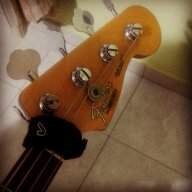
First, detune the string till the knob stops. Then push down on the little wire catch which will free the wheel and you can remove the string.

Crimp new string and insert in the hole in the wheel. Hand tighten the wheel with your fingers as much as possible, then continue raising to pitch using the tuner knob.
If you can't quite get up to pitch you didn't get the wheel ratcheted tight enough by hand asnd you'll need to repeat and try to get it 1 or 2 clicks tighter before using the tuner knob. Like any new thing, once you've done it a couple times it's no biggie.


OK, I broke my first string. An E string at that. How do you change strings on this stupid bridge. I cant seem to figure it out. Is there a video somewhere, you can watch how its done ? :confused:
 
It's really pretty easy, but not something you can see by just looking at the bridge... One of us really ought to post a YT video for KubiNewbies. I know it would have helped me.

'til then:

1) Spin the string's tuner counter-clock to loosen the string. As you do, you'll see that little silver wire dingle rise slowly from the space between the big ratchet wheel and the tuning knob. Loosen the tuner knob all the way until it stops and be SURE not to force it any further.

2) Now put your plucking-hand thumb (dunno if you're right- or left-handed) just behind that little silver wire dingle and give it a gentle push forward (toward the neck). The ratchet wheel pops free of it's cam and spins freely.

3) If whoever sold you the bass had it strung correctly, you'll see that the end of the string was bent at the end through one of the small holes in that ratchet wheel. Pull the old string out and put the new one in making the same bend as you notch the string through that hole.

note: DON'T cut your new string yet. On standard bass tuning posts, it's easy to see how much you should snip off: With these, it's not. You MUST have enough string to wrap two to four times around that big ratchet wheel. Better to guess too long at first than too short.

4) Here's the tricky part: You have to put the ball end of the string into the brass 'cup' at the head of the bass and keep it there while you begin to wind up the slack by turning that big ratchet wheel by hand. When you turn your attention to the ratchet wheel, the ball end will want to pop out of the cup. No, really, it WANTS to come out. And it will. If you listen carefully, you'll hear it mock you with a hateful little giggle every time it does. You need a third hand to keep the ball end in place, to keep tension on the string, and to wind the ratchet wheel. You won't get it right the first time. You'll get pissed at it. We all did. You'll figure out a way to make it work. Some of us use hair ties to hold the string down.

5) Now take up the slack in the string. Roll that ratchet wheel all the way until you can't roll it any further by hand. DON'T force the wheel any further than you can turn it by hand. DON'T put an object in the teeth and try to force it a little further: You'll break teeth off the wheel. There should be enough string to go around the wheel two to four times.

6) Now, use the tuning knob to spin the string up to pitch.

7) One more thing: You'll probably get the string to pitch with almost no room left to tighten the knob. Be CAREFUL not to overtorque the knob: You'll trash the whole thing. If you need more tightening on the string, you'll have to back up to step 5 to take up more slack in the string.

It SOUNDS like a lot of work, but it really isn't. After you do it once or twice, it gets easy. I know I got flustercated with it at first, but now it's a do-it-in-my-sleep kinda thing. PM if you need more help.
 
Just to emphasize: Phil's manual, and it doesn't have the mid adjustment mentioned somewhere above.

And I found this and I share his opinion:
http://www.talkbass.com/forum/showpost.php?p=3785024&postcount=12

Someone else care to comment?

Interesting... not the fact that position 3 sounds more like the bass and treble are enhanced (I would agree with that assessment), I mean that Phil's manual states that position 3 has a mid-boost. Both my Kubickis are post Fender, have Phil's preamp and position 3 definately DOES NOT sound like a mid boost to my ears either. The only manual I've been able to find online has been for the Fender era Kubickis and I'm aware that those preamps did have the mid adjustment in the rear cavity.

- Ugly.
 
Thanks TimWilson VERY MUCH

The silver wire dingle, goes all the way down, while your tightening. Sometimes it goes to far down before your at the correct pitch. Seems it works better, if you leave the string off, the saddle untill you've tighten it a bit, and then force the string on the saddle. Then the dingle seems to be at the correct height :hyper:

Yea, this bass is from 1986. There's several teeth missing on the cam wheel

Thanks again, Mr. Wilson
Very glad to be any help, bro. Embly and others were super-helpful to me when I was trying to learn this bass' mechanics, too. Your discovery about lifting the string onto the bridge saddle after the tuner is tightened some is a good 'un, too! I'll try that myself next time. Thank YOU!

I think a LOT of players break the teeth off those wheels trying to get the string as tight as possible before starting with the tuning knob. I actually tried doing that myself with a steel ruler before I saw a warning from someone else about it. I'm glad (and lucky) that I didn't pop some teeth off my own!

You're going to love this bass. Take special note of all the players here and elsewhere on TB who write about their deep regrets in selling their Kubickis. You'll never find anything else that plays and sounds like these amazing basses.
 
Take special note of all the players here and elsewhere on TB who write about their deep regrets in selling their Kubickis. You'll never find anything else that plays and sounds like these amazing basses.
Agreed. I was financially forced into selling my yellow (1992) a several years ago. Fortunately, I was extremely lucky to find another (1986). When I picked it up, it felt like home. :)
 
Do I qualify?
dsfgfhghj122.jpg


dsfgfhghj123.jpg

Jajaja this is original :smug:
 
Status
Not open for further replies.

Latest posts