• TalkBass has been independent since 1998. Add your voice.
    Create a free account to reply to discussions, view embedded media, and browse with fewer display ads.
    Join freeLog in
    Want zero display ads or expanded classifieds tools? Compare plans.

Lady 5Jane - Headless, Fretless 5 String Prototype (With Piano Pins)

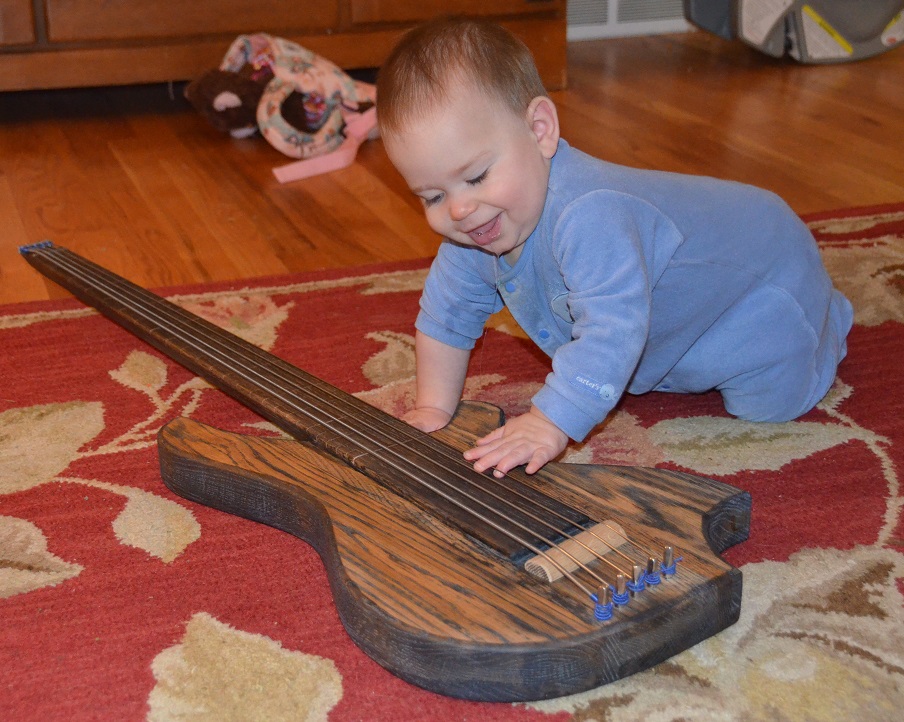
Baptism by toddler...

DSC_0236_zps1daea112.jpg
 
I am going to unscrew a few of them and experiment with bees wax as a lubricant to see if that helps with easier tuning. I may have to widen the holes a bit as well.

Have you considered coloring in the threads of the pins with a #2 pencil? Graphite is a very good dry lubricant, that wont have any effect on the body wood.
 
Have you considered coloring in the threads of the pins with a #2 pencil? Graphite is a very good dry lubricant, that wont have any effect on the body wood.

It had not even crossed my mind, but now I feel foolish for not considering it. ;) I have a .032" gauge flatwound C string on order, and when it gets in next week I will do exactly that.

 
Though not directly pertinent to this build thread, I have finished the guitar except for the head stock logo. I have mixed feeling about this. This is a guitar I would love to keep as my own, but of course that's what I was shooting for. This was my first build for someone else, and it turned out well, though I have a whole list of things I would do differently if I were to build it again.

DSC_0261.jpg
 
  • Like
Reactions: vmabus
The guitar looks great, very clean and headstock is great also :) What kind of logo were you planning to put on? I'm graphic designer also, maybe i can mock up couple of versions onto headstock if you post some images.

 
The guitar looks great, very clean and headstock is great also :) What kind of logo were you planning to put on? I'm graphic designer also, maybe i can mock up couple of versions onto headstock if you post some images.

That's very nice of you! Thanks, but the logo is already worked out. It will be the nickname of the eventual owner. This was built for a friend for her father-in-law.

Also - I can't take credit for the neck...it's a Mighty Mite. The neck on the Lady 5Jane was my very first attempt at a neck. ;)
 
Last edited:
I am usually up with my 8 month old son (he's my alarm clock) who is just starting to crawl. Every morning since the prototype has been strung up he has been immediately making a beeline for the bass and wanting to "play". Perhaps he will follow in his father's foot steps....
 
  • Like
Reactions: ctmullins
Just found and read, and enjoyed, the whole thread, hope the following are useful.

Neo magnets swap in cheap pickups -
I have done this on several pickups, they give a different sound probably due to the different inductance of the coil when the steel pole pieces are replaced with neo. They can be very HOT (depends on the magnet strength) so may need to be further away from the strings to prevent "Strat-itis". Also it is best to use a pickup that has the the pole pieces in a plastic former. If you try it with one that has the wire wound straight onto the pole pieces you risk damaging the wire and wrecking the pickup (don't ask how I know this!).

Piezo pickups -
I was in instrumentation for part of my career and we used piezo devices extensively. Ideally they need to be amplified by a "charge amplifier" http://en.wikipedia.org/wiki/Charge_amplifier, then you can use long leads without affecting the signal. Failing this a very high impedance buffer will work as long as you keep the cable capacitance as low as possible. This is what every guitar/bass/DB preamp has been that I have seen. (One day I really must build a charge amplifier and see if there are any advantages.)

With piezo pickups it is all about transferring the vibrations into bending forces (for the disks) or compression forces (bendable strip type).

I installed one of the cheap strip type in an acoustic guitar directly under a semicircular brass bridge "fret". This is amplified by a cheap (Chinese Ebay purchase) acoustic guitar 4 band preamp. It works very well and is not lacking in bass at all, so much so that I am thinking of making a similar style bridge for my project bass.
 
  • Like
Reactions: michaelwayneharwood
"With piezo pickups it is all about transferring the vibrations into bending forces (for the disks) or compression forces (bendable strip type)."

Care to explain more about bending forces? I use disc piezo a lot so any first hand info is much appreciated.
Also, great post, thanks for sharing. I'll look into charge amp too. Weirdly enough all piezos I've made had excellent output without preamp, but I did notice that with firm pressure to the discs rim also comes feedback.

I'm not sure if I commented on the bass - it's looks totally awesome! kinda raw which I really like!

Btw I wasn't suggesting to make a logo but to mockup the various positions onto head - a near real visualization can sometimes bring faster solution/decision :)
 
  • Like
Reactions: michaelwayneharwood
@michaelwayneharwood; little kiddies and basses go well together. The strings are thick enough and strong enough that they won't snap or cut the child's hands. I say let him rip, there's not much damage he can do. ;)

I installed one of the cheap strip type in an acoustic guitar directly under a semicircular brass bridge "fret". This is amplified by a cheap (Chinese Ebay purchase) acoustic guitar 4 band preamp. It works very well and is not lacking in bass at all, so much so that I am thinking of making a similar style bridge for my project bass.

@delta7fred; unfortunately, while chinese piezos work exceedingly well for guitars, they don't work so well for bass. I know because I've tried. I think this is because piezos naturally accent the frequencies we want to hear coming from an acoustic guitar. Upper mids and crystal clear highs. However, on bass, lots of upper mids sound clacky and lots of highs make for muchos fingernoise. What the piezos are good for (as I've said before) is adding detail to a mag pickup. Mag pickups on a fretless can easily get a bit woofy and indistinct in a band, especially if the pickup is away from the bridge and/or you're using flatwounds/tapewounds. The piezo can add back in all those highs and mids that help the fretless sound clear in the mix.
 
  • Like
Reactions: delta7fred
@delta7fred; unfortunately, while chinese piezos work exceedingly well for guitars, they don't work so well for bass. I know because I've tried. I think this is because piezos naturally accent the frequencies we want to hear coming from an acoustic guitar. Upper mids and crystal clear highs. However, on bass, lots of upper mids sound clacky and lots of highs make for muchos fingernoise. What the piezos are good for (as I've said before) is adding detail to a mag pickup. Mag pickups on a fretless can easily get a bit woofy and indistinct in a band, especially if the pickup is away from the bridge and/or you're using flatwounds/tapewounds. The piezo can add back in all those highs and mids that help the fretless sound clear in the mix.
I believe you, but still fancy giving it a go on my project bass. I am intrigued to find out just what they do sound like and am sure I can lash up something in a few minutes.

Here is a quick sketch of my acoustic guitar pickup.

zyfs1AP.jpg


On the piezo discs, they are the same as used in piezo sounders. When you apply a voltage across the piezo it bends so put AC across it and it flexes back and forth producing sound. They also work in reverse, when you flex them they produce a voltage so to get the optimum output from them you need to support the outer edge and apply the vibration to the centre so it flexes. The problem is that if you apply too much pressure and bend the crystal too far it cracks and is not so effective.