• TalkBass has been independent since 1998. Add your voice.
    Create a free account to reply to discussions, view embedded media, and browse with fewer display ads.
    Join freeLog in
    Want zero display ads or expanded classifieds tools? Compare plans.

Lakland Owners Group #69

Early days to be sure but as I sit here and play this thing I'm wondering where it's been all my life. 😃 I know bedroom tone and gig tone are completely different but it's hard to find a bad tone on this thing. I can see gigging this thing using anything from soloing the front pickup to soloing the MM pickup or any combination in between. I hate to say it but it is so much smoother sounding than my Sadowsky. I'm also loving the fact that it's vintage and already worn in. It's got just the right amount of wear and patina to know that it's been well loved by previous owners but not abused. The finish must be rock hard because even though there's some light buckle rash on the back there isn't a chip or ding to be found anywhere. I did find the dip switches in the flawless, unmolested control cavity. They were set to 250 and on a recommendation from another user I changed the setting to the highest at 800 I think it was. I think I prefer to cut a little at 800 instead of boosting 250. Anyway, that's just what I can tell noodling around in my practice room. Curious to know what other users of the old Bart system prefer. Lastly, I love how the 35 scale makes the B and E string just so much clearer as you go up the neck which is something I'm not used to. That and I like how having a B string to rest my thumb on makes me play the E string with more evenness then I tend to do when it's the lowest string. All good things. Hope you all don't mind me rambling on! It's fun to share the joy and excitement of a new bass.
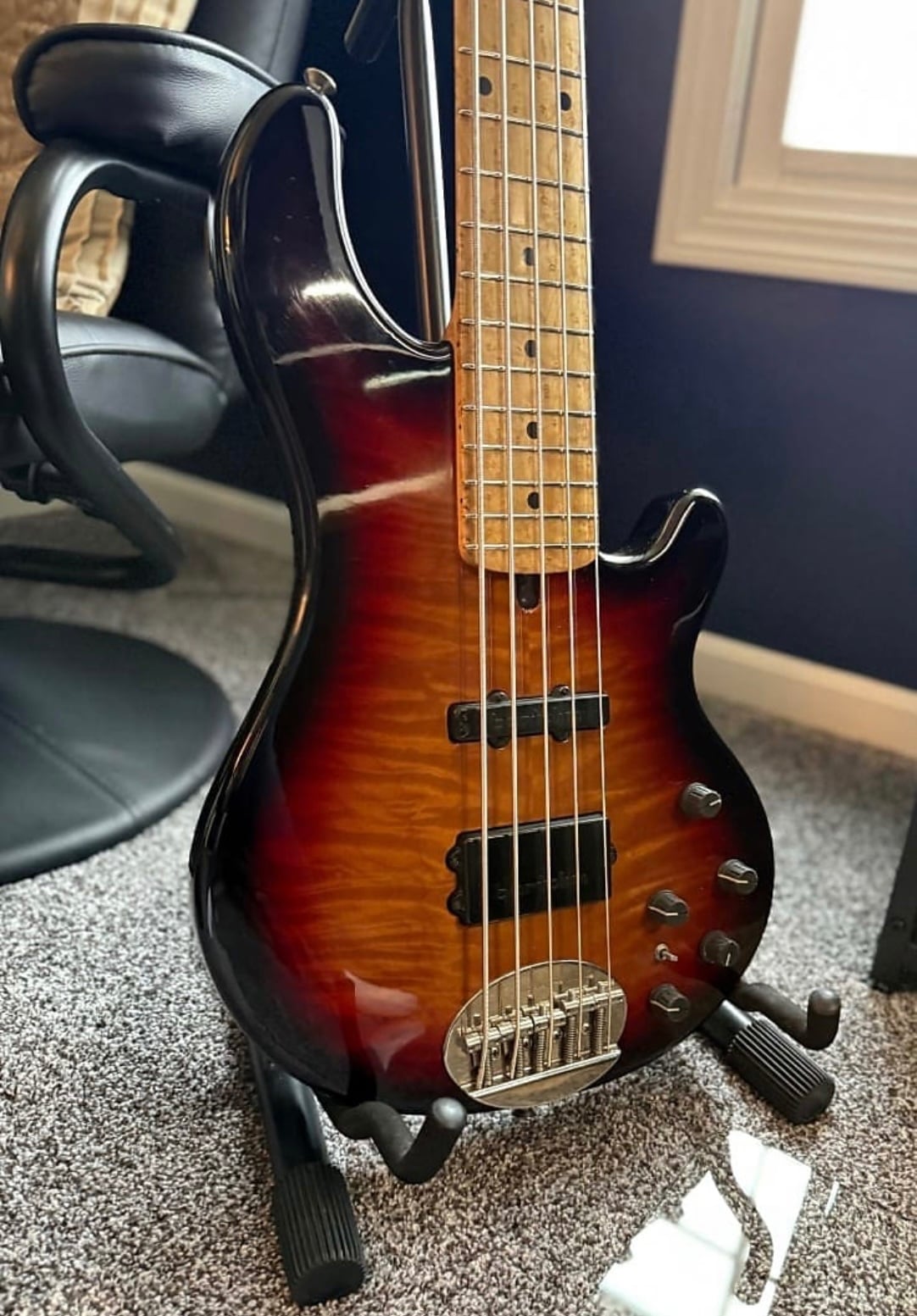
IMG_0310.jpeg
 
Last edited:
Early days to be sure but as I sit here and play thing I'm wondering where it's been all my life. 😃 I know bedroom tone and gig tone are completely different but it's hard to find a bad tone on this thing. I can see using anything from soloing the front pickup to soloing the MM pickup or any combination in between. I hate to say it but it is so much smoother than Sadowsky. I'm also loving the fact that it's vintage and already worn in. It's got just the right amount of wear and patina to make it seem well loved by previous owners but not abused. The finish must be rock hard because even though there's some light buckle rash on the back there isn't a chip or ding to be found anywhere. I did find the dip switches in the flawless, unmolested control cavity. They were set to 250 and on a recommendation from another user I changed the setting to the highest at 800 I think it was. I think I prefer to cut a little at 800 instead of boosting 250. Anyway, that's just what I can tell noodling around in my practice room. Lastly, I love how the 35 scale makes the B and E string just so much clearer as you go up the neck which is something I'm not used to. That and I like how having a B string to rest my thumb on makes me play the E string with more evenness then I tend to do when it's the lowest string. All good things. Hope you all don't mind me rambling on! It's fun to share the joy and excitement of a new bass. View attachment 7373119
Glad to hear the love is still there!

I'm sure it will be a long term affair!
Congrats
 
  • Like
Reactions: JB Player
Early days to be sure but as I sit here and play this thing I'm wondering where it's been all my life. 😃 I know bedroom tone and gig tone are completely different but it's hard to find a bad tone on this thing. I can see gigging this thing using anything from soloing the front pickup to soloing the MM pickup or any combination in between. I hate to say it but it is so much smoother sounding than my Sadowsky. I'm also loving the fact that it's vintage and already worn in. It's got just the right amount of wear and patina to know that it's been well loved by previous owners but not abused. The finish must be rock hard because even though there's some light buckle rash on the back there isn't a chip or ding to be found anywhere. I did find the dip switches in the flawless, unmolested control cavity. They were set to 250 and on a recommendation from another user I changed the setting to the highest at 800 I think it was. I think I prefer to cut a little at 800 instead of boosting 250. Anyway, that's just what I can tell noodling around in my practice room. Curious to know what other users of the old Bart system prefer. Lastly, I love how the 35 scale makes the B and E string just so much clearer as you go up the neck which is something I'm not used to. That and I like how having a B string to rest my thumb on makes me play the E string with more evenness then I tend to do when it's the lowest string. All good things. Hope you all don't mind me rambling on! It's fun to share the joy and excitement of a new bass. View attachment 7373119
Great feedback! As a LOG rambler myself, I'll encourage this! There's lots to learn from each other's experiences, trials and mods, and supporting multiple acquisitions (haha) - LOGers here are amazing, kind, knowledgeable and talented in every way - so go for it! see, easy to ramble! :)
 
Bass arrived today! There's a chip on the headstock that was not pictured and I'm going to have to decide how much it bothers me, unfortunately.

Put some DR Pure Blues on it and did my best on a setup, plays pretty darn well but I'm going to get it to a pro before taking it out. If I keep it there's just not going to be any reason to keep my 4-string Fender MIM jazz. It sounds worlds better.
Congrats on receiving the bass! I know that feeling of receiving an instrument with something unexpected and need to take some time to "accept" it, even if its a minor cosmetic flaw, it's the build up and expectation - but that's a great bass to own and play, so hope you enjoy even more over time!
 
Congrats on receiving the bass! I know that feeling of receiving an instrument with something unexpected and need to take some time to "accept" it, even if its a minor cosmetic flaw, it's the build up and expectation - but that's a great bass to own and play, so hope you enjoy even more over time!
Thanks! I'm keeping it for sure, the seller gave a little discount for the reduced resale value. The neck is really comfy to me, I'm taking it to practice tomorrow I think.
 
After reading all the threads about how dark the Bart pickups and pre's are I actually considered trying some steels like hi beams but so far I'm thinking my usual slinkies will work fine.

Presently, what's really got me wondering is the finish on this neck. I feel like I've seen conflicting information on the internet on wether or not the 97 and earlier necks (not sure of the exact time frame) had some kind of satin finish applied to them from the factory. That and I'm also thinking of the EB's that I've had in the past with oil finished necks and unfinished maple boards. The EB's have a definite parting line on the back of the neck where they transitioned the oil finish to the satin polly on the headstock. You all have probably seen that many times. Anyway, I recall that the oil finish on the back of those necks and in particular the unfinished boards would get dirty over time. I don't see any of that on this most beautiful Lakland neck. No evidence of any discoloration from the back of the neck where it's been played for many years to the headstock or the fretboard. It's all uniform and even. It makes me think that it was sprayed with a satin finish of some sort. I'd say it's just a point of curiosity but I really wonder if I can spray the back of the neck with the same silicone free guitar polish that I use on the body. Which I would never do to an oil finished neck on a stingray. Oddly enough the early stingray necks with birds eye maple boards were spayed with a satin finish before they started doing the oiled finish. What does the combined knowledge and experience from the LOG think? Here's a couple of pics just for the fun of it.
IMG_0317.jpeg
IMG_0318.jpeg
IMG_0319.jpeg
 
  • Like
Reactions: GregC and JB Player
I don't remember them using anything but an oil finish on the USA line. They do not have a line like the EBMM instruments do because its all oil where EBMM has a poly finish on the whole headstock. I never really thought about it but you are right as far as getting darker/dirtier. EBMM's stuff tends to get real dirty but I've never really noticed a Lakland like that. I'm sure it happens but it can't be as common.
 
After reading all the threads about how dark the Bart pickups and pre's are I actually considered trying some steels like hi beams but so far I'm thinking my usual slinkies will work fine.

Presently, what's really got me wondering is the finish on this neck. I feel like I've seen conflicting information on the internet on wether or not the 97 and earlier necks (not sure of the exact time frame) had some kind of satin finish applied to them from the factory. That and I'm also thinking of the EB's that I've had in the past with oil finished necks and unfinished maple boards. The EB's have a definite parting line on the back of the neck where they transitioned the oil finish to the satin polly on the headstock. You all have probably seen that many times. Anyway, I recall that the oil finish on the back of those necks and in particular the unfinished boards would get dirty over time. I don't see any of that on this most beautiful Lakland neck. No evidence of any discoloration from the back of the neck where it's been played for many years to the headstock or the fretboard. It's all uniform and even. It makes me think that it was sprayed with a satin finish of some sort. I'd say it's just a point of curiosity but I really wonder if I can spray the back of the neck with the same silicone free guitar polish that I use on the body. Which I would never do to an oil finished neck on a stingray. Oddly enough the early stingray necks with birds eye maple boards were spayed with a satin finish before they started doing the oiled finish. What does the combined knowledge and experience from the LOG think? Here's a couple of pics just for the fun of it.View attachment 7374079View attachment 7374080View attachment 7374081

From Lakland's website FAQ:

Q. What recommendations do you have for maintaining the neck on my US made Lakland bass?
A.
The back of the neck is a hand rubbed oil finish with a thin wax coating. We recommend occasionally cleaning the neck with pure orange oil and reapplying a coating of clear paste wax or bowling alley wax. After applying the wax, allow to dry for five minutes then wipe off the excess. The wax can be scuffed with fine steel wool to produce a satin finish or polished to a dull luster depending on your preference. Avoid cleaners and polishes that contain added thinners or silicone.

We also recommend orange oil for cleaning the fingerboards. The maple fingerboard does not require any sealer after cleaning. We recommend Howard Brand Feed N Wax after cleaning for our rosewood and ebony fingerboards.