TL;DR version: My first Lakland. Very cool bass with some mods. Does anyone know how the "unpublished" DIP switch settings might affect the mid control frequency points? I can't find much at all on this. Any thoughts on Series/Single Coil/Parallel for the 3 way switch vs the stock configuration?
___________________
Hello Lakland users.
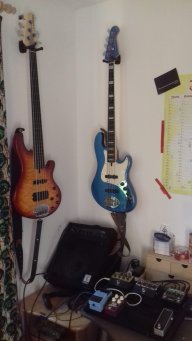
I picked up this Skyline 55-02 last week, my first experience with a Lakland. It's Korean made from 2006 per the serial #.
View attachment 4244078
I could tell while playing it in the store that it had been modded to some degree. What would ordinarily be the control for the high EQ band had no center detent, and was clearly functioning as a passive tone knob, functional both in passive and active modes. It did not occur to me in the store that the exposed pole pieces on the pickups might have been an indicator of non-stock pickups.
After getting it home I found this little surprise in the control cavity. You can see what was the original high control pot bagged for insulation and otherwise left intact, except that one wire had been disconnected from its pad on the circuit board to disable it. The pickups had been replaced with Nordstrands. The LH-3 remains. And whoever did the work left documentation from Nordstrand and an explanation of the current pickup wiring. Well done, thanks!
View attachment 4244079
The three way switch for the humbucker now selects between Series/Back Coil/Parallel.
View attachment 4244080 View attachment 4244081
I'm considering changing this to the stock configuration for the switch. Based on the wiring diagram on the Lakland site, I believe that would be Front Coil/Parallel/Back Coil, though I could be reading that incorrectly. I'm far from being any kind of electronics expert.
I found after gigging it over the weekend that the series humbucking mode seemed to completely overpower the neck pickup. I found I liked both coils much better in parallel than series with the neck and bridge blended 50/50. Also, though I didn't hear it playing through an amp, when monitoring over in-ears the series humbucking mode seems to be clipping the LH-3's input. I know there's a trim pot for that, but the volume balance between passive and preamped modes seems perfect otherwise, and I think I'd prefer to leave that as is.
Given the addition of a passive tone control, I'm likely to use this bass in passive mode at least as often as active mode, probably more. Though, who knows. I generally prefer passive electronics on my instruments, but the preamp on this sounds pretty fantastic.
The passive tone circuit is wired with .047 and .022 caps in parallel on a 500k pot. Again, I'm no electronics expert, and my experience with different cap values is mostly limited to Fender type circuits with 250k pots. When rolled all the way off, this tone control doesn't sound to my ear quite to get quite as dark as a typical Fender circuit. It seems very usable throughout its range.
View attachment 4244082
I didn't spend a whole lot of time yet playing with the various published mid frequency points. After a quick audition of each, I left it set at 600Hz. But when I first opened this up, it was set to a switch configuration for which I've seen no published value.
View attachment 4244083
On that setting, which I only auditioned in the store, on an unfamiliar amp, various classic riffs and solos dueling across the room, it sounded almost like it was simply boosting overall volume. I neglected to audition that setting at home before running through all the published ones.
A Lakland rep told me he had no info on this beside what's published on their site. I know it's only of academic value, how each setting sounds is all that really matters, but the details nerd in me would love to know specifically what each permutation of DIP switch configurations is actually doing.
Do any of you more experienced Lakland users have any knowledge on this? Has any tech savvy user expended the effort to figure all that out?
Any thoughts, tips, or general advice on how you more seasoned Lakland people like to use yours would be welcome.
Thanks!