• TalkBass has been independent since 1998. Add your voice.
    Create a free account to reply to discussions, view embedded media, and browse with fewer display ads.
    Join freeLog in
    Want zero display ads or expanded classifieds tools? Compare plans.

Lakland Owners Group #69

40 - 95 EBMM Cobalt Flats. Lightest set they make, but still plenty of tension. And, they sound amazingly roundwound-ish. They're on all my favorite basses.

Thanks for the reply... I may not go that light, but I'll check em out..
Question... how do the Cobalts compare feel wise with their regular slinky flats.. when I first tried flats, I tried the slinks, because I'd played the rounds for years... I absolutely hated them.. the sound, and they felt... sticky, for lack of a better word trying to do slides was impossible
 
  • Like
Reactions: JEDI BASS
Yikes! Had a very wet gig this weekend so I had all my gear sitting out after I'd uncased and dried/cleaned everything. I picked up my 55-14 (backup bass) today to play it and realized the strings had bottomed out and needed some relief. So after addressing that, I checked a couple others that I haven't played for a while and both 55-01's needed to have quite a bit of relief taken out but my trusty 55-02 was perfect. I bought that one new and it never needs to be tweaked. Just sits there perfect year 'round.

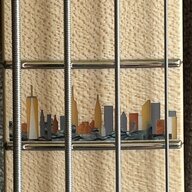
Sadly and somewhat unexpectedly, my BEM 55-94 is the finickiest of them all and needs to be tweaked constantly but she sure is pretty to look at!

IMG_0327.jpg
 
Last edited:
That’s surprising the 55-94 needs constant tweaking. I would think quarter sawn necks would be more stable. Do you know if it has graphite stiffing bars in the neck? I believe those are in newer neck, but I could be wrong. My 44-01 neck is very stable.

I mistyped in my original post as I meant to say "somewhat unexpectedly" with how sensitive it appears to be. I don't know if graphite rods were used back in '98 but she moves quite a bit. The strings were fully bottomed out back in April and I play it quite a bit. When it's adjusted, it has the lowest action of all of them but I need to keep an eye on it.
 
Sadly and somewhat unexpectedly, my BEM 55-94 is the finickiest of them all and needs to be tweaked constantly but she sure is pretty to look at!

View attachment 4777106

Somebody always lambastes me when I mention this, but birdseye maple seems to have a tendency to be a little softer and more elastic than plain maple, and the birdseyes can cause structural weak points. Because of this, the neck won’t hold to tension when the truss rod is tightened - it goes back to having too much relief pretty quickly.

I’ve had several instruments with birdseye maple necks where this happened so I’ve stepped away from using them. I’m not saying every example of a birdseye maple neck will do this, but it’s been my experience. Some well- respected builders will not make necks out of it unless it is made from roasted/torreified stock.
 
The 55-76 arrived from GC. Neck is dated 3/10/98. GC listed it as a 5175- that's the serial #. It plays well and truss is working but who the hell does this to a US Lakland? I'm sure the socket is stripped but my Lakland hex won't squeeze through this mess. The nut unscrews so it's replaceable. Bartolini preamp. The Bass Place sold it on Reverb 8 yrs ago and their ad stated a Nordstrand pickup. Anyone know what this actually is as it isn't a 24 yr old Nordy? She plays well with my Carvin LB75fl and the MM pickup location is only 1/16" difference.
 

Attachments

  • 20220806_163508.jpg
    20220806_163508.jpg
    624 KB · Views: 92
  • 20220806_164559.jpg
    20220806_164559.jpg
    1.4 MB · Views: 96
  • 20220809_163052.jpg
    20220809_163052.jpg
    1.2 MB · Views: 92
  • 20220809_164648.jpg
    20220809_164648.jpg
    763 KB · Views: 85
Last edited:
Thanks for the reply... I may not go that light, but I'll check em out..
Question... how do the Cobalts compare feel wise with their regular slinky flats.. when I first tried flats, I tried the slinks, because I'd played the rounds for years... I absolutely hated them.. the sound, and they felt... sticky, for lack of a better word trying to do slides was impossible
I can’t urge you enough to take a chance on the 40-95 set! I typically played roundwound sets that are normal 45-105 or even 110 for the E. And the 40-95 flats felt perfect to me.

As for stickiness, the cobalts aren’t silky smooth like Dunlop flats or LaBella LTFs. But, I don’t have any issues sliding. Do some searching and you’ll find lots of reviews and comparison talk.
 
Yikes! Had a very wet gig this weekend so I had all my gear sitting out after I'd uncased and dried/cleaned everything. I picked up my 55-14 (backup bass) today to play it and realized the strings had bottomed out and needed some relief. So after addressing that, I checked a couple others that I haven't played for a while and both 55-01's needed to have quite a bit of relief taken out but my trusty 55-02 was perfect. I bought that one new and it never needs to be tweaked. Just sits there perfect year 'round.

Sadly and somewhat unexpectedly, my BEM 55-94 is the finickiest of them all and needs to be tweaked constantly but she sure is pretty to look at!

View attachment 4777106
I have had the same experiences with my older BEM 55-94s. Knowing what I know now about tru oil and wax finishes, I would advise removing the necks and applying a healthy number of coats, allowing each to dry throughly. That includes coating the fretboards. Word from an insider is that Lākland used to only hit the necks with one diluted coating, and that is not enough to form a good moisture barrier.

Here’s a link showing the process, just skip the part where he removes the poly finish, LOL.
 
That’s surprising the 55-94 needs constant tweaking. I would think quarter sawn necks would be more stable. Do you know if it has graphite stiffing bars in the neck? I believe those are in newer neck, but I could be wrong. My 44-01 neck is very stable.
It’s the tru oil finish versus the satin poly on the imports. Tru oil is softer and needs to be re-applied, after a while, and in many layers, which Lākland doesn’t do. Poly is stronger and, when done correctly, 100% resistant to moisture… also it doesn’t flex like tru oil will.
 
  • Like
Reactions: MaxSpinrun
I mistyped in my original post as I meant to say "somewhat unexpectedly" with how sensitive it appears to be. I don't know if graphite rods were used back in '98 but she moves quite a bit. The strings were fully bottomed out back in April and I play it quite a bit. When it's adjusted, it has the lowest action of all of them but I need to keep an eye on it.
Mine did the same thing.
 
Somebody always lambastes me when I mention this, but birdseye maple seems to have a tendency to be a little softer and more elastic than plain maple, and the birdseyes can cause structural weak points. Because of this, the neck won’t hold to tension when the truss rod is tightened - it goes back to having too much relief pretty quickly.

I’ve had several instruments with birdseye maple necks where this happened so I’ve stepped away from using them. I’m not saying every example of a birdseye maple neck will do this, but it’s been my experience. Some well- respected builders will not make necks out of it unless it is made from roasted/torreified stock.
Yep… highly figured birdseye is not strong. But, paired with a stiff quartersawn neck blank with graphite rods… it should be okay. I’m not sure how many necks Lākland has had to replace though.

I still think most of the issue we’ve all apparently experienced has been due to not having an adequate moisture barrier.