• TalkBass has been independent since 1998. Add your voice.
    Create a free account to reply to discussions, view embedded media, and browse with fewer display ads.
    Join freeLog in
    Want zero display ads or expanded classifieds tools? Compare plans.

Lap joint instead of scarf joint?

Not necessarily. Depends on how you lay it out and cut the nut. As long as you establish a good witness point on the nut. I've been playing a couple basses with this config. No issues

Either way, there is nothing gained by this, and it does cause some compromises. I guess I just don't see the point
 
I've been thinking about this a bit over the last couple hours. Personally, I'd have a bear of a time getting that joint perfect. More surfaces to true up for an airtight joint. All of the lap joints I have done didn't require precision (work bench legs), however.
 
Like Hopkins said, I think it will be too far into your playing area. I've twice played with longer (in the body direction) volutes, and both times cut them back as soon as I picked up the neck to try it out.

This depends also. If you look up hand position for playing an electric bass, the thumb is positioned in the middle of the back of the neck, in parallel with about your second finger. Your thumb should get now where near the volute.
 
If you bevel the end of the neck at 45 or 30 degrees onto the lapped headstock piece (past the nut), that'll give you more adhesion area and you could also round the end of the headstock piece to give you more 'felt' thumb area while still maintaining the length of the adhesion area. It you use good clean wood and slow-set epoxy for good penetration, it'll never come apart.
Fender style headstocks have no more length to the straight grain at that point. Type of wood will be a determining factor.
 
The real test is build one up alongside a traditional configuration and then stress load them both to failure and see which one is stronger. For me the question really comes down to why do you have a need to glue up two half inch boards for a neck? The materials for a Fender style neck are so minimal to begin with that it makes no sense to me to dumpster dive for them and then gamble 20 hours or more work when you can find a beautiful piece of almost any wood you would want for less than $50 in board form; most of the time a $50 board will get you several necks. The whole idea makes me laugh inside today considering I've got a couple of new double bass necks going on the workbench this week. Now those are a big piece of wood!

In the end, it all comes down to regardless of what other people tell you, if your heart tells you something else then I'd say follow that. Even if it fails, you may learn something from the failure or it will lead to something that a few other experimental necks down the road is exactly what you were searching for. Far better to push the boundaries and fail than to live a life unfulfilled....

j.
www.condino.com
www.kaybassrepair.com
 
  • Like
Reactions: Scoops and PDX Rich
You're going to have less wood at the joint than you're currently showing because you'll have to shape the neck plus hog out space for the truss rod and that is not an additive process.

Also, scarf jointed headstocks are sandwiched in between the neck and fret board. It provides more clue surface and the head stock is essentially clamped in between two other pieces of wood which makes especially strong material like ebony or rosewood an attractive choice.

What if you took a neck blank and cross cut it diagonally to produce a headstock, then flipped the headstock to get it angled? Add a fret board and there you have a scarf joint.

I'm guessing a heel adjusted truss rod would help keep more wood in the headstock?

And just to toss an idea into the ring (because my coffee just ran out and my brain has halted), what about a mortise and tenon?
 
Last edited:
You're going to have less wood at the joint than you're currently showing because you'll have to shape the neck plus hog out space for the truss rod and that is not an additive process.

Also, scarf jointed headstocks are sandwiched in between the neck and fret board. It provides more clue surface and the head stock is essentially clamped in between two other pieces of wood which makes especially strong material like ebony or rosewood an attractive choice.

What if you took a neck blank and cross cut it diagonally to produce a headstock, then flipped the headstock to get it angled? Add a fret board and there you have a scarf joint.

I'm guessing a heel adjusted truss rod would help keep more wood in the headstock?

And just to toss an idea into the ring (because my coffee just ran out and my brain has halted), what about a mortise and tenon?

He is talking about a Fender style headstock, scarf joints don't really apply. But to your point, yes, the sandwiching of the joint between the fretboard does add some strenght, but the real gain comes from the fact that the long grain is running through the angle of the head stock.
 
He is talking about a Fender style headstock, scarf joints don't really apply. But to your point, yes, the sandwiching of the joint between the fretboard does add some strenght, but the real gain comes from the fact that the long grain is running through the angle of the head stock.

Good point about the scarf joint but I don't see what Fender has to do with this. I don't see what is to be gained by thinking of this in terms of Fender styled instruments. He's decided to use two pieces of wood in place of one. That's not a Fender design. Having decided to use two pieces of wood the question is how to make it work and the Fenderish way has it's problems. So, I would forget about Fender here.

Hmm, what if the neck was a lot longer, making the head stock twice as thick the entire length and channels for the strings and tuners were cut out leaving as much wood as possible?
 
Good point about the scarf joint but I don't see what Fender has to do with this. I don't see what is to be gained by thinking of this in terms of Fender styled instruments. He's decided to use two pieces of wood in place of one. That's not a Fender design. Having decided to use two pieces of wood the question is how to make it work and the Fenderish way has it's problems. So, I would forget about Fender here.

Hmm, what if the neck was a lot longer, making the head stock twice as thick the entire length and channels for the strings and tuners were cut out leaving as much wood as possible?

Because the whole point of this thread was using a lap joint in place of a single carved blank to make a Fender style headstock. If we were talking about an angled headstock a scarf joint would be obvious.
 
Because the whole point of this thread was using a lap joint in place of a single carved blank to make a Fender style headstock. If we were talking about an angled headstock a scarf joint would be obvious.

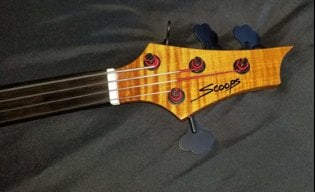
Alright, the issue looks resolved then. But before the thread ends, what about this?

AEB-1scrollbass.jpg


Can that be made by stacking and lapping material?
 
  • Like
Reactions: Will_White