I think this headstock idea/question is relative to a cigarbox build in another thread, so expensive, pre-finished necks and elaborate workings are not part of the scheme.

Enjoy the benefits of a premium membership!
Upgrade Account
-
TalkBass has been independent since 1998. Add your voice.
Create a free account to reply to discussions, view embedded media, and browse with fewer display ads.
Join free Log in
Want zero display ads or expanded classifieds tools? Compare plans.
You are using an out of date browser. It may not display this or other websites correctly.
You should upgrade or use an alternative browser.
You should upgrade or use an alternative browser.
Lap joint instead of scarf joint?
- Thread starter Will_White
- Start date
More options
Who Replied?Alright, the issue looks resolved then. But before the thread ends, what about this?
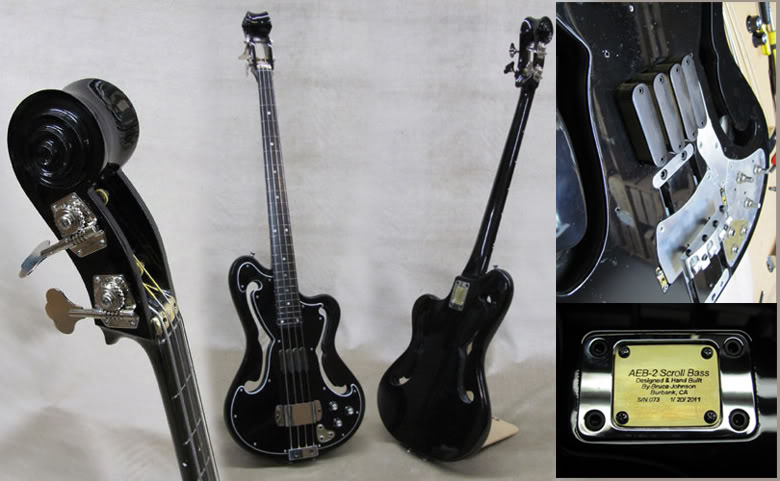
Can that be made by stacking and lapping material?
Nice!
Is that enough string break angle for ya?
24 frets, and look at those pickups!


Nice!
Is that enough string break angle for ya?
24 frets, and look at those pickups!
One pickup per string, tempting.

Hmm, the headstock needs to be only as strong as necessary to hold strings and take a reasonable fall. So, what wood would be strong enough to make this work? Rosewood? Ebony? What about screws? Dowels? Threaded inserts?

Yes that's what sparked the idea, but I was also thinking about using it for a standard bass, they seem to be working well for the CBG too, the baritone is strung with a heavy set of flats and other then one of the the tuners not being able to handle the stiffness of the core and stripping the gear. We're also talking half the tension of a standard bass neck.I think this headstock idea/question is relative to a cigarbox build in another thread, so expensive, pre-finished necks and elaborate workings are not part of the scheme.
I think that would work for what I'm thinking of doing and give it a unique look too.Alright, the issue looks resolved then. But before the thread ends, what about this?
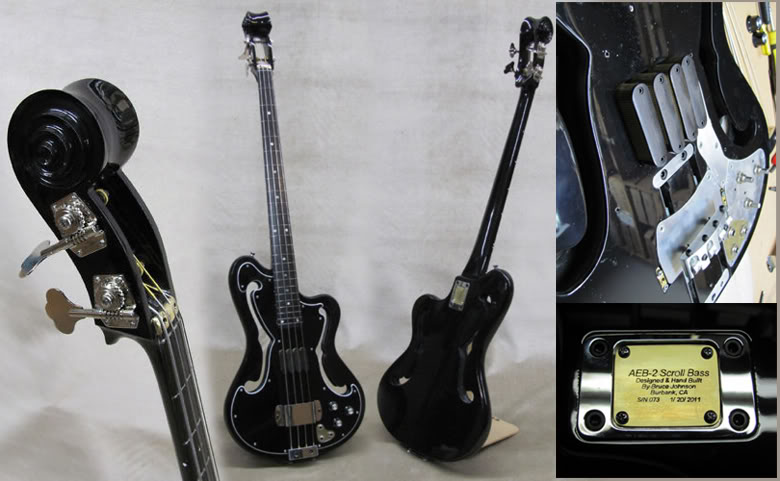
Can that be made by stacking and lapping material?
Yes that's what sparked the idea, but I was also thinking about using it for a standard bass, they seem to be working well for the CBG too, the baritone is strung with a heavy set of flats and other then one of the the tuners not being able to handle the stiffness of the core and stripping the gear. We're also talking half the tension of a standard bass neck.
I think that would work for what I'm thinking of doing and give it a unique look too.
When I see that picture, my mind mumbles "tru bodee", like it's trying to tell me something.

Alright, the issue looks resolved then. But before the thread ends, what about this?
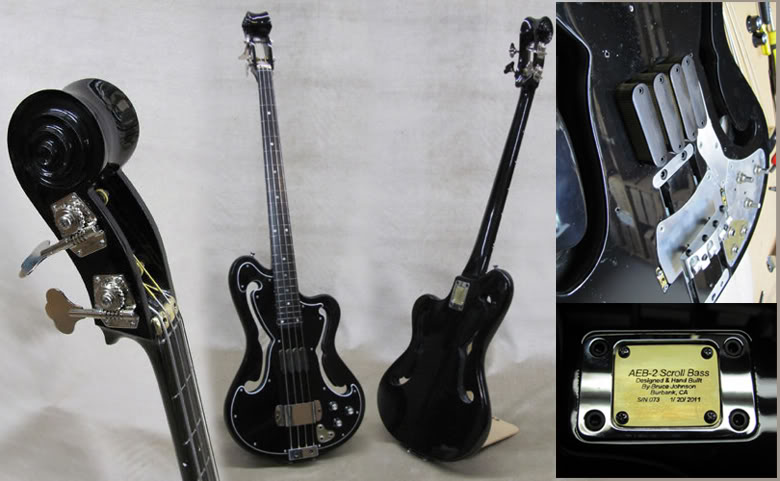
Can that be made by stacking and lapping material?
Hey, that looks familiar! Yes, I build these necks from 5 pieces of maple. The main length of the neck is a 3-piece side-by-side laminate, and the headstock block is two pieces side-by-side. It's a lap style glue joint between the neck and the headstock. The key thing is that there's a long overlapping length to the lap joint. That's what gives it strength.
If you haven't seen it, here's a set of web pages showing how I build these necks:
Building Scroll Basses- Neck 1
On the third page you can see how it goes together. I use West Systems epoxy for all the joints these days.
Hey, that looks familiar! Yes, I build these necks from 5 pieces of maple. The main length of the neck is a 3-piece side-by-side laminate, and the headstock block is two pieces side-by-side. It's a lap style glue joint between the neck and the headstock. The key thing is that there's a long overlapping length to the lap joint. That's what gives it strength.
If you haven't seen it, here's a set of web pages showing how I build these necks:
Building Scroll Basses- Neck 1
On the third page you can see how it goes together. I use West Systems epoxy for all the joints these days.
Nice!
Would it be possible and desireable to make one of those where the face of the headstock is closed?
Do you think it would be feasible to instead start with a one piece wide neck blank that is the entire length of the neck from heel to tip of headstock then build up the headstock? Let's say it's no more than an inch think, milled. Then build up the back of the head stock area with three pieces, ~1/2" thick each piece. Then hallow out the back of the head stock and shape the sides of the head stock so the tuners will fit on the side of the head stock, without opening the face of it. Then drill holes so the strings can pass through to the tuners. It's kind of the equilvalent of passing the strings through the body. Call it through head stock I suppose. Could that work?
I guess I'm thinking of the headstock as a sort of box. Hmm, what about stacking altoid cans?
Oh, and what about a 5 string?
Last edited:

Yeah, but - Bruce has a separate "separator nut" on those, which have a fairly generous radius, and then a zero fret. And the separator nut is at a well-considered height with respect to the zero fret, in addition to its radius. So the speaking part of the string is not subjected to any weirdness or "float" from the extreme break angle, since it's distributed and smoothly transitioned. If you had that kind of break angle going to a conventional nut with no zero fret, you would have the problems that I pointed out.Is that enough string break angle for ya?
Yeah, but - Bruce has a separate "separator nut" on those, which have a fairly generous radius, and then a zero fret. And the separator nut is at a well-considered height with respect to the zero fret, in addition to its radius. So the speaking part of the string is not subjected to any weirdness or "float" from the extreme break angle, since it's distributed and smoothly transitioned. If you had that kind of break angle going to a conventional nut with no zero fret, you would have the problems that I pointed out.
Yes, the slots in the "separator nut" are shaped carefully. These basses are designed specifically for flatwounds, and flatwounds have definite minimum radiuses to which you can bend them. The way I make it, the string takes about a 5 degree bend over the zero fret as it passes into the nut slot. That's about what you want to keep enough pressure on the zero fret without doing weird things to the string. Then the slot in the nut curves down at a radius, aiming towards the center of the tuner post. The outboard E and G string slots also angle inwards in two axes to aim the string right. The string has to be able to slide smoothly through the steep curved path, or there would be tuning problems. I cut the slots a good bit wider than I would on a conventional nut. I rough cut the slots with a bandsaw and finish shaping them with BEAD width nut slot files.
This is another of those tricky little problems that you have to figure out when building this type of headstock. There are many more, particularly if you try to make them small and thin walled, like mine. I've been building these Scroll Bass necks for 18 years now, about a hundred of them, and I went through a lot of R & D in the early years. Much more engineering and labor is needed than a conventional headstock. That's why you rarely see them on production instruments. Too expensive and risky.
Last edited:
I was trying to figure out how this turned into a discussion on the break angle that a string comes off the nut. I see where it went a skew. The diagram that Hopkins drew up is not in alignment with what the OP was asking. I think the OP was questioning doing something as pictured in his post #51 in this Cigarbox Style Bass Build etc.. What the OP is suggesting is similar to but not like what Hopkins drew up.
Ok, so then there's 2 points of discussion.
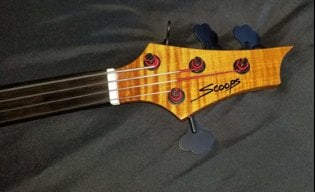
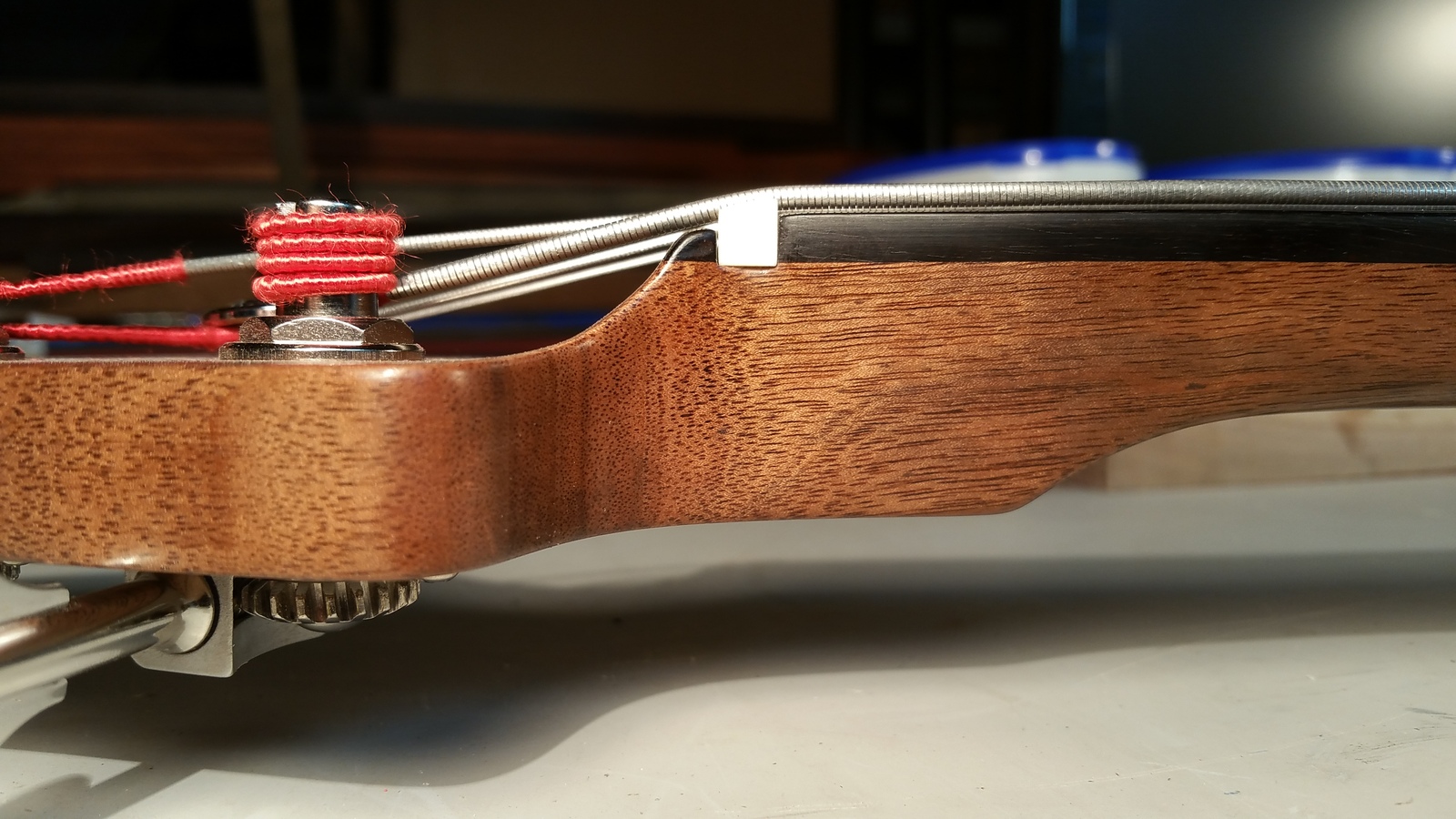
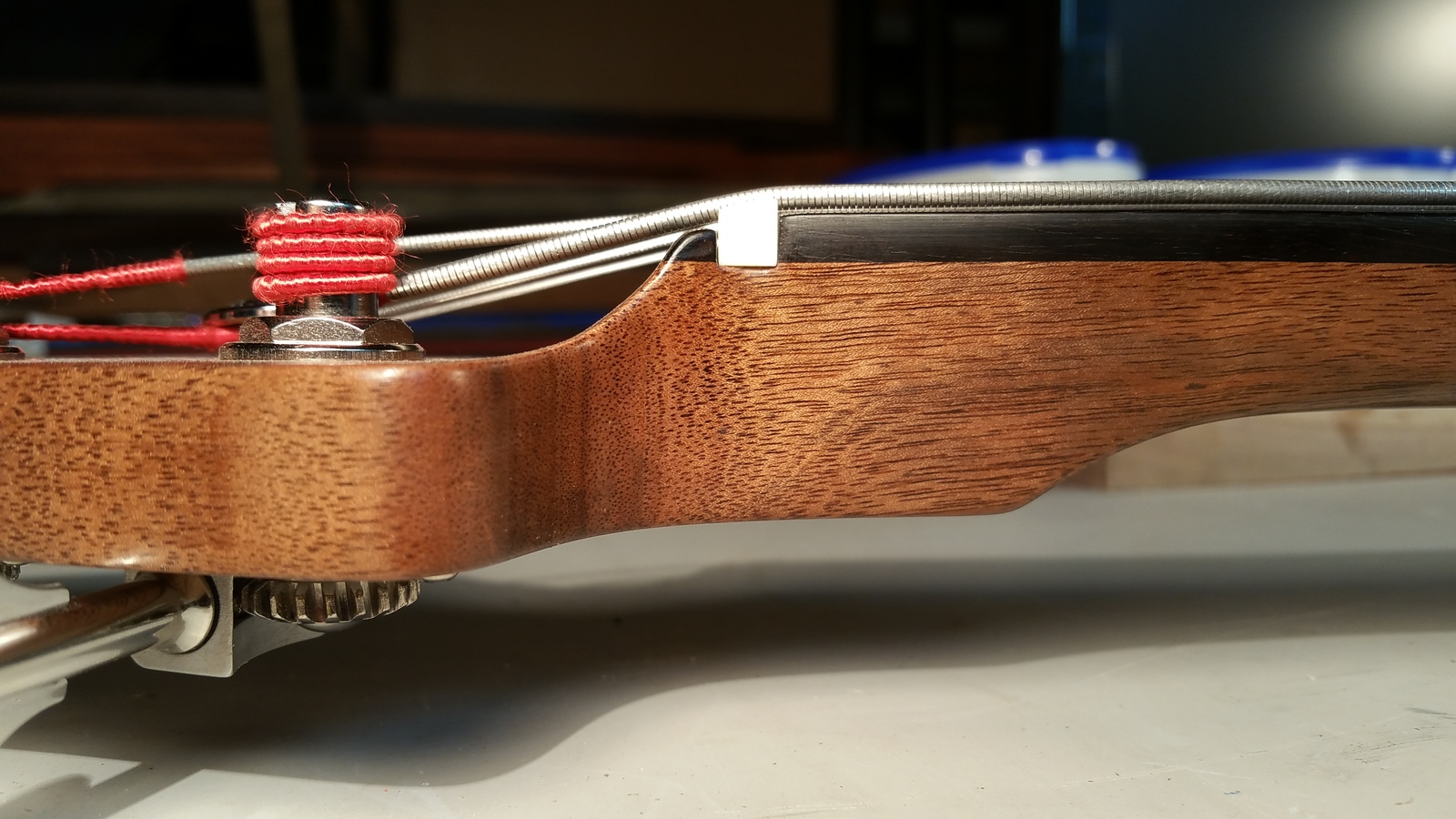
1) Break angle - Some have suggested that the angle would be too steep. In the pic below, I have been consistently making break angles as shown. The E string is @ 14 degrees. No Issues. What's too steep, and will the OP hit that angle? These are the 2 big questions. I have heard of people going up to 18 degrees.
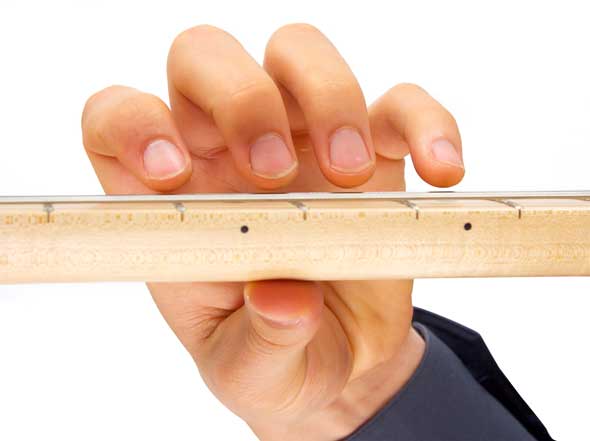
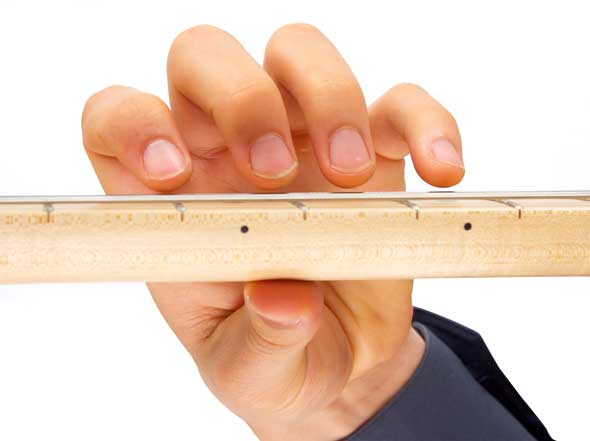
2) Volute - To make for a stronger lap joint, the OP will probably have to move the volute forward. I bring my volutes forward. This one is set so that it starts it's radius at @ the first fret. For those that don't like this, fine, I get it. However I conform to the proper hand positioning as shown in the second pic. Notice that this persons thumb comes nowhere near the volute if playing on the first fret, so this kind of volute is perfectly acceptable for me.
If any one has an idea of what the maximum break angle is, it would be nice to capture it here in this post
Ok, so then there's 2 points of discussion.
1) Break angle - Some have suggested that the angle would be too steep. In the pic below, I have been consistently making break angles as shown. The E string is @ 14 degrees. No Issues. What's too steep, and will the OP hit that angle? These are the 2 big questions. I have heard of people going up to 18 degrees.
2) Volute - To make for a stronger lap joint, the OP will probably have to move the volute forward. I bring my volutes forward. This one is set so that it starts it's radius at @ the first fret. For those that don't like this, fine, I get it. However I conform to the proper hand positioning as shown in the second pic. Notice that this persons thumb comes nowhere near the volute if playing on the first fret, so this kind of volute is perfectly acceptable for me.
If any one has an idea of what the maximum break angle is, it would be nice to capture it here in this post
Last edited:
I was trying to figure out how this turned into a discussion on the break angle that a string comes off the nut. I see where it went a skew. The diagram that Hopkins drew up is not in alignment with what the OP was asking. I think the OP was questioning doing something as pictured in his post #51 in this Cigarbox Style Bass Build etc.. What the OP is suggesting is similar to but not like what Hopkins drew up.
Ok, so then there's 2 points of discussion.
1) Break angle - Some have suggested that the angle would be too steep. In the pic below, I have been consistently making break angles as shown. The E string is @ 14 degrees. No Issues. What's too steep, and will the OP hit that angle? These are the 2 big questions. I have heard of people going up to 18 degrees.
2) Volute - To make for a stronger lap joint, the OP will probably have to move the volute forward. I bring my volutes forward. This one is set so that it starts it's radius at @ the first fret. For those that don't like this, fine, I get it. However I conform to the proper hand positioning as shown in the second pic. Notice that this persons thumb comes nowhere near the volute if playing on the first fret, so this kind of volute is perfectly acceptable for me.
If any one has an idea of what the maximum break angle is, it would be nice to capture it here in this post
I dont know why, but the pics I posted aren't showing up in the post when I view the post. Can anybody else see them? They show up when I created the post, and edit the post.
Edit: Ok, looks like something went wacko in Firefox
Last edited:
Last but not least we need to answer the OP's original question, will a lap joint be strong enough.
That's a tough one as I don't have any experience in this. Don't think too many people do.
Maybe Will, you could do it and let us know.
That's a tough one as I don't have any experience in this. Don't think too many people do.
Maybe Will, you could do it and let us know.
Scoops
Pics are not showing for me either, so it's not your ffox.
The max break angle depends on the string. The stiffer the string, the lower the max angle before it will float up the string in the first fret area. That's why B and E strings are the worst.
Pics are not showing for me either, so it's not your ffox.
The max break angle depends on the string. The stiffer the string, the lower the max angle before it will float up the string in the first fret area. That's why B and E strings are the worst.
Scoops
Pics are not showing for me either, so it's not your ffox.
The max break angle depends on the string. The stiffer the string, the lower the max angle before it will float up the string in the first fret area. That's why B and E strings are the worst.
It's odd because I can see them on my phone and in IE Exploder.
It did start working in ff
Odd
Second pic shows ok here on Opera, but nothing for the first one, and nothing to click.
Edit: 1st one doesn't show using Chrome either...???
Edit 2: doesn't show on phone either..
The break angle has as much to do with the height of the nut/distance down to the tuner post, as how far/close the tuner is to the nut. I prefer the B and E tuners to be farther away from the nut (allows flexibility in string type/makes to keep the outer wrap off the post), and certainly don't like Fender-style headstocks as the largest string post is jambed up too close to the nut, as well as the post is not perpendicular to the string angle. Nothing to copy there.
Edit: 1st one doesn't show using Chrome either...???
Edit 2: doesn't show on phone either..
The break angle has as much to do with the height of the nut/distance down to the tuner post, as how far/close the tuner is to the nut. I prefer the B and E tuners to be farther away from the nut (allows flexibility in string type/makes to keep the outer wrap off the post), and certainly don't like Fender-style headstocks as the largest string post is jambed up too close to the nut, as well as the post is not perpendicular to the string angle. Nothing to copy there.
Last edited:

Hopkins
Commercial User
The photos are working now. The first pic you posted, while its a bit more extreme than your standard Fender, the plane of the top of the headstock is still in in line with the meat of the neck. A lap joint would have brought that plane down another 1/4 to 3/8 of an inch.
That's probably what I'm going to end up doing, full 34" scale 4 string with 50lbs of tension for each string as an experiment. For the actual build I am planning, I'll probably either do a variation on the half lap and route a reccess or trim it off the face and add another piece on the back to bring it back up to thickness.Last but not least we need to answer the OP's original question, will a lap joint be strong enough.
That's a tough one as I don't have any experience in this. Don't think too many people do.
Maybe Will, you could do it and let us know.
That's probably what I'm going to end up doing, full 34" scale 4 string with 50lbs of tension for each string as an experiment. For the actual build I am planning, I'll probably either do a variation on the half lap and route a reccess or trim it off the face and add another piece on the back to bring it back up to thickness.
If you choose to stay with that headstock style, having ALL the strings pull at the angle they are in Scoops 1st photo in post #51 (except for that A string) you shouldn't have a problem- strings have a lot of leverage pulling up at the angle of that A string.
Also, the shortest straight grain you have (non-continuous), regardless of config, stepping, etc, will be the weakest point. If you step it high enough, you could add a couple thru-pins to help, but that's more work, weight, mat'l, time trying to make that style work. A shallow, angled scarf joint will allow you to use thinner wood stock (than a straight-thru flat Fender style), have plenty of strength, keep the strings perpendicular to the tuner pegs coming off the nut, NO 'trees, 'rods, etc., and have a good break angle over the nut w/o it having to be 'rigged'.


