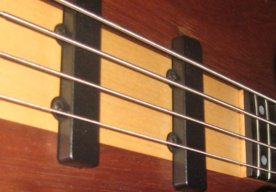
That is a pretty slick piece of craftsmanship. What a cool gift! What's the scale length?
I am currently on a steel hiatus, but I got pretty into it for awhile and I'm sure the itch will come around again. I settled on a Shubb-Pearse SP1 steel, which has the fluted sides like the wood/metal one posted above...but with a rounded bullet nose like a pedal steel bar, so you can tip it up on its nose for single-string or double-stop moves. I think it's chrome-plated brass, but it might be steel. I've tried the ones without the bullet nose and you can do the same stuff with them, but I think the rounded nose makes it easier. I can't seem to hold onto the cylindrical bullet-nose ones.
I use bare fingers, no picks. I can't use fingerpicks on guitar either, and I don't like the way the note attacks come across when I use a flatpick on the steel. I like the darker, rounder attack of bare fingers.
I generally dislike distorted steel, because--rightly or wrongly--it immediately makes me think of distorted slide guitar beer commercials. Singing, sustainy clean pedal steel tones are what I try to achieve, and--in my limited-skills kind of way--I try to emulate simplified versions of the pedal moves and steel-type close intervals. For instance, bending and releasing one string (behind the slide) of a chord to emulate one of those suspension tricks the pedal steel guys do...raise the third to the fourth in a major triad, then release, etc.
I have messed around in C6 tuning and there's a lot of instructional material available for that one, but most of my playing has been in Dobro G (G B D G B D--or 1 3 5 1 3 5, low to high) which forces you to slant the bar and do string pulls and stuff to achieve a minor chord (or just play a minor third along with other instruments) but it's pretty resonant and easy to do in-tune-sounding simple stuff.
Since I lack pedal steel chops and western swing vocabulary, but identify with the pedal-steel end of the spectrum, I find myself trying to achieve that kind of feel with single-note melodic stuff or two-note harmony stuff...thirds, sixths...it puts a sustainy countryish texture in otherwise non-country things and that seems to please my ear. If you want to do bluesy or rock-sounding distorted stuff, you might like something like open G (D G D G B D), D (D A D F# A D), E (E B E G# B E) or A (A E A C# E A) tuning, so you can distort it and access that sort of guitar Drop-D sounding lower string power chord sound. Note that all of those are 1 5 1 1 3 5 intervals except open G, which is 5 1 5 1 3 5...I think that's because that arrangement is easier to achieve on a guitar without blowing its neck into outer space from excessive string tension. On a lap steel, I think you are less at risk of that.
I have never liked playing steel through dirty-toned amps. I like it clean, bright (my steel is kind of dark and midrangy, and I play bare-fingered) with a little compression and reverb. A compressor pedal into my Peavey Special 150 1 x 12 amp (basically a Bandit with twice the output stage) is perfect for what I like to hear. The one time I had a successful lap steel recording experience, I used two amps together that were sitting around at the studio...a Fender Princeton Chorus and a Fender BXR200 bass amp. Sounded huge and clean and glistening into a single condenser mic a few feet out in front. But either of the amps sounded pretty good alone, too.
My point is, unless you want a really trick amp (to go with looks like a pretty trick steel), just try stuff until you find something that sounds right to you. For now, focus on your hands and your ears...you've got your work cut out for you, but it's worth the effort! It's going to sound like a dying housecat for a little while. Don't get discouraged. Your hands will learn if you keep at it. Also, wear shoes. You will drop the steel on your foot, and it can hurt.
edited for length...honest





 )
)