Thanks again everyone, for your high praise.
Yeah, this was another aspect of this build I had to think about, while I was putting it together. I'll say that I didn't really want 24 frets but that's what Carvin makes, so I went with it. For a while I though to shave off the last few frets which would allow a proper neck pickup position, and a shorter reach to the first few frets. I have long arms, but they do have limits, and I could have moved the body panels further up. However, since I didn't build the neck, I had no idea where the truss rod ended, and didn't want to ruin the whole neck based on conjecture.
In my first build, the Reformer, I used the same neck and indeed took advantage of the deep cutaway on the lower body wing. It also helped that the original body design was made for a 24 fret neck. But that also seriously impinged on the pickup locations, and I didn't want to make it worse on this build. I rarely use the frets up that high anyway - maybe hitting a high "E" once in a while, and don't really mind the body/neck positioning on this build. I also didn't want to make this bass any longer. The Reformer came out pretty long and as a result, won't fit in a standard case. I ended up making one for it. I wanted to be able to use a standard size case for this build, so went with the current design.
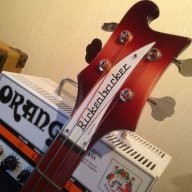
Yes, without your input, I'd still be struggling with tuning machine selection, and trying to figure out how to extend those top two tuner stems. Thanks for the suggesting and rough draft of that head stock design. That made a huge difference in the outcome of this build.
Unfortunately, I started doing a setup as soon as I glued in the magnets and TRC, and ended up putting too much pressure on the glue connection before it was fully cured. Second verse, same as the first, with some changes based on yesterday's experience. The first thing I did was to loosen the middle two string to provide a little clearance in which to work.
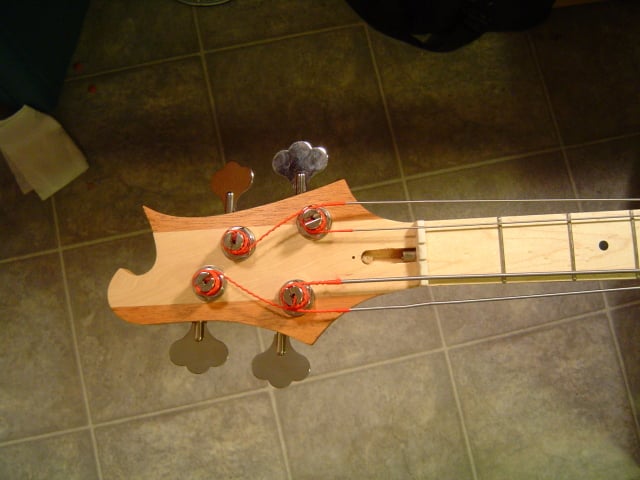
Then I took the dremel and flattened out the dowel piece still glued in the truss rod cavity. It was a little canted toward the nut, and pretty roughed up with the remaining glue.
Then I stuck the magnet onto a hex bit, put a little glue on the dowel, and pushed tight for about 60 seconds.
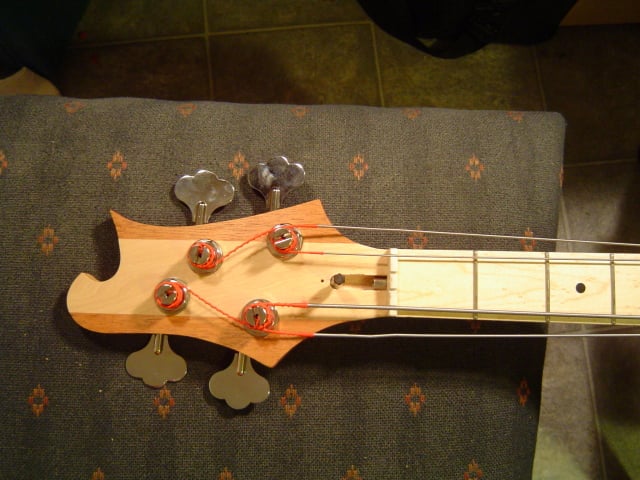
I'll let that cure for a while, maybe even over night, before I start gluing the other magnet to the TRC. I don't want the same thing to happen again. I'm not even going to try to pull off the hex bit, in fear of it pulling off the magnet from the dowel. These are neodymium magnets, and are surprisingly strong for their size.
So I've got a pretty full plate these days. The guitarist left my band, so the drummer and I are auditioning a new guy this weekend. And I want to refinish my SVT cabinet as well. I'll begin that on Saturday. And we have a new song list, so I have to get working on that. It might be best to wait until we pick a guitarist, and just record the practice. I could post that here which would solve a few requests for the sound/video clips.
In the mean time, I have to start on dinner
Again, thanks to everyone who offered their suggestions, input, feedback, and support with this build. I can honestly say that it never would have happened without you all.
I think that given that this bass has a 24 fret neck, it would have been nice to see the cutaways brought in deeper for better fret access, and perhaps the whole lower bout moved rearward an inch or so. Then the whole bass would have been as evolved as the headstock.
Yeah, this was another aspect of this build I had to think about, while I was putting it together. I'll say that I didn't really want 24 frets but that's what Carvin makes, so I went with it. For a while I though to shave off the last few frets which would allow a proper neck pickup position, and a shorter reach to the first few frets. I have long arms, but they do have limits, and I could have moved the body panels further up. However, since I didn't build the neck, I had no idea where the truss rod ended, and didn't want to ruin the whole neck based on conjecture.
In my first build, the Reformer, I used the same neck and indeed took advantage of the deep cutaway on the lower body wing. It also helped that the original body design was made for a 24 fret neck. But that also seriously impinged on the pickup locations, and I didn't want to make it worse on this build. I rarely use the frets up that high anyway - maybe hitting a high "E" once in a while, and don't really mind the body/neck positioning on this build. I also didn't want to make this bass any longer. The Reformer came out pretty long and as a result, won't fit in a standard case. I ended up making one for it. I wanted to be able to use a standard size case for this build, so went with the current design.
yep - thanks!
Yes, without your input, I'd still be struggling with tuning machine selection, and trying to figure out how to extend those top two tuner stems. Thanks for the suggesting and rough draft of that head stock design. That made a huge difference in the outcome of this build.
Unfortunately, I started doing a setup as soon as I glued in the magnets and TRC, and ended up putting too much pressure on the glue connection before it was fully cured. Second verse, same as the first, with some changes based on yesterday's experience. The first thing I did was to loosen the middle two string to provide a little clearance in which to work.
Then I took the dremel and flattened out the dowel piece still glued in the truss rod cavity. It was a little canted toward the nut, and pretty roughed up with the remaining glue.
Then I stuck the magnet onto a hex bit, put a little glue on the dowel, and pushed tight for about 60 seconds.
I'll let that cure for a while, maybe even over night, before I start gluing the other magnet to the TRC. I don't want the same thing to happen again. I'm not even going to try to pull off the hex bit, in fear of it pulling off the magnet from the dowel. These are neodymium magnets, and are surprisingly strong for their size.
So I've got a pretty full plate these days. The guitarist left my band, so the drummer and I are auditioning a new guy this weekend. And I want to refinish my SVT cabinet as well. I'll begin that on Saturday. And we have a new song list, so I have to get working on that. It might be best to wait until we pick a guitarist, and just record the practice. I could post that here which would solve a few requests for the sound/video clips.
In the mean time, I have to start on dinner
Again, thanks to everyone who offered their suggestions, input, feedback, and support with this build. I can honestly say that it never would have happened without you all.


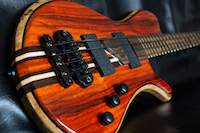



 ) to the cover, and let that set up for a while. Of course, I could make a new truss rod cover out of metal...