• TalkBass has been independent since 1998. Add your voice.
    Create a free account to reply to discussions, view embedded media, and browse with fewer display ads.
    Join freeLog in
    Want zero display ads or expanded classifieds tools? Compare plans.

Learning bass as an nth instrument

Hey TBers! First time posting here. It's been a longtime goal of mine to learn to play bass, and I wanted to get some input on how to approach this as someone with a fair amount of musical experience.

For reference, I've been playing piano for over 20 years (mostly classical, some jazz), so I read and know theory. I've been playing mandolin off and on for the last ~8 years, and I started taking mando lessons at the beginning of quarantine. Fretboards are still somewhat mystifying to me, but I'm getting there :D

Seems like a lot of beginner method books (for most instruments, not just bass) start off with lessons like: "What are notes? What's a scale?"

If you've been in a similar position, what were some resources that helped you skip past the beginner theory, build technique, and just start playing?
 
  • Like
Reactions: Bassic_desires
Perhaps this will be of help:
D4861922-71BB-47F4-A64F-BFEA682D0BF8.jpeg
 
Welcome to TalkBass! My advice is to take some of your favorite piano pieces, and play the left-hand (bass clef) parts on your bass. For example I am a huge Bach fan and think he wrote some great bass lines. :)

One very important thing to remember is that bass is a "transposing instrument" that sounds 1 octave lower than written. So when you play piano music on bass, usually you want to transpose it an octave. A lot of people incorrectly think they need to buy a 5-string bass to play piano music, not realizing the transposing thing.
 
Honestly learning a fretboard is the same as learning a keyboard. There are two right ways to do it. Scales and arpeggios. And, scales and arpeggios.
You also need to do metronome work. Focus on SLOWSLOWSLOWSLOW exercises emphasizing an effort to keep your articulation consistent; notice how each degree of motion, the slightest change in plucking angle or position, the roll of your fretting fingers, your posture in shoulder and waist, etc., all add up. Trust me if you don't sound good playing slowly you DON'T sound good playing fast.

As for understanding your nth instrument's role, as a keyboard player you may struggle with the "less is more" but truly, it's everything. Bass players play strings of sixteenth notes sometimes, too, but.....it's usually one pitch. The root. Consistent and convincing delivery of every rhythmic, harmonic, and structural motif is what it's your job to deliver; not the "wow" factor that other instruments are designed for. The fluid, chaotic roles of melody, hook, and lead, perform the acrobatics above our steady static support.
 
Ok skip all that theory stuff, you already know it a C is a C, a G is a G.

What exactly is the difficulty with the fretboard?

It doesn't really have the sensible layout of the keyboard (you can alter the tuning to Tritones, to gain symmetry but I wouldn't recomend it), you do have to learn the locations of the notes if you want to apply you previously gained knowledge and concepts.

When I started, I just jammed with folks older and better than me. I taught myself to read and music theory.
 
  • Like
Reactions: pipaberg
Traditionally, most people learn electric bass just by playing along to rock/pop songs they like, not through any formal method. There are lots of play-along books out there for different bands/artists/genres, and if you want a bit of guidance, YouTube probably has at least one video of someone doing a bass play-along for almost every rock/pop you could possibly want to play. If you're not sure where to start, I would suggest Beatles songs. Paul's basslines are usually quite easy to play but still musically interesting. Once you have got some songs under your belt and had a good deal of fun in the process, then maybe think about approaching the instrument in a more formal, rigorous way, if that is what you want. But it is worth remembering that many well-known rock/pop bassists, including Sir Paul, have had minimal formal musical training of any kind. Exceptions would include Jack Bruce, John Entwistle, John Paul Jones, Phil Lesh.
 
Welcome to TB @standing_wav (nice handle btw)

Recently I started singing lessons which began by learning how to correctly hold the instrument (my body).

This reminded me how much effort I put into unlearning my self-taught approach to bass after being shown good posture and technique by a professional bassist (also a reformed pianist) who explained the importance of the physical movements of playing (eg. "walking fingers") to achieve good timing and correctly find and fret notes.

I'd suggest that without the correct posture and technique, you'll likely hit a wall sooner than later.

The same teacher also said bassists have just one job:
"Serve the song"
And as you'd know, there are some songs that only need I & V.

However, I believe it's more important than anything else to find an instrument you love playing; zen out, become one and enjoy the journey!
 
  • Like
Reactions: S-Bigbottom
If you already know your theory and want to get into playing bass to accompany other instruments, you can probably skip scales and get right into learning arpeggio patterns. There are two great Scott’s bass lesson videos where he teaches two different exercises for learning common arpeggios moving up the fretboard and then playing them all in one position. (I can’t find them, maybe someone can help.)
But learning them will be a huge help to you to learn to play a “bass guitar” since it sounds like you already know how to play “bass” with your left hand on a keyboard.
 
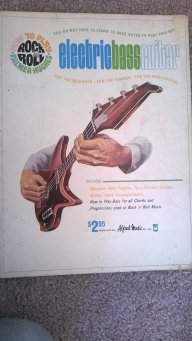
Simandl's New Method of Double Bass is mostly applicable to bass guitar, but weirdly there just does not exist a good method series for bass guitar.

If you are already familiar with classical repertoire, you might think the Zimmerman orchestral excerpt books are fun. I think they are fun to play to play on electric bass.

But, you know, electric bass is really all about sitting down with your headphones and figuring out how to play a bass line from the recording. So definitely work some transcription into your practice routine, because that is a core skill for the instrument.
 
You know enough theory already; more of that won’t help you much.

Unless your goal is to always play by reading music (not how most bass guitar is done), what you need is ear/hand coordination - what to play when. That doesn’t come from a book, it comes by playing along with music, and learning to play something that fits and helps drive the music.

Coordination is also important. My 5 string, 22 fret basses have 110 possible places to play a note - more than a piano. A given note only occurs in one place on a piano; on a bass it shows up 1,2,3,4, or even 5 places, depending on the note. Where you play it is a combination of where the notes are around it, and how you want it to sound. You won’t find that info in a book.

Technique is also important. On a piano, there are two parameters/ degrees of freedom - when and how hard are all you have. Plucking a string on a bass, while it may seem simple, has a lot more degrees of freedom - where on the string you pluck, what part of the finger or thumb you use, what direction you pluck, etc. Again, this is not stuff you’ll find in books - it comes from playing.

You need... to play. Proficiency (where the notes “fall under your figers”) and feel come from repetition. 42 years after starting, I’m decent at all this. Given another 42 years, I might master this.
 
Hey TBers! First time posting here. It's been a longtime goal of mine to learn to play bass, and I wanted to get some input on how to approach this as someone with a fair amount of musical experience.

For reference, I've been playing piano for over 20 years (mostly classical, some jazz), so I read and know theory. I've been playing mandolin off and on for the last ~8 years, and I started taking mando lessons at the beginning of quarantine. Fretboards are still somewhat mystifying to me, but I'm getting there :D

Seems like a lot of beginner method books (for most instruments, not just bass) start off with lessons like: "What are notes? What's a scale?"

If you've been in a similar position, what were some resources that helped you skip past the beginner theory, build technique, and just start playing?

What is a "nth instrument"?
 
Unlike a piano, there is less mechanical certainty to playing a note on a bass guitar. A piano key can be hit hard or soft, but the player has little effect on the sound and quality of the note.

Practice playing along to easy stuff that gets you making the notes sound good with muting, sustain, and plucking/picking.

Learn the octaves.
 
Until you get some facility on the fretboard, nothing else will matter. So those who have spoken about correct technique (including posture) are the starting point. And just as on a piano where fingerings matter, they matter on the fretboard. So exercises to develop finger strength (along with coordination between the hands) are important. Those include simple 1-2-3-4 (index, middle, ring, pinky) across the fretboard and progressively up and down the fretboard. Then 1-3-4, 1-2-4, 1-4, 2-4, etc.

Accompany that with simple, beginner-book reading exercises. Simple melodies. That way, as your finger strength develops so will your bass-reading skill.

As you get better at that and start to move to more complex melodies, you will begin to need the skill of arpeggios. That’s when you start doing arpeggios as finger exercises, up and down and across the neck. Do those to written exercises, so that again you are playing the notes as you see them on the staff.
 
  • Like
Reactions: standing_wav