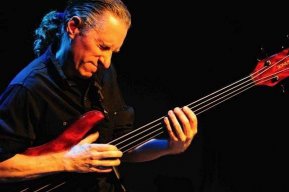
Removing in-piece retuning from the equation, whether it be Mr. Manring or other Hyperbass players, there seems to be a stylistic commonality including melodic phrasing, thumb and multi-finger technique and the extensive use of harmonics present when reviewing videos and music samples available on the internet.
At some point, I would like to purchase a Hyperbass and explore this style to it's fullest. Until then, what path of learning would anyone recommend to build a solo style on a "fixed-tuner" fretless bass to prepare one to take the final step to Hyperbass?
Frankly, while I understand the importance of playing in "the groove", I have no immediate attentions of playing in a group setting and have gravitated toward Hyperbass players based on the solo capabilities of the instrument.
At some point, I would like to purchase a Hyperbass and explore this style to it's fullest. Until then, what path of learning would anyone recommend to build a solo style on a "fixed-tuner" fretless bass to prepare one to take the final step to Hyperbass?
Frankly, while I understand the importance of playing in "the groove", I have no immediate attentions of playing in a group setting and have gravitated toward Hyperbass players based on the solo capabilities of the instrument.