• TalkBass has been independent since 1998. Add your voice.
    Create a free account to reply to discussions, view embedded media, and browse with fewer display ads.
    Join freeLog in
    Want zero display ads or expanded classifieds tools? Compare plans.

Learning to Read...

One of my (musical) New Years resolutions is to work on my reading, and specifically my jazz bass playing. I’m a long-time trumpet player- so I’m a pretty strong treble clef reader. But as a self-taught bassist my bass clef is very slow going...

So I got some books!
A570AAC8-B85C-44AC-B309-28A89CB727B9.jpeg A0F25F15-C57D-4C56-87AC-3A28969B8100.jpeg 6B619056-0590-49D8-BD21-50A4B5E191AD.jpeg

I try to practice 30-60 minutes a day, so I’ll do 10-15 minutes on these reading exercises each session. Sometimes it can be really hard to crack that book open and start dead cold on a piece I’ve never seen. But it’s so satisfying to go from “I got a rough idea what this sounds like” to “I can play this up to tempo” to “memorized!” :D

here’s my exercise for this week, from the Aebersold blues book:
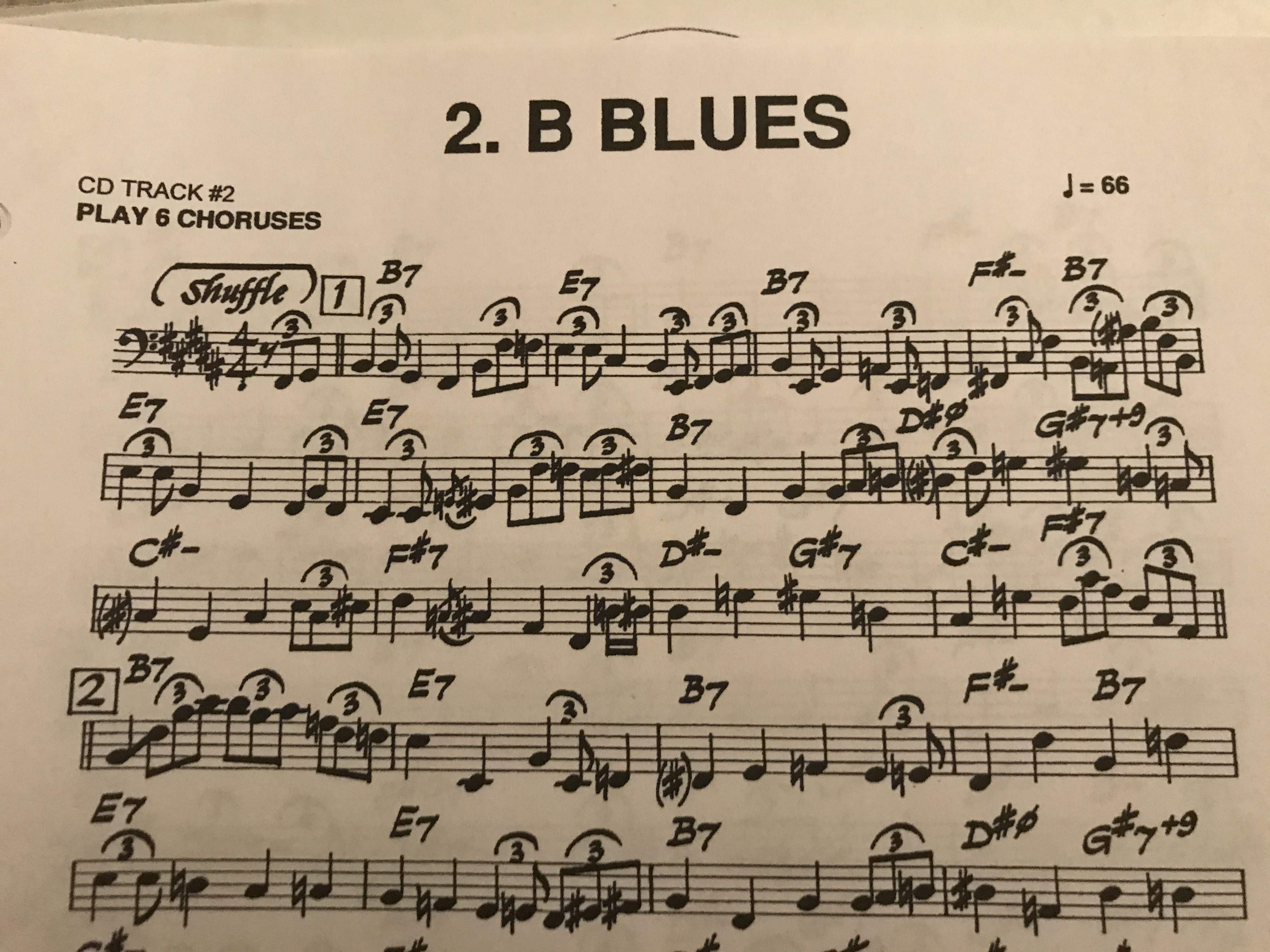
5CF6A87A-8446-402F-A697-20A8D8B3E800.jpeg

this chart is 6 choruses of the blues, but it’s tough enough for me, I’m just focusing on one chorus this week! :wacky:
I’ve just started this one last night, and I’ve already got a good handle on it. Very exciting!
:hyper:

So- anyone else in my shoes? How’s it going? What do you do to get better at reading?
 
Learning to read music is like learning to read a foreign language. There's really no shortcut. You just gotta do a lot of it.

And further, like a foreign language, it's better learned as a mode of communication rather than an solitary experience. Get with others who are learning to read, or get in a group that performs from sheet music. Big Bands, church groups (some), community anything are good examples. Or, get some music together, a group of similarly experienced players, a couple beers and have a great evening playing together.
It's tough to keep the motivation going by yourself and without specific goals and a time frame.
 
And further, like a foreign language, it's better learned as a mode of communication rather than an solitary experience. Get with others who are learning to read, or get in a group that performs from sheet music. Big Bands, church groups (some), community anything are good examples. Or, get some music together, a group of similarly experienced players, a couple beers and have a great evening playing together.
It's tough to keep the motivation going by yourself and without specific goals and a time frame.
Thanks! Great ideas

I’m in 2 gigging cover bands, playing blues, rock, r&b, jazz, country, folk and bluegrass. I’ve learned and developed bass lines from a combination of learn-by-ear, chord charts, YouTube lessons and tab.

In Jazz specifically, I use chord charts, and rely mostly on arpeggios. I’m not trying to play a ton of jazz, but believe this study will make me a better musician. Sometimes when our drummer can’t make it, the guitarist and I will just play real book charts. (Songs he knows, most are sight reading for me.)

So my short term goals will be to a) learn jazz transcription, to apply new patterns and licks to jazz charts; and b) read transcription for new cover songs (eg the Jamerson book)
 
So- anyone else in my shoes? How’s it going? What do you do to get better at reading?
You are ahead of me. I can read SN, but, never are handed SN by any director I play for so I really get on time with SN. And it's not a big thing with me. All the music handed out is fake chord.

Like you I use both fake chord and Nashville numbers, depending on the music I'm playing. Scale degree notes fill out when fill out is needed.

My point; as others have said if you want to play from SN you have to play (or read) SN every day or rust happens. Take some sheet music with you and get some reading in when ever you have a chance.

Keep going and good luck.
 
Last edited:
  • Like
Reactions: alanloomis1980
So- anyone else in my shoes? How’s it going? What do you do to get better at reading?

Practice, Practice and in your spare time practice.
(PS I'm a life long brass player)
If you read already youre more than half way there.

Try learning bass clef first, try taking ANY BC music with you, every day and everywhere, in a spare few minutes just look at it to learn the notes. When you can sight read ANY BC music in your head then try putting it to the BG. That way you only be faced with one challenge at a time.

I played several brass instruments and had forgotten that I transpose as I read. So on BG being "concert" I had to start again learning BC. I tried to cheat by using TAB. It was that old adage, walk backwards, pay your head, chew gum etc.

So since breaking it down to knowing what note I need to play, I just had to work out which finger on which fret.

ENJOY and don't forget to practice.
 
  • Like
Reactions: alanloomis1980
Thanks guys!


You are ahead of me. I can read SN, but, never are handed SN by any director I play for so I really get on time with SN. And it's not a big thing with me. All the music handed out is fake chord.

Like you I use both fake chord and Nashville numbers, depending on the music I'm playing. Scale degree notes fill out when fill out is needed.

My point; as others have said if you want to play from SN you have to play (or read) SN every day or rust happens. Take some sheet music with you and get some reading in when ever you have a chance.

Keep going and good luck.
I don’t ever imagine being in a situation where I’ll be handed bass lines in SN. My main goal is to increase my understanding of walking jazz, build my stock of licks, and make my lines more “mature.”

So- anyone else in my shoes? How’s it going? What do you do to get better at reading?
Practice, Practice and in your spare time practice.
(PS I'm a life long brass player)
If you read already youre more than half way there.

Try learning bass clef first, try taking ANY BC music with you, every day and everywhere, in a spare few minutes just look at it to learn the notes. When you can sight read ANY BC music in your head then try putting it to the BG. That way you only be faced with one challenge at a time.

I played several brass instruments and had forgotten that I transpose as I read. So on BG being "concert" I had to start again learning BC. I tried to cheat by using TAB. It was that old adage, walk backwards, pay your head, chew gum etc.

So since breaking it down to knowing what note I need to play, I just had to work out which finger on which fret.

ENJOY and don't forget to practice.
I’ve taken a few piano lessons; so I have that as a foundation but I’m still very rusty. It might be beneficial to read some very rudimentary lines, like hymnals. That hungerford book is also much easier than the Aebersold, it’s just quarter notes.
 
I don't ever expect to sight read and will never be in a situation where I need to, but I've been trying to seriously learn to read bass clef for the last year (to learn bass lessons out of books) and am now moving to treble clef so that I can read the melodies on real book charts my jam pals bring to play dates.
 
  • Like
Reactions: alanloomis1980
I was also a long-time trumpet player before coming to bass. I like the advice above about practicing reading the notes without your instrument first - then when you're comfortable with that you just have to connect the notes you're reading to the bass. I would also suggest simpler tunes if you're just learning and making slow progress. More half notes!
 
  • Like
Reactions: alanloomis1980
I was also a long-time trumpet player before coming to bass. I like the advice above about practicing reading the notes without your instrument first - then when you're comfortable with that you just have to connect the notes you're reading to the bass. I would also suggest simpler tunes if you're just learning and making slow progress. More half notes!
The other book (Hungerford) looks like this:
FC2D79D5-2B25-4ADC-A8EE-D6C3795F07B0.jpeg

so, much easier than what’s in the Aebersold. I’ve tackled 4-5 charts from the first book. So far working on the Aebersold has been exciting, not frustrating, so I think I’m ready. :D
but I’ll definitely be mixing it up, using simple stuff as well to build my literacy.
 
What do you do to get better at reading

I like to isolate rhythm from pitch. I often say the great thing about isolating rhythm is you don't need an instrument. You can tap , clap, vocalize whatever. A few years ago I spent 2 gym days a week on a treadmill with my rhythm exercises in front of me. My running pace became the metronome. My rhythm reading improved significantly!

For pitch I had always assumed I needed an instrument, but recently had an epiphany while using Solfege singing ( do re mi ...) to preactice melody recognition. In college I was able to pass the ear recognition test of the 12 isolated intervals - but that gave me nothing in terms of really undertandinga melody in context. I want to reach the point where I can recognize the intervals of a melody against a diatonic chord progression, Like this:


But I struggle to recognize the patterns of sequences of intervals -melodies.

So what I did was start simple: Do Mi So , a major triad arpeggio. I have an app on my phone that can drone a
major chord, so on my commute I practiced singing sequences using only these three notes and hearing them against the chord. ( don't for get to descend too) A week later I added Re...I'm currently working on Do Re Mi So La, the major pentatonic.

In the midst of doing this I realized: If I know the solfege notes, I can visualize the notation as well.
Do - Re is a space + the line above or vice versa
Do - Mi is line+the line above or space +the space above
and so on. So, as I practice singing and hearing, I am also visualizing the pitch notation

All without any instrument.
 
  • Like
Reactions: alanloomis1980
The first sample, B blues from the Aebersold book looks to be a good practice for me. Back to back triplets etc, in not so friendly keys would be a streach for me to read This kind of practice might do me good. What is the exact name of this publication? I'd like to struggle through it. The second example from the Hungerford book, I can read without struggle. thanks!
 
  • Like
Reactions: alanloomis1980
I like to isolate rhythm from pitch. I often say the great thing about isolating rhythm is you don't need an instrument. You can tap , clap, vocalize whatever. A few years ago I spent 2 gym days a week on a treadmill with my rhythm exercises in front of me. My running pace became the metronome. My rhythm reading improved significantly!

For pitch I had always assumed I needed an instrument, but recently had an epiphany while using Solfege singing ( do re mi ...) to preactice melody recognition. In college I was able to pass the ear recognition test of the 12 isolated intervals - but that gave me nothing in terms of really undertandinga melody in context. I want to reach the point where I can recognize the intervals of a melody against a diatonic chord progression, Like this:


But I struggle to recognize the patterns of sequences of intervals -melodies.

So what I did was start simple: Do Mi So , a major triad arpeggio. I have an app on my phone that can drone a
major chord, so on my commute I practiced singing sequences using only these three notes and hearing them against the chord. ( don't for get to descend too) A week later I added Re...I'm currently working on Do Re Mi So La, the major pentatonic.

In the midst of doing this I realized: If I know the solfege notes, I can visualize the notation as well.
Do - Re is a space + the line above or vice versa
Do - Mi is line+the line above or space +the space above
and so on. So, as I practice singing and hearing, I am also visualizing the pitch notation

All without any instrument.

Thanks, great ideas! Like I said I’m a strong treble reader so rhythm is no issue. But I would definitely benefit from focusing on the notes. I still find I often “translate” to treble clef to know what the note is.

The first sample, B blues from the Aebersold book looks to be a good practice for me. Back to back triplets etc, in not so friendly keys would be a streach for me to read This kind of practice might do me good. What is the exact name of this publication? I'd like to struggle through it. The second example from the Hungerford book, I can read without struggle. thanks!
Invalid Link Removed

There are several books of bass line transcriptions from the Aebersold series!
 

What Ant’s demonstrating there is Miles’ statement that, "It’s not the note you play that’s the wrong note – it’s the note you play afterwards that makes it right or wrong.” But that isn’t what reading standard notation is about. When you play jazz you’d better hit a “wrong” note now and then but if you’re in an orchestra or in the pit, that doesn’t apply.

BTW thanks, mambo4, for that. I’d been looking for it to pass to a friend who’s made his way to intermediate.
 
  • Like
Reactions: alanloomis1980
Alan,
Good choice of books. Are you comfortable with the time value of the notes you are playing?
Thanks Groot!
Any other book recommendations in this vein would be welcome.

you mean comfortable reading the rhythms? Or executing them? I’m on day 2 with this piece, but it feels pretty good. I can’t really play it as a cohesive unit (the whole 12 bars) but an individual measure is comfortable up to tempo.

PS I have the metronome in your avatar :woot:
 
  • Like
Reactions: IamGroot
Thanks Groot!
Any other book recommendations in this vein would be welcome.

you mean comfortable reading the rhythms? Or executing them? I’m on day 2 with this piece, but it feels pretty good. I can’t really play it as a cohesive unit (the whole 12 bars) but an individual measure is comfortable up to tempo.

PS I have the metronome in your avatar :woot:
Great to hear that. The Jamerson book is a great book.
The Latin Bass Book is recommended after tbe Jamerson book, for reading fast straight feel.
 
  • Like
Reactions: alanloomis1980