• TalkBass has been independent since 1998. Add your voice.
    Create a free account to reply to discussions, view embedded media, and browse with fewer display ads.
    Join freeLog in
    Want zero display ads or expanded classifieds tools? Compare plans.

Leo Fender did it best....

Leo Fender was a functionalist, from all I've read. He didn't get into the finer aesthetics so much. Freddie Tavares was the man with an eye for curves and proportions, to the degree that any slight variations on the classic P/J/S trio just look off.

ED: Almost equally classic are the modernist shapes Ray Dietrich, a retired automotive designer, drew for Gibson. Roger Rossmeisl created the Rickenbacker "wave", which continues to attract. EBMM employed BMW's design team for the Bongo, and while it was divisive when it appeared, it's certainly distinctive and memorable.
 
Last edited:
  • Like
Reactions: FantasticFour
In my humble opinion I feel that the jazz and precision body shapes that Leo Fender whittled and honed him self, are by far the most sexy and perfect shapes for the bass guitar - the Strat too body
He just hit it out of the park with those perfect curves and perfect length horns and double cut away, and headstock shape, pick guard shapes accenting the body....NAILED IT!!

And with all the different brands and models made since then, everything has fallen short (ok "fallen short" might be too harsh)....some to the point that they just give up on there own design and get in line and directly copy Leo like all the other's.

The only other body style on that pedestal is the Les Paul....respect due there too.

Just had to blurt my appreciation umungst peers.
My wife and kids don't give two sh!ts one way or the other ;-)

And if you disagree, who/what is your favorite body shape?

Leo did do it right, but it took him a few tries......

IMG_0190.JPG
 
Last edited:
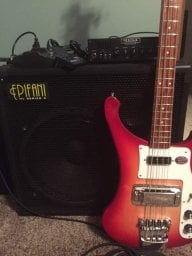
I'll get into what will be a mess early:

View attachment 2759400

Nice curves. Very comfortable. Very light weight. Balances perfectly. By far my favorite headstock of all time.
There ya go!!
I'll take that bad boy over that same old paint,plastic and chrome schema any day!
 
Like this? (No string tree, so I assume the head is tilted in some way

View attachment 2759821

Yeah like that. You can see the head it slightly pitched back. Makes a difference IME. I actually like the idea and look of string trees. It's just that darn A string can get wonky at times depending. Not that it's a problem per say. I have an Ibanez ATK and the head tilts backs so there's no string tree, I'm a fan of that design. But I always wondered how a fender would feel with a tilted headstock. I've installed a second string tree on one of my fenders and a long tree on another. I feel they add some stability to the A. But I guess Fender finally caught on because they started putting that retainer clip on the A tuner on some of the newer models.
 
In my humble opinion I feel that the jazz and precision body shapes that Leo Fender whittled and honed him self, are by far the most sexy and perfect shapes for the bass guitar - the Strat too body
He just hit it out of the park with those perfect curves and perfect length horns and double cut away, and headstock shape, pick guard shapes accenting the body....NAILED IT!!

And with all the different brands and models made since then, everything has fallen short (ok "fallen short" might be too harsh)....some to the point that they just give up on there own design and get in line and directly copy Leo like all the other's.

The only other body style on that pedestal is the Les Paul....respect due there too.

Just had to blurt my appreciation umungst peers.
My wife and kids don't give two sh!ts one way or the other ;-)

And if you disagree, who/what is your favorite body shape?

Leo did it first. but what that was first is still best? car? computer? calculator?
and 2K for a +100 year old mass produced bass is asinine.

I prefer the 4003 shape over the old fender. and refusing to match the head stock color is cheap and lazy.
 
There is such a thing as objective improvements over the first Fender bass designs, such as neck joint design, access to upper frets, dead spots, and weight. There are also numerous examples of superior woodwork and luthier ability. None of that takes away from the greatness, utility, and enterprise of the Fender Co.


512189000645000-00-750x750.jpg


GuildB-301.jpg


Ibanez-SR1400-MLG-Bass-Body.jpg
 
  • Like
Reactions: Gbonus Uralias
There is such a thing as objective improvements over the first Fender bass designs, such as neck joint design, access to upper frets, dead spots, and weight. There are also numerous examples of superior woodwork and luthier ability. None of that takes away from the greatness, utility, and enterprise of the Fender Co.

THE FIRST TIME, I SAY!

Grumpy-Grandpa.jpg
52pb..jpg
 
In my humble opinion I feel that the jazz and precision body shapes that Leo Fender whittled and honed him self, are by far the most sexy and perfect shapes for the bass guitar - the Strat too body
He just hit it out of the park with those perfect curves and perfect length horns and double cut away, and headstock shape, pick guard shapes accenting the body....NAILED IT!!

And with all the different brands and models made since then, everything has fallen short (ok "fallen short" might be too harsh)....some to the point that they just give up on there own design and get in line and directly copy Leo like all the other's.

The only other body style on that pedestal is the Les Paul....respect due there too.

Just had to blurt my appreciation umungst peers.
My wife and kids don't give two sh!ts one way or the other ;-)

And if you disagree, who/what is your favorite body shape?


Leo Fender, much like Henry Ford. Henry didn't have the first but was the one most first owned here in the States. Lots of people all over the world with ideas but Leo's coalesced into one the masses could both adopt and afford.

Much like the Model A, cars have improved but their improvements primarily improved on the original idea.

Unlike Henry who could not conceive why people would want anything more, Leo always working towards something new. A true pioneer and his engineering was pure as he didn't play but relied on observing and talking to players of the day to refine his ideas.

He was a Man In Full when it came to his musical innovation.
 
  • Like
Reactions: scuzzy
I have 3 basses with P bodies and similar, though not identical headstocks. While they play fine, there are some things that in my opinion, are not ideal:

1) The horns are too thick - thay're much more massive than necessary for strength, they add dead weight in an are where it doesn't help the balance much, and the look... cro magnon.

2) The flat headstock and string tree make the thing more easily manufacturable, but passes some non-ideal things to the user.

3) 4 in line tuners make the bass heavier and more awkward size wise than it needs to be.

4) Top routing, and covering it up with a slab of plastic - for a Squier, I'd be OK with that. For a professional instrument, I expect a more elegant solution ( my basses are rear routed)

Leo got it OK the first time, but IMHO, he left room for improvement in some areas.

To add to the heresy, I don't consider the jazz bass to be an improvement. He didn't fix any of the issues I had with a P, he moved away from humbucking pickups, and the offset body is worse on a guitar stand and makes the bass even more awkwardly large.
 
Sorry, OP, but no.

P bass (and J for that matter) - Upper horn is a bit too thick. Looks clunky. Lower horn is too close to the neck, cutout not deep enough, too chunky. All serve to mess up upper fret access making players work around the instrument.

J Bass - lower horn interferes bumps into the chair when you sit down. Not so good.

Tuning machines way too heavy, neck dive.

P pickup should have been reversed for better overall sound.

Scale length was wrong. Shorten it to 33 or 32" and the dead spot will diminish or go away. The bass will sound a bit fuller, both are positive improvements.

Neck side markers are little dots; hard to see. Kubicki made a vast improvement by using wide ovals.

Flat headstock makes the break angle for the A string troublesome.

4 inline headstock contributes to neck dive. Leo made it better with the MM 3x1 approach.

(micguy - apparently we are on the same page :-) )
 
I've always felt that the headstocks are waaaaay too big. And they tend to have noisy electronics.

But I do like the simplicity of the P and J
If I remember correctly, I'll have to whip out the book I was reading the other day, the headstock was made a little bigger from the initial P Bass model (which had the telecaster type headstock ) because of it's inherent design flaw that caused a dead spot on the G string. It didn't remove the problem entirely, just lessened it somewhat.

All in all, it's a gross understatement to say Leo Fender is the biggest single contributor to the development of the electric guitar and bass, pretty amazing considering he never learned how to play the guitar or bass.
 
  • Like
Reactions: Gbonus Uralias

Latest posts