• TalkBass has been independent since 1998. Add your voice.
    Create a free account to reply to discussions, view embedded media, and browse with fewer display ads.
    Join freeLog in
    Want zero display ads or expanded classifieds tools? Compare plans.

Let's be completely honest here about vintage basses...

Let's put aside mojo, collectability, value, colour, quality of tort, etc...

Regardless if it's a Fender, Gibson, or a Rickenbacker... are the vintage basses inherently better quality than newer stuff?

Discuss.

I think in electronics this might not matter so much, due to electronics being.. rather unchanging over time. However, on the side of acoustic basses, I feel compelled to offer the question to you all. Many violinists (for an example of instrument) agree and believe that after thousands of hours of playtime (read as: century old or older) their instruments sound and feel better due to the ever so gradual adjustment of the wood to all involved forces of playing (bowing, vibrations of the strings, stresses from the hand, etc. This, to an extent, is why Stradivarius violins are so highly sought after.

The case of Stradivarius violins is so curious and interesting that chemists have attempted to understand the instruments on a molecular level - why they're of such tonal quality, and how they came to be. Now, while a violin is a violin, fundamentally speaking all orchestral strings (perhaps excluding a piano, for simplicity's sake) are the same. By extension, I don't think it would be too believe such a thing to be true. What do you all think?

Now, I chose violins as an example because I am the proud owner of an heirloom violin that was made approximately 125 years ago - handmade by the brother of the great-great-great-grandfather of my best friend (it was bestowed upon me as a "bring this instrument back from the dead" project, as they knew very well I loved instruments :)), and I've never heard one in person that has a better sound or feel to it.

 
I suppose the difference is you can buy a new bass that is functionally the same as one of the old basses, with pretty much identical components, for less than an old car, but you'd have a hard time buying a new Mini Cooper [roughly the same vintage as the split pickup P bass] that is the same as the old ones for 1/10th what you could get an old one for as they don't make them like that any more. It would be like only being able to buy a Wal now.

With Fenders, I see little difference between old and new. Ditto for some of the 60's Gibsons to the ones made now.
Except for the one piece bridge on Thunderbirds, my new one feels like my old T-bird II.
Blues guys like the patina and wear, I guess it makes them feel more manly when they play a old Fender with a worn finish.

Exotic basses that are no longer made are the Deloreans and Studebakers of the bass world.
People want them to the were the demand is demand gets big and the prices inflate.
 
The case of Stradivarius violins is so curious and interesting that chemists have attempted to understand the instruments on a molecular level - why they're of such tonal quality, and how they came to be. Now, while a violin is a violin, fundamentally speaking all orchestral strings (perhaps excluding a piano, for simplicity's sake) are the same. By extension, I don't think it would be too believe such a thing to be true. What do you all think?

The evidence isn't there that they are any better than new ones, based on double-blind trials (more tests are needed, though).
 
  • Like
Reactions: 96tbird
Let's put aside mojo, collectability, value, colour, quality of tort, etc...

Regardless if it's a Fender, Gibson, or a Rickenbacker... are the vintage basses inherently better quality than newer stuff?

Allow me to narrow down to this example (just to get things started, obviously we can talk about anything that's on a bass) Pre-CBS Kluson tuners, better, worse, equal to the Gotoh/Hipshot replacements?

How about Pre-CBS Klusons vs. In-house Fender tuners?

Discuss.
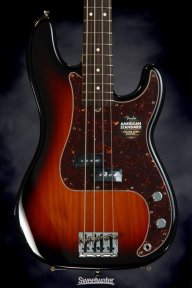
I only read the OP here, and I can only speak on Fender as I currently have an original '74 Jazz and a 2014 Am. Standard. I played several vintage ones when looking for mine. IME, the modern instruments are far better in terms of build quality and electronics, no question. My '74 is all original and has been well looked after, love the feel and play's nice, but it's nothing like the modern version. I bought the '74 for sentimental reasons as its my "music" decade of growing up. (I'm not a collector or investor, and have no intention whatsoever of selling it). If I could only buy one bass as a working instrument, it certainly would not be an original vintage. Just my opinion.
 
While there may be some who genuinely seek out pre-CBS era Fenders for the tone, and the feel of the neck, there is definitely a market out there for those who desire road worn, weathered, vintage-y looking instruments.

I saw a fender jazz up for sale on CL a few years back, don't remember the year, although it WAS old, and by the looks of it in mint condition, but $7000? Crack'a puh-leeze! That may be a "fair" price, but, let's face it, it's not going to be one's work horse, so all the talk of play-ability and tone is kind of moot, unless you're a professional studio musician getting paid good money to bring that old school vibe to the recording. But whatever shakes yer spear
 
We all play because we enjoy it. Having an instrument that when looked at brings an emotion of giddyness for sure helps in that endeavor. I am a drummer who has some very collectible and great sounding kits, but have also sold a few kits that sounded every bit as good as my 7000.00 caviotto DW for 300.00. One of my favorite snares is a throwaway cb500 steel stundents snare I got in a trade. I threw it on a yamaha stage custom kit I had for a kit I leave at a venue for jams and backline. That 25.00 snare is a freakin cannon! I get more compliments on that snare than any of my "high end" snares. I am a woodworker and the appeal of the DW kit to me is the absolute craftsmanship that went into making it.

I have started buying parts on ebay (necks, bodies, elec, etc) and building my basses. The amazing thing is my quilted top flame maple neck p bass with all gold hardware, nordstrand pups, and US electronics would get people commenting on its beauty before I put the fender logo on the headstock. Once that fender logo went on it, people went bat shat crazy over it. I have a total of 400.00 in that bass, but it easily looks like a 2000.00 instrument, and sounds incredible.

The vintage basses I have played have not impressed me tone wise, but I can see how if one were mine I would enjoy it just because of its uniqueness. Anyone who tries to tell you human hands are more precise than a router hooked up to a cad program is insane. Build a computer chip by hand if that's the case. The actual woodworking portion of the instruments coming out of china is phenomenal bang for the buck. 140.00 for a pbass clone, seriously? I cant even turn the light on in my shop and run to the lumber supplier for 150.00! Even stuff like a john east 300.00 deluxe preamp could be mass produced in china for around 10.00 each. Amazing time we live in. Hand made goods carry value because nothing is hand made anymore, and people who know how to make things by hand are getting hard to come by.

I guess basically my point is that new stuff dollar for dollar is way better than its vintage counterpart. a 3000 new bass vs a vintage 3000 bass...no comparison, new wins every time. The reason we covet vintage stuff is its rarity, and if we own that rarity we believe some of it rubs off on us and we have some of that uniqueness. Just imagine how much a 69 fender jazz will be coveted in the year 2069. Nothing wrong with that as no matter how powerful or new your cnc is, it can never produce a bass made in 1969.
 
As I read all this I see people saying things and apparently they are speaking of fit and finish all the time. Quality. Tight pockets.

Seems to me, being owner of a 1962 Jazz, that those are not the issues that should be considered when bass players valuing and listing pros/cons around the vintage value question.

My jazz has a delicacy in the neck that no CNC made Jazz neck THAT I PERSONALLY HAVE TRIED comes close too. Sure, the pocket isn't as tight as a 2015 Custom Shop, but the new CS can't touch the neck on my Jazz. It is nothing near it.

Sure a new CS sounds awesome, but my old 62 sounds awesome as well. Every time I bring it out people go gaga over the tone; so those old pickups were JUST AS GOOD AS anything wound today. Not better, nor are the new ones better. It's magnets and wire for the love of all that is good. There's no magic.

But the neck. No modern CNC neck can touch it because the program they're running isn't running the profile that was carved into my neck in October 1961 by the ten year + employed at Fender, by 1962, highly skilled neck maker using their human hands.

Close, but no cigar.

My 53 year old 100% functioning Jazz bass should be worth exactly as much as a similar passive brand new custom shop for that reason; it meets or exceeds the CSJ in tone and feel. No more. no less. Sentimentality of a collector is the only consideration that would push the value of a pre CBS beyond a new CSJ.
 
No modern CNC neck can touch it because the program they're running isn't running the profile that was carved into my neck in October 1961 by the ten year + employed at Fender, by 1962, highly skilled neck maker using their human hands.

In theory you could scan the neck and program a CNC machine to create one, though. And you could save that neck profile for yourself for future reference.

Maybe this will be a future aftermarket offering - have your neck reprofiled to whichever one you select. Combine it with a PLEK operation and maybe you have the ultimate in aftermarket neck tweaks?
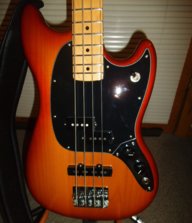
 
In theory you could scan the neck and program a CNC machine to create one, though. And you could save that neck profile for yourself for future reference.

Maybe this will be a future aftermarket offering - have your neck reprofiled to whichever one you select. Combine it with a PLEK operation and maybe you have the ultimate in aftermarket neck tweaks?
Sure they can do that but they won't. It's just so slender compared to the modern profile that I doubt they would want to chance the potential problems that may arise with even less wood there.

Anyway what I'm saying is if you haven't held my bass in your hands, you simply cannot make ANY statement as to whether a vintage bass is worth it or not. I have $2600 CDN in mine which includes the refinish from 1970's crud oil varnish to SB nitro. It will at least equal any passive CSJ out there.
 
Cars are often used as a comparison with basses/guitars, and that comparison works here as well. A 2015 Dodge Challenger is faster, more reliable, more comfortable, and handles better than a 1970 Challenger, but which one would you rather have? Personally I would take the 1970 Challenger TA with a 340 6 pack all day.


A lot of people look for old cars because they don't have to be emissions tested.
They were simpler, less expensive (even adjusted for inflation), and didn't have a lot of unnecessary crap on them.
They were also easy to maintain by yourself.

I think using your example, you might take the newer Challenger if it were made exactly to the old specs,
and were subject to the same regulations as the older one.
I know I would.
 
In 1976, Stephen Stills was on the cover of Guitar Player. They had an article about Stills being upset that Alvarez was buying pre-war Martins, only to take them apart to examine and copy them. He got into a bidding war with them over a pre-war Martin, and drove the price up way up for the day. Before this bidding war, there was no big "vintage market." It all changed with this one transaction. It was the start of "vintage" instrument prices rising, and they rose quickly.

I've had a few "vintage" instruments. Basses include a 62 P ($125 in 1969), a great 64 P ($200 in 1975), a 68 Jazz bass and a 68 Tele bass...both $130, and a few others.

The 64 was my favorite...best 4 string I've ever owned, except for a bass I built in 1980. It was a decent weight, no neck dive, and a fantastic wide, but flat neck. The pickup was awful...it buzzed under bar lights, and the D and G were always weak, no matter how the pickup was adjusted. When Dimarzio came out with the Model P, I jumped and it was a huge improvement. Years later, I pulled the original out of my junk pickup box, and measured it. The D and G coil was underwound, defeating the humbucking effect of the two coils. Had I known when I had problems, I could have added windings to match the E and A coil.

I also replaced the spudly bridge with a Shaller roller bridge and was rewarded with much better sustain and evenness in tone from string to string.

The original frets lasted 2 years of Rotosounds. I refretted it...my first refret, and the replacements showed little wear 4 years after the refret. The original frets were much softer. I've never worn out frets on a bass since despite only using rounds, and mostly stainless.

My 62 P was a good bass. I had just switched to bass and didn't know enough to really appreciate it. I almost bought the high school's 63 P for $100 in the mid 70's...until I played it. Heavy with a huge, chunky neck. It felt awful. I wanted a new P in 1975, but hated every one I tried at the music store...all with that awful, thick poly and way too heavy. So I bought an ebony Ripper...a real dog...what was I thinking? I found the 64 a few months later and bye-bye Gibson. I traded the Ripper for a G-3, which was better feeling and sounding, but it didn't last long.

Nothing wrong with the 68 Jazz...I just liked the P better. I bought the Tele bass to use while I refretted the P. Once done, I didn't need it.

I switched to 5's in the late 80's so vintage there means little. I have 5's that are far better built and also sound and feel better than any old basses I had.
 
  • Like
Reactions: Laurent
A lot of people look for old cars because they don't have to be emissions tested.
They were simpler, less expensive (even adjusted for inflation), and didn't have a lot of unnecessary crap on them.
They were also easy to maintain by yourself.

I think using your example, you might take the newer Challenger if it were made exactly to the old specs,
and were subject to the same regulations as the older one.
I know I would.


You would rather have this
2015-dodge-challenger_100467598_l.jpg


Than this?
1fODYuanBn&name=Y2Fyc19kb2RnZV9jaGFsbGVuZ2VyXzE5NzBfY2xhc3NpY19jYXJzXzE2MDB4MTIwMF93YWxscGFwZXI=.jpg


Not me, I would take the 1970 Challenger ever time
 
I own numerous P-Basses from '64 to '12 and have owned many more from every decade but the '50s. My current favorite is a '75 that sounds and plays like a dream. I've never played a newer one that matches it. That said, I've had some very mediocre, heavy '70s Ps. I'd say there's more variation between vintage instruments, but there are great rewards if you find a good 'un.
 
Is there an advantage to vintage? Maybe. That is a personal decision. Case in point: I own 2 Jazz basses from 1960 in Shell Pink. That was a custom color at the time. They were a birthday gift from Leo to my uncle who was a personal friend and player. I have the original goofy card from Leo as well as all paperwork and the then "case candy" from one of these basses. One saw much use and some abuse. The other is in about as mint condition as could be possible. I bought these off my uncle for investment purposes - Not for use out in the world. The heavily used one I sometimes noodle on. The other I check on from time to time to see how the old girl is holding up. They get a yearly check-up for health reasons. Both are kept keep in their cases in a climate controlled safe due to the value. Lucky for me, some of the the ancient materials used on both have held very up well.

The beat up one sounds real nice, but not much better that my 70's and later ones. The clean one sounds rather weak. My last buy was a new 2012 '62 AVRI. It sounds better than all my Jazz basses. In Billy Gibbons' book "Rock and Roll GearHead" he tells the story of "Miss Pearly Gates". That is his 1959 Les Paul that made the sound of ZZ Top what it is. Saying that it was, in his opinion, a perfect build. Was my 2012 bass a perfect build? Beats me, but with my Mesa gear and that bass I have found the tone in my head. Finally.

Go figure.
 
I think way to many people think old is synonymous with good. There were many basses made back in the day that were good ones, and just as many that were nothing special. You can't dispute that hardware has come a long way since the early days. I had some from the 60's and 70's I wish I still had, and some that were dogs. I had a fabulous sounding 66P that played about as bad as one could. The neck felt awful, but the sound..... I also remember many Fenders from the 70 that had major quality control issues. We used to laugh at some of the terrible finishes that made it off of the line and out the door. Again, we thought the basses we nothing special............so we thought. Now those $375 basses are worth 10+ times as much, many while being pretty beat up. As they say one man's gold is another mans garbage.
 
You would rather have this
2015-dodge-challenger_100467598_l.jpg


Than this?
1fODYuanBn&name=Y2Fyc19kb2RnZV9jaGFsbGVuZ2VyXzE5NzBfY2xhc3NpY19jYXJzXzE2MDB4MTIwMF93YWxscGFwZXI=.jpg


Not me, I would take the 1970 Challenger ever time

It depends what you want it for as to which is preferable. If it is a machine for getting from A to B in a certain amount of comfort then the first one is the one you've want. I've been in some vintage cars of the second sort and comfortable is not what I'd call them and cars back then seemed to rust as soon as look at them :(

But then we have the power to build cars that look like the second one externally but have all the bells and whistles of the second.

However, for gigging, I don't think either of them is ideal. I have what is essentially a small van.