• TalkBass has been independent since 1998. Add your voice.
    Create a free account to reply to discussions, view embedded media, and browse with fewer display ads.
    Join freeLog in
    Want zero display ads or expanded classifieds tools? Compare plans.

Double Bass let's be honest with string technology we don't need basses that big we need logistics

bom esse é um video antigo mandei para minha conta do youtube agora pra mostrar que não sou uma pessoa frustrada que nem toca baixo eu era mais novo lá começando uns 2 anos atrás não toco com arco alemão eu estava experimentando sou fã do francês mas enfim já faz 3 anos de baixo só estou dando uma opinião muitos solistas usam contrabaixos pequenos não vejo porque ficar policiando e dizendo que não é uma coisa certa
https://youtube.com/shorts/eJTOF3nlW0s?feature=share
 
I've already learned the pivot but I think it's worth using smaller basses because not because everything needs to be as traditional rabbath invented pivot and crab marcos machado perfected this technique even using small bass nowadays used to use a 7/8 I'm just giving logical logistics solutions in the end a good bass will be built by a good luthier and a good wood if it were a big acoustic box all giant basses would be the best basses but they are not so a smaller bass think you need to take a bus to move if you don't have a car with a small bass it would be easier or if you have to call a taxi or uber not everyone accepts such an instrument here in my city taking it ends up disturbing a lot bassist's life
 
I actually asked to make a smaller bass due to logistics but of course I used 4/4 and 3/4 most of my life and after having played a smaller bass and used it for a week I felt the practicality and saw how it was better than my big 3/4 above normal due to its manufacture My current bass is very cheap, this one from the video I play don't judge my german bow i don't play with a german bow i'm a french player
 
this video is also old I posted it on YouTube now not to say that I don't play doublebass, I don't like to record myself so much so I feel uncomfortable I realize that there were more mistakes in techniques that were corrected with time I like to play in a theater presenting myself I have more recordings now but I'm ashamed to post shyness
 
let's see a lot of 4/4 basses are horrible to play the standard 3/4 size is already challenging they sound better than these monsters."but the bass or resonates more"let's be honest not everyone is going to hear that 5th string tuned to B and you won't even enough strength you will have to play a lot of notes there, I really understand there are still big old basses but there are small ones if we look at the technology of the strings it already resonates very well a smaller bass 1/2 1/4 would be much better for all bass players in orchestras for the logistics and easier to play less tired, easier to transport to store clean and cheaper maintenance I've been talking to many professionals that using a smaller bass would make life easier not only in playing but transport logistics we need and of course czech-bass or electric bass not everyone wants to have many prefer the sound of the acoustic like me


You don't need logistics...you need interpunction!
 
Smaller then 3/4 size basses are often played by soloist that don't need the low notes that much, playing mostly in thumb position anyway. For that a 5/8 or maybe even a 1/2 size bass in standard or solo tuning works well, the big body is not nessary for the higher notes played. The standard bass is the 3/4 in standard tuning, supporting the normal range from low E up with it's body size. Allmost all 5 string basses with a low B are at least 7/8 or 4/4 size, else the body of the double bass does not support the lowest string well.
A C extension on a 3/4 size double bass works because of the longer string length, but I myself don't like playing with them, fingering the lowest notes works only, if only one is needed, that can be gated. Try playing a chromatical part starting at low C, then D flat, D and E with an extension not to slow and you will see, why I would prefere a 5 string bass over the extension.
The normally used size of the double bass have a very good reason, they work and sound good and loud acoustically. String technology has less to do with that then body ressonces. If you use a 1/8 size 5 string double bass with low B for orchestral playing, the logistics of the instruments may be more simple, but don't neclect the added logistics of the amplifiers, bass boxes, power cords, pickups, preamps, cables... you need to play them compared to the other instruments that are much louder acoustically.
Finding a 1/8 that sounds good even in standard tuning is impossible, finding a 1/4 is extremly difficult, there are much more 1/2 and 5/8 basses that sound good and very many 3/4 basses. Basses bigger then 3/4 are not needed for standard tuning and can sound better or worse then 3/4. On the other hand, it is difficult too find 3/4 basses sounding good with low B, very seldom that works with basses smaller.
 
There are these pesky things called the laws of physics.

The way around the need for a large resonance chamber and long strings to produce low pitch bass tones is to use a different technology.

If, for example, one were to stop relying on the large resonant box to produce sufficient sound, instead using electronic amplification, then it would be possible to reduce the size of the resonant chanber, even eliminate it and just have a solid slab of wood or other suitable material. Similarly, it would no longer be necessary to have 40-44" strings; something on the order of 32" or 34" would work. Now shortening the scale that much, hitting exact pitches might become more challenging, but it seems quite possible to use frets, as on guitars or the old viol family. Such an instrument would be much smaller and lighter than the double-bass. True, you'd need an electronic amplifier and speaker to make it audible since you've eliminated the resonant cavity - but that would be a separate device, and probably could be a fairly small cube or rectangle, say 18" on a side.

I haven't thought this thing out completely, but it certainly seems technologically feasible.

Oh wait, someone just showed me a picture of something like that...

never mind...
 
There are these pesky things called the laws of physics.

The way around the need for a large resonance chamber and long strings to produce low pitch bass tones is to use a different technology.

If, for example, one were to stop relying on the large resonant box to produce sufficient sound, instead using electronic amplification, then it would be possible to reduce the size of the resonant chanber, even eliminate it and just have a solid slab of wood or other suitable material. Similarly, it would no longer be necessary to have 40-44" strings; something on the order of 32" or 34" would work. Now shortening the scale that much, hitting exact pitches might become more challenging, but it seems quite possible to use frets, as on guitars or the old viol family. Such an instrument would be much smaller and lighter than the double-bass. True, you'd need an electronic amplifier and speaker to make it audible since you've eliminated the resonant cavity - but that would be a separate device, and probably could be a fairly small cube or rectangle, say 18" on a side.

I haven't thought this thing out completely, but it certainly seems technologically feasible.

Oh wait, someone just showed me a picture of something like that...

never mind...
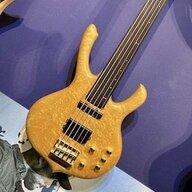
I don't think my conductor would be very happy if I showed up with one of those.
 
You know the big basses, they have more sustain and many bass players love that, but in the concert hall you can't hear that of course wind instruments bass you hear so much acoustic instrument can't compare in sound volume to a wind instrument
 
You know the big basses, they have more sustain and many bass players love that, but in the concert hall you can't hear that of course wind instruments bass you hear so much acoustic instrument can't compare in sound volume to a wind instrument

That's one reason orchestras like big basses, and several of them.
 
bom cada um do seu bass bom independente do tamanho cada um escolhe o baixo do seu tamanho desde que seja maior que um violoncelo Na orquestra jovem que eu toco eu uso 3/4 que sempre deixo lá mas quando preciso viajar para tocar em eventos ou apenas para ir a um lugar ou outro lugar posso ter um baixo menor, acaba sendo a necessidade que você achar melhor para você. e toque. aqui na minha cidade a orquestra principal usa baixos 3/4 com extensão ou 1/2 mas e a escolha deles
 
bom cada um do seu baixo bom independente do tamanho cada um escolha o baixo do seu tamanho desde que seja maior que um violoncelo Na orquestra jovem que eu toco eu uso 3/ 4 que sempre deixei lá mas quando preciso viajar para tocar em eventos ou apenas para ir a um lugar ou outro lugar posso ter um baixo menor, acaba sendo uma necessidade que você achar melhor para você. e toque. aqui na minha cidade a orquestra principal usa baixos 3/4 com extensão ou 1/2 mas e a escolha deles
that doesn't make him any less of a bass player than others
 
Well it wasn’t quite like watching paint dry…
Yes, it wasn't.
Let's be honest - Most paintbrushes are much larger than they need to be and are difficult to transport and are cumbersome to use, even though they are more efficient at applying paint.
We should throw out all the large paintbrushes, and use only small paintbrushes, (which are easier to transport and use.)
Problem identified and solved!
Thx!
 
Yes, it wasn't.
Let's be honest - Most paintbrushes are much larger than they need to be and are difficult to transport and are cumbersome to use, even though they are more efficient at applying paint.
We should throw out all the large paintbrushes, and use only small paintbrushes, (which are easier to transport and use.)
Problem identified and solved!
Thx!
How would you get a good fundamental out a smaller paint brush? :D
 
  • Like
Reactions: Don Kasper