• TalkBass has been independent since 1998. Add your voice.
    Create a free account to reply to discussions, view embedded media, and browse with fewer display ads.
    Join freeLog in
    Want zero display ads or expanded classifieds tools? Compare plans.

Double Bass let's be honest with string technology we don't need basses that big we need logistics

What's missing from the reboot of this thread is overtones. The core difference in sound between a 42" scale and a 34" scale is the overtones, which make the voice more complex. Using a shorter, heavier string can give you the same note, but it won't produce the same overtones. The bass is a machine built of compromises — the longest string a person can practically play, the largest resonating chamber we can still reach around and bow, the practical aspects of maintenance and repair. The instrument evolved to this form over hundreds of years and thousands of experiments, and I think it's wise to respect that embedded knowledge.

Is there a plausible approach to string technology that produces the overtone complexity with less length? I imagine it's possible, and I further imagine that the person who's able to formulate it for practical use and manufacture it will be very successful across the range of stringed instruments. That would open up a new evolutionary path for the bass, but because players are conservative about change it'll be many decades at least before it's widely adopted. This makes it economically hard on the innovator.

I don't think there's any particular nobility in the daily hassles we accept as players of large, fragile and temperamental instruments, but I prefer to see solutions over complaints.
 
There are these pesky things called the laws of physics.

The way around the need for a large resonance chamber and long strings to produce low pitch bass tones is to use a different technology.

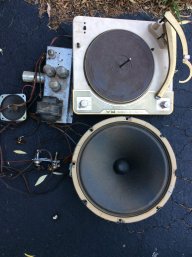
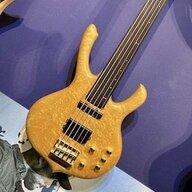
If, for example, one were to stop relying on the large resonant box to produce sufficient sound, instead using electronic amplification, then it would be possible to reduce the size of the resonant chanber, even eliminate it and just have a solid slab of wood or other suitable material. Similarly, it would no longer be necessary to have 40-44" strings; something on the order of 32" or 34" would work. Now shortening the scale that much, hitting exact pitches might become more challenging, but it seems quite possible to use frets, as on guitars or the old viol family. Such an instrument would be much smaller and lighter than the double-bass. True, you'd need an electronic amplifier and speaker to make it audible since you've eliminated the resonant cavity - but that would be a separate device, and probably could be a fairly small cube or rectangle, say 18" on a side.

I haven't thought this thing out completely, but it certainly seems technologically feasible.

Oh wait, someone just showed me a picture of something like that...

never mind...
But will it work for metal?
 
condino alcoa 1.JPG
yes.
 
I don't think there's any particular nobility in the daily hassles we accept as players of large, fragile and temperamental instruments.........

OH MAN! You just shattered my entire raison d'etre.

If you need me I'll just be over there crying in the corner.
 
Yes, it wasn't.
Let's be honest - Most paintbrushes are much larger than they need to be and are difficult to transport and are cumbersome to use, even though they are more efficient at applying paint.
We should throw out all the large paintbrushes, and use only small paintbrushes, (which are easier to transport and use.)
Problem identified and solved!
Thx!

Wow! I hope I never get on the wrong side of you, Don. LOL
 
You know the big basses, they have more sustain and many bass players love that, but in the concert hall you can't hear that of course wind instruments bass you hear so much acoustic instrument can't compare in sound volume to a wind instrument

But isn't that really an argument in favour of a larger bodied instrument instead of a smaller ones?

Your solution here seems to be: "Give it up! Youse can't hear us anyway"! (or I must be mistaken and you are also opting for smaller wind intruments :-) )
 
Mas isso não é realmente um argumento a favor de um instrumento de corpo maior em vez de um menor?

Sua solução aqui parece ser: "Desista! Você não pode nos ouvir de qualquer maneira"! (ou devo estar enganado e você também está optando por instrumentos de vento menores :))

Smaller instruments are sounding louder but don't have that cloud around the sound… I like it better without the cloud but each one should play how they want… I don't like it when people say this is right and this is wrong… there are many ways to get the same result yes, nothing prevents someone from playing solo with 5/4 and someone playing in an orchestra with 1/4 for example yes i did wrong to try for my opinion as best
 
Despite my previous comment, I have no problem with trying to make the bass more practical or ergonomic. A 1/4 size bass that plays like a 3/4 would certainly be a marvel. And most bassists aren't searching for anything bigger than a 3/4.

The issue is that it does have to sound better, because somebody will still be willing to show up with a full size bass.
 
there are small basses with huge sounds, and giant basses with no projection. everything in between.

i can't believe we have not all agreed on this yet :roflmao:

Gary Karr talks a lot about the projection. he prefers smaller basses for the orchestra because of how they'll sound out in the audience (more audible.) giant basses (as per gary's opinion) fill the stage with sound but it doesn't sound quite as clear and full out in the audience.

while i'm sure he's competent as a section player i'm not sure i'd consider him the top expert on orchestral tone, but nonetheless he's a man who has lots of experience, and knows basses quite well.

many orchestra players find themselves with a variety of instruments for many reasons.

it's funny we can talk (argue) about size so often. yet we all know the arching and graduation of the top and back plates has a lot more to do with the sound than the size alone can determine. just because it's not as visually obvious we don't argue about it. but it's the real core of the sound in a lot of cases.

when i was shopping for a bass i played an old hawkes (big!!) bass that had a really nice solo voice and was not an overly "fat" sound. compare that with some of the smaller basses from makers such as andrea spada, whos basses famously had a significant thickness to the sound despite being truly petite in size.

:thumbsup:
 
Well, it's pretty easy to make a big bass that doesn't project and sounds lousy; just do a bad job.

Making a small bass that's loud and sounds good (and isn't so lightly built that it just folds up under string tension) is a more difficult and expensive proposition.

But those kinds of discussions have to do with maybe a 5/8 or 1/2 bass that sounds "pretty loud", not 1/4 size or smaller. No matter what you do, if you are relying on strings to excite a top plate, resonate air in a chamber, etc., for sound output, the laws of physics still apply. And the laws of physics tell us that you're not going to get the same sound output from a 1/4 bass as from a 3/4 bass if the design and build are similar. Can you build a 1/4 and a 3/4 bass that put out the same sound? Yes, if the 3/4 is particularly overbuilt and unresponsive and the 1/4 is unusually light and responsive. But in that case, why not apply the same design and build techniques to a 3/4 and get a real honest to goodness cannon?

If you want a small bass to sound like a big bass, at some point you're going to have to use a different technology - as in, electronic amplification. I knew a guy who often played a small bass (maybe 1/4 or 3/8) with a big band, and it sounded really good. But he was ALWAYS amplified.
 
Bem, é muito fácil fazer um baixo grande que não projeta e soa péssimo; apenas faça um trabalho ruim.

Fazer um baixo pequeno que seja alto e soe bem (e não seja tão leve que se dobre sob a tensão das cordas) é uma proposta mais difícil e cara.

But those kinds of discussions have to do with maybe a 5/8 or 1/2 bass that sounds "pretty loud", not 1/4 size or smaller. No matter what you do, if you are relying on strings to excite a top plate, resonate air in a chamber, etc., for sound output, the laws of physics still apply. And the laws of physics tell us that you're not going to get the same sound output from a 1/4 bass as from a 3/4 bass if the design and build are similar. Can you build a 1/4 and a 3/4 bass that put out the same sound? Yes, if the 3/4 is particularly overbuilt and unresponsive and the 1/4 is unusually light and responsive. But in that case, why not apply the same design and build techniques to a 3/4 and get a real honest to goodness cannon?

Se você quiser que um baixo pequeno soe como um baixo grande, em algum momento você terá que usar uma tecnologia diferente - como na amplificação eletrônica. Eu conhecia um cara que costumava tocar um baixo pequeno (talvez 1/4 ou 3/8) com uma big band, e parecia muito bom. Mas ele SEMPRE foi amplificado.
o que seria 5/8 e 3/8 nunca ouvi falar desses tamanhos e como o baixista adquire o jogo de cordas certo para esses tamanhos
 
Bass sizes, especially in the small fractionals, aren't standardized. So when I say "5/8", people generally understand that as "somewhat smaller than the usual 3/4" but to know specifics you have to provide actual measurements. Same with "3/8" which would mean something a bit bigger than 1/4, but not specifying exact measurements.
 
The primary weirdness here is really about an overall opinion that is stated as if it affects all of us. If this wants to make a case for small bass in the orchestra he plays in, then fine. It is not something most of us are concerned with. The double bass isn't even the biggest or most inconvenient instrument. Piano, harp, vibes and even drums can be worse to deal with and transport.

The travel solutions we have are pretty solid. Traveling with a Chadwick is simple enough that I have done it just for practice during family trips.
Amps are so small now and things like wheels and bass buggys make it pretty easy to get this instrument around. I think most of us have really made peace with what the instrument is.
 

Latest posts