• TalkBass has been independent since 1998. Add your voice.
    Create a free account to reply to discussions, view embedded media, and browse with fewer display ads.
    Join freeLog in
    Want zero display ads or expanded classifieds tools? Compare plans.

Lets Chat about different body wood combinations...

Mr Johnson, I believe you 110%. Finally someone who understands the intricacy of Mother Nature's greatest gift to mankind. The humble tree. You and I are talking the same language, but your words are much more elegant than mine. Certainly nothing needs to be added. However, as you have discovered over the years, the naysayers usually speak from a place of ignorance and pass it off as voodoo, nonsense, groundless, foolish and just about every other adjective you can name. However, ignorance is just a lack of knowledge and can be fixed with open minded education. Now, stupid; that's different. It can't be fixed. EVER! Most are just plain stupid. As we say in Texas, Bless their heart! My compliments, sir. Touche!!
Cheers
 
  • Like
Reactions: chinjazz
Yes.... in fact... at the risk of being labeled "in" the Tonewood Believers camp...
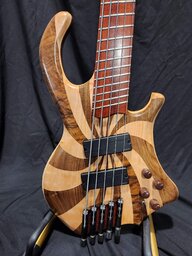
This wood combination was absolutely the most articulate, piano-like... punchy.... I've done to date.
How do I know? ... I was using EMG exclusively during that time. Pretty much the same circuitry in 6 to 8 separate basses.
This Cocobolo/ Maple/ Purpleheart/Ebony combination, was just special... somehow.
(It actually made me cry when I heard it the first time)
Yes... just the BODY wood made big a difference. :facepalm: What can I say?... it's a thing.

View attachment 3798748
Was the tone a surprise? Have you been able to duplicate it on other instruments with other wood combinations? The same combination of woods? Just looking for some insight I may not have learned. I am always interested about what other builders/luthiers may have discovered, so I can improve my own instruments.
Cheers
 
  • Like
Reactions: chinjazz
With regards to the Stradivarius question mentioned above, first those are acoustic instruments in which wood and construction should make a dramatic difference in their sound. Also, it doesn't: Invalid Link Removed

I'll put my vote in with the the wood matters in as much as it supports the rigidity of the system, as Bruce states. That said I have seen MANY A/B tests with different kinds of woods, but have never seen a demonstration of Bruce's hypothesis, build two basses out of the same woods and pickups, controlling the rigidity and compare the two.

I have seen oscilloscope supported testing on through neck, bolt on and set neck guitars, and it basically came to the conclusion that bolt on had the most sustain due to the additional mass of the connection method. That's only testing sustain though.
 
  • Like
Reactions: TrustRod
Oh man, I've been writing about this subject here on TalkBass for about 10 years. Most of my career as a Bass Luthier has been focused on this: how to shape the tone of an electric bass by working with the wood frame. My own line of Scroll Basses are full examples of this. I've tuned the structures to get a specific sound. The things I've done to the wood frame are a major part of the final sound of my bass, that goes through the wire to the amp. As are details with the mounting of the metal hardware, and details in the internal construction of my pickups.

Here's a mash-up of a bunch of posts I've written about this, covering the general ideas. I haven't yet edited them all together into a smoother article, so it's a bit disjointed.

It starts out from a question about whether the shape of the body can affect the tone, about Geddy Lee's famous teardrop P-bass:

The body shape can change the overall tone of the bass, but only if it significantly changes the stiffness of the body. If the body is made stiff, by being thick, using a hard wood, no chambering, etc., then you can change the shape and it won't make any difference in the sound. But, if you cut away enough wood that it becomes significantly weaker structurally, then it will affect the tone. Both the low end and the high end become weaker and mushier, and the sustain is less. That's what happened with Geddy's bass. He cut away so much that the body became structurally weaker.

In the case of comparing the P-bass to the 2x4, they are both real stiff. So they sound the same.

That's the element that's missing from all of these long arguments about whether wood matters, or whether the bass's frame affects the tone: The net stiffness of the frame is what affects the tone.

If you build the frame of a bass really stiff, then it will have almost no effect at all on the tone. The sound going to the amp will be all strings and pickups. Most mass produced basses are built that way. Slabs of wood with pickups and strings. And most customers are happy with that.

But, if you start trimming away at the structure to make it weaker, then it will start affecting the tone. This can be done by making the body thinner, cutting internal chambers, cutting away at the external shape, or using softer woods. The weaker you make the structure, the more it will affect the sound on the strings. Which gets additionally shaped by the pickup and sent on to the amp. And the weaker it is, the more you are able to hear the differences between different woods. That's what builders like myself do. We deliberately make the structure weaker, down into that zone where the wood does matter, and play around with different woods and different shapes of the parts to finely shape the tone.

Another example:
Suppose you build three P-Basses which have thick unchambered bodies, and are identical, except the bodies are made from three different woods. Those three basses will probably sound just about identical. They are all stiff structures, so it doesn't matter what wood the bodies are made from. Their sound is strings and pickups.

Now, suppose you take those same three basses and thin the bodies down to, say, 1 1/4" thick. Everything else is the same. The three basses will sound different from before; softer, mushier high and low end, richer background coloration. You will also now hear some difference between them. The different woods have different stiffnesses. Once you've reduced the overall stiffness of the bodies down to the point where they are affecting the tone, then you will be able to hear the tone differences that the different woods make.

So there's your answer: Wood doesn't make a difference, except when the bass is built so that it does make a difference. And the shape probably won't affect the tone.....unless you take it too far. Then it might.

It's that simple!


Here's another of my old posts that may help with the basics: It was about the tone differences between Bolt-on, neck-thrus, and set necks.

You're not imagining things! The frame of your new neck-thru bass is clearly stiffer overall than the Jazz or the Washburn. That is, it takes more pounds of force to flex it. That's why the strings feel tighter. It's not that the tension in the strings is higher; that's fixed by the scale length and the note that they are tuned to. But when you pull the string to the side with your fingertip, you are yanking on the tuner and the bridge, causing the bass's frame to bend a little bit. The stiffer the frame is built, the more pounds you'll feel on your fingertip as you pluck. So, the sensation is that the strings are tighter, and they snap more when you release. That's one of the things you get with a stiff-frame bass.

Neck-thru construction basses are generally stiffer than bolt-ons, but not always. You can build a neck-thru from soft woods with a thin profile, and it can be soft and springy. And, you can certainly build a bolt-on to be very stiff. It all depends on how the bass is built. The stiffness of the frame is one of the factors we luthiers play around with to get the feel and tone where we want it.


As usual, that didn't convince a bunch of the guys. One of them posted this: "I respect your educated opinion, but I've never experienced a difference in string feel between BO, SN or NT basses. So are you saying the the entire bass warps when you pluck a string? Sorry, I just don't really get it, and it sounds like snake oil."

So, I took the time and wrote a long, more detailed post:

A bass is like an archery bow; a wooden frame with a string stretched tightly between the two ends. Obviously, the archery bow is an exaggerated example, but when you pull the string off to the side, the wooden frame bends to take up the shorter length. The string isn't made of rubber; it's a very stiff material lengthwise, stiffer than the wood. When you pull the string off to the side the two anchor points at each end get pulled towards each other, with a lot of force. The result is that the two wooden arms of the bow bend from the load. The stiffness of those two wooden arms determines the power of the bow, and how many pounds of force it takes to pull the string off to the side some fixed amount. The thicker the bow arms, the harder you have to pull sideways on the string.

When you release the bow string, it snaps back towards straight, overshoots past straight, then swings back the other way. It oscillates back and forth for a while, decreasing the amplitude with each swing, until it finally comes to a stop in a straight line, under the nominal tension. Every time the string oscillates off to the side of center, the bow frame's wooden arms are again being flexed, for the same geometric reason as described above. As the string oscillates and slows down, the wooden arms go through a cycle of increasing and decreasing load. If you watch the tips of the wooden arms, they are flexing in and out with every cycle of the string. The "out" is every time the string crosses the centerline and is straight for an instant. The "in" is when the string is deflected off to the side. The frame is moving as long as the string is moving.

The same thing happens on a bass, but on a smaller scale. Hopefully you're not pulling the string that far off to the side! The bass is a wooden frame with a steel string stretched tightly between the tuner post and the bridge. The steel is a lot stiffer than the wood. I'm sure you've watched the neck and body flex as you bring the strings up from loose to full tension. You can see the strings lifting up off the fingerboard, to end up at some height above the fingerboard. That's the bass's wooden frame bending into a curve, just like the arms on the archery bow.

When you pull the string off to the side (when plucking), you are forcing the bass's frame to bend just a little bit more. The stiffer the frame is, the more pounds it takes to pull the string the same distance to the side, just like the archery bow. When you release it, the string snaps back and goes into the back-and-forth oscillations. The wooden frame is also flexing back and forth with every cycle of the string. The movement is visually small, but it's definitely happening. It has to. Something has to move.

That cyclic flexing of the wood frame is at the heart of the final tone that an electric bass makes. The flexing of the wood frame changes the sound on the string, because with every cycle that it flexes, it removes some energy from the string. On a soft wooden frame that flexes easily, the string dies out quickly. Less high end and less sustain. On a very stiff wooden frame, the frame doesn't flex as much, and the string rings longer and with a wider frequency range. Stretch a string across a block of granite, and the frame doesn't move at all. The string will keep ringing all day. In that case, when you pluck the string, all of the flexing is being done by the steel in the string. On a granite guitar, you're hearing the pure sound of the string itself.

And yes, I'm talking about the plugged in sound of the bass. The tone curve that rings on the string is detected by the pickup and sent off to the amp.

Here's the important thing to understand:

The stiffer the bass's structure is, the more you are hearing the tone that the string itself is making. The structure flexes less, so therefore it has less effect on the tone on the string.

The softer (more flexible) the bass's structure is, the more the structure is able to modify the tone on the string. The flexing itself changes the tone, but ONLY if the structure is able to flex.

That difference is the reason why we so often get into heated arguments around here on whether the wood frame affects the tone of an electric bass. The answer is yes or no, depending on the bass.

On basses that are built with very stiff frames, the amplified tone does indeed come primarily from the character of the strings and the curve shaping of the pickup. The wood has very little to do with it.

However;

When you build a bass structure to be more flexible, then it will have a significant effect on the tone out through the amp, and the feel on the strings. The more it's able to flex, the greater the effect, and the less the bass sounds like pure steel strings. That's why we luthiers fuss with all the different woods and shapes of the structures. We're trying to make our basses sound less like metal and more like a violin.​

(Another poster showed a bass of his where he had built a new mahogany body for it, and the tone had changed dramatically)

That's it exactly. An excellent example of what's going on. Now, is the new body very much different dimensionally from the old one? The lower stiffness of the body may be partly due to your weakening it in the design, and partly due to switching to the softer mahogany. Whichever, you got there. You softened the overall structure enough that you got the frame to start bringing in background coloration. Those are the off-harmonics in the background that make the warm sound.

You can push it further if you like, to bring out even more of the warmth. Keep trimming away at the body, mostly in the area right between the neck pocket and the bridge. Trim it thinner front-to back, rout some slots, whatever you like. But go slowly. You're in the "zone" now. It doesn't take much once you've got the body working. But, if you go too far, you can always add some reinforcements to stiffen it back up.

Here's where it all gets so confusing to most people. If I were working with you, I could show you how to build a replica of your mahogany body, still out of mahogany, but with enough reinforcements and dimensional changes that it would end up with the same stiffness as the original maple body. Hell, we could make similar looking bodies from 10 different woods, but adjusting them each to the same stiffness. All stiff bodies, but made of different woods.

The test results would be dramatic: They would all sound the same! And the crowds in the streets with the WOOD DOESN'T MATTER banners would be cheering! Definitive proof that you can build a bass body out of any kind of wood, and there won't be any difference in sound! That's what it proves, right? Right?

No, not really. What it proves is that if you have a batch of bodies that are all built to the same stiffness, then the wood choice doesn't matter. That's it.

Here's the other side of the experiment:
I could build you a maple body that would resemble your mahogany body, but I could trim it away enough to bring its structural stiffness down pretty close to the mahogany body. It wouldn't sound exactly the same, but it would be close. The warm background coloration, with the reduced range and sustain. This maple body would sound like what you'd expect of a mahogany body. Yes, you can build a bass with a carbon fiber neck and a maple body, and have it end up with a nice warm tone. Nothing to do with the pickups. It's all about the stiffness of the structure.

You can see why the arguments get so confusing.

Conclusions:
1.) You can't say that a particular wood will cause a bass to sound a particular way. Likewise, you can't say that a particular sound from a bass is caused by the presence of a particular wood. Maybe, but it's probably more complicated than that. You can get to a particular tone from different directions, using different choices of wood.
2.) You also can't say that wood doesn't matter...at all. In many cases, the wood choice may not make any tone difference to the player. But with your Steinberger, you've shown that it does.

It's all about the structural stiffness, and the choice of wood is just one of the variables.​

Thanks so so much Bruce! You've helped me so much thru TB:LC with your practical guidance, but I'd say this is possibly the mac daddy lesson of all time for me! :) :)

I have done quite a bit of chambering recently but myopically only to reduce weight (with not a single thought of tone shaping). Cheers!!
 
Last edited:
Wow, When I as


Thanks so so much Bruce! You've helped me so much thru TB:LC with your practical guidance, but I'd say this is possibly the mac daddy lesson of all time for me! :) :)

I have done quite a bit of chambering recently but myopically only to reduce weight (with not a single thought of tone shaping). Cheers!!

Yes, we've had other threads about cutting chambers in bodies; how they may or may not affect the amplified tone. You can cut them to significantly change the stiffness of the body (structurally weakening it) or you can cut them to make no change at all to the stiffness. Your choice.
 
  • Like
Reactions: chinjazz
Was the tone a surprise? Have you been able to duplicate it on other instruments with other wood combinations? The same combination of woods? Just looking for some insight I may not have learned. I am always interested about what other builders/luthiers may have discovered, so I can improve my own instruments.
Cheers
It honestly was kind of a surprise back then...lol...
(About 3 years ago)
I have only been seriously building instruments for about 5-6 years. So I can't claim much "wisdom" on the subject.
But I catch on quickly by listening to those with much more experience.... like @Bruce Johnson
And this bass was a perfect example of what Bruce says about "stiffness".
My client wanted this bass to be crisp and piano-like... (think: Mark King Level 42)
So... instead of the 7 pc laminated neck I normally do.... this one was 9 pc.
I always do "stiff" stringers down the middle of the neck but usually flank them with (soft) curly maple.
This one has half the maple... and extra Purpleheart
...and it rang like a bell.
Mission accomplished!
20170426_133007.jpg
 
With regards to the Stradivarius question mentioned above, first those are acoustic instruments in which wood and construction should make a dramatic difference in their sound. Also, it doesn't: Invalid Link Removed

I'll put my vote in with the the wood matters in as much as it supports the rigidity of the system, as Bruce states. That said I have seen MANY A/B tests with different kinds of woods, but have never seen a demonstration of Bruce's hypothesis, build two basses out of the same woods and pickups, controlling the rigidity and compare the two.

I have seen oscilloscope supported testing on through neck, bolt on and set neck guitars, and it basically came to the conclusion that bolt on had the most sustain due to the additional mass of the connection method. That's only testing sustain though.
You are absolutely correct about the bolt on neck adding sustain. Tone can be built into the neck as well as it can the body. I quit using neck throughs several years ago. You have absolute control over tuning a bolt-on neck. If you want a neck through because of how it looks, that's easy to accomplish with a bolt on, too. Use a practical number of bolts to join everything. Each hole weakens the structure a little. 5 is plenty as long as the are at least a #10. I use #10-32 into threaded inserts on all of mine. I've done many of them successfully. As far as chambers go, I chamber every one of my instruments without losing any strength at all. (If it matters to anyone, I happen to be a structural engineer. Thanks to my career in construction.) Chambers are my main tuning tool to use to get the same frequency range(tone) I'm looking for regardless of the wood I choose. You may want to look into choosing and tuning your fretboards to match the harmonics of the wood(s) you use for the neck. Again, the sum of the parts = the whole. Think of the bolt-on neck as a single musical instrument by itself. Tune the whole neck to the harmonics of the body. Use the same criteria for each individual part you choose. The result will be the sum-total. If all of the parts meet the same criteria; the magic will happen all by itself. Food for thought: Tone first. The sustain & pretty will still be there when that's accomplished.
Cheers
 
  • Like
Reactions: YunDu
With regards to the Stradivarius question mentioned above, first those are acoustic instruments in which wood and construction should make a dramatic difference in their sound. Also, it doesn't: Invalid Link Removed

I'll put my vote in with the the wood matters in as much as it supports the rigidity of the system, as Bruce states. That said I have seen MANY A/B tests with different kinds of woods, but have never seen a demonstration of Bruce's hypothesis, build two basses out of the same woods and pickups, controlling the rigidity and compare the two.

I have seen oscilloscope supported testing on through neck, bolt on and set neck guitars, and it basically came to the conclusion that bolt on had the most sustain due to the additional mass of the connection method. That's only testing sustain though.
I'm baffled as to why being an acoustic instrument as opposed to being a "solid body" would make any difference. The pickups have to have something to transmit to the amp. The pickups couldn't care less about the sounds they send out. You know, the old cliche "trash in--trash out". If the sound is pure coming in, it will be pure going out. That is unless you corrupt it before the amp can process it. If it is crap coming in, it will just be louder crap going out. So, why would it matter if the sound was coming from an acoustic instrument with an attached pickup or from a "solid" instrument with built-in pickups? Pickups just send what they "hear" to the amp for increased volume, don't they? I'm sorry, I don't see that it matters; acoustic or solid. Tone is tone wherever it originates from. Good or bad. JMHO
Cheers
 
Last edited:
  • Like
Reactions: Rôckhewer
It honestly was kind of a surprise back then...lol...
(About 3 years ago)
I have only been seriously building instruments for about 5-6 years. So I can't claim much "wisdom" on the subject.
But I catch on quickly by listening to those with much more experience.... like @Bruce Johnson
And this bass was a perfect example of what Bruce says about "stiffness".
My client wanted this bass to be crisp and piano-like... (think: Mark King Level 42)
So... instead of the 7 pc laminated neck I normally do.... this one was 9 pc.
I always do "stiff" stringers down the middle of the neck but usually flank them with (soft) curly maple.
This one has half the maple... and extra Purpleheart
...and it rang like a bell.
Mission accomplished!
View attachment 3800834
May I ask what method you use to cut the rear cavity cover plate for your instruments? Your work is exquisite. Simply beautiful. What finish are you using?
Cheers
 
For all the kajillions of lines of text that have probably been written about wood selection and tone, and how humans perceive the relationship, it seems like someone - somewhere - some time - would have just put a mic on an oscilloscope and captured images of the soundwaves for identical instruments built with different woods and formats. Does anyone know of such a study? I've kind of half heartedly looked a few times on google but never came up with much that seemed meaningful. With something like that out of the way, then we could at least conclusively say "we have data that shows these differences" and then we could all just sit back and argue over which curve should get called "warm" or "bright."
I have seen a handful of tests where people use oscilloscopes on finished instruments and wood blocks. There's a youtube video with a bunch of hits doing that somewhere out there. I would point out there was no comparing of "identical guitars" to see if they also vary. I'm sure we all have examples of picking through a number of identicals at a store to find the magic one.

You mention we could define a guitar as being warm or bright. Those attributes have both been described to every wood used in guitars. Ash has been described as mid heavy and scooped, hifi and compressed etc... Some people think all ash or all maple has a distinct sound, others argue that individual species instead sound different. Wood experts don't often agree on the qualities they are ascribing and rarely use terms that aren't vague. You'll never see someone say Brazilian Rosewood has a peak at 1.2khz while Indonesian peaks at 1.1khz. There is also much overlap in wood qualities so it seems un reasonable that any one species would own a certain quality that other woods don't also share to a certain degree.

But even demonstrating that 2 guitars sound different does not suggest different wood species have unique and identifiable tone qualities in electric guitars that can be heard. And it doesn't offer any evidence to claims of being able to clearly hear wood species through an amp. Most arguments trying to support the signature sounds of wood fall into a false dichotomy which to me is telling. My position is simply that I have never seen any demonstration of someone being able to identify wood genus or species without knowing what wood it is before hand. When I ask experts on wood tone if they can tell me what wood is used in a guitar if I just send them a sound clip the usual response is anger and personal attacks. I know enough about the human brain to know we are not highly calibrated test equipment and simply can't demonstrate these abilities in an honest blind test.

That said I do believe people actually hear a difference. But feel that is added by us and not something present in the soundwave in the air. The concept of our brains being part of our perceptions is well accepted in many scientific fields. As is defending those perceptions.

I'm happy to continue discussing this with you.
 
Tone wood matters. If the supporting structure of an instrument is wood, then it matters. The fallacy is attributing specific qualities to all examples of a given wood species. As construction materials go, wood is probably the least consistent from piece to piece of the “same” species. And sometimes Wood A is marketed using a common name (“Mahogany”) when in fact it turns out to be something different altogether (Entandrophragma cylindricum, also known as “Sapele”).
This seems reasonable in my opinion. I never argue that wood can not influence tone. I do argue no one can reliably identify wood through an amp.

You could say if I slipped $20 into Jeff Bezos bank account I have changed his net worth. However I don't think he would be able to notice it. Unless he was told to look for it.
 
You may have also read where I said where I said it was right there in front of you all this time if you took time to just pay attention. Most of us just take things for granted any more. Your tuning fork? Ok...drum roll.... it's the 440hz A note. 440hz is the first A note above middle C on a piano. Your voice coach teaches you the A note first. A piano tuner uses the 440hz A as the base note on a piano. Our electronic tuners use 440hz for guitars, basses, violins, cellos and almost every stringed instrument we use. It is the magic number in our world; embrace it and use it. It's not that hard.
440 is not the standard you may think it is. My clavichord tunes well below that and Baroque music tunes to A415. Some examples are mentioned here. A415: Tune in - Baroque tuning (and the title of this blog) explained

You can buy tuning forks not tuned to 440, most digital tuners allow you to change that setting quite easily. To quote yourself "It's not that hard."
 
Mr Johnson, I believe you 110%. Finally someone who understands the intricacy of Mother Nature's greatest gift to mankind. The humble tree. You and I are talking the same language, but your words are much more elegant than mine. Certainly nothing needs to be added. However, as you have discovered over the years, the naysayers usually speak from a place of ignorance and pass it off as voodoo, nonsense, groundless, foolish and just about every other adjective you can name. However, ignorance is just a lack of knowledge and can be fixed with open minded education. Now, stupid; that's different. It can't be fixed. EVER! Most are just plain stupid. As we say in Texas, Bless their heart! My compliments, sir. Touche!!
Cheers
Your arguments seem to be based mostly on personal attacks and insults. Bless your heart. As you say ;)
 
Mr. TrustRod, if you are talking about why we didn't publish any papers on the subject.... I had a long answer for that question written, but just erased it. No sir, I didn't. No excuses, I just didn't. Sorry. But, bless your heart anyway for asking.
Cheers
More insults? Didn't you just explain what you really mean by bless your heart? No one else in this thread is arguing their positions with insults. Why don't you join us?
 
440 is not the standard you may think it is. My clavichord tunes well below that and Baroque music tunes to A415. Some examples are mentioned here. A415: Tune in - Baroque tuning (and the title of this blog) explained

You can buy tuning forks not tuned to 440, most digital tuners allow you to change that setting quite easily. To quote yourself "It's not that hard."
I am fully aware of all those tuning ranges and I even understand how they work & why we can use them. All electronic tuners have those ranges as well as Chromatic tuning scales for different instruments. There are tuning forks in C, Bb, E and almost every note we need. Clarinets, Trumpets, Saxaphones. Oboes.. all instruments have their own harmonic range of which it is based on. And I am not aware of anyone even wanting to change them. However, the way I read the original post, we weren't talking about Baroque tuning or any other instruments except bass guitars. For that we use 440hz. I have assisted in tuning pianos as well and not one was ever tuned to anything other than 440hz A. But, we aren't talking about pianos here either. We are talking about bass guitars here in America in this particular forum. I centered my post around that understanding as I think everyone else has. However, if you would like to discuss other tuning ranges that deal with other base frequencies other than 440hz, I am pretty well versed in those, too. Just start another forum discussion on those subjects and I will jump right in there with you and we can debate it until the sun don't shine if you like. But, I won't participate in meaningless discussions with anyone who purposely tries to sabotage it with meaningless rhetoric that has nothing to do with the subject. I certainly won't dignify it with any further responses than this reply. If I am that annoying to anyone here, then I will just excuse myself and listen to all you guys and keep my thoughts to myself. I will lose no sleep if I don't share what knowledge I have gained in over 50 years of playing, performing and building guitars & basses. I hold no animosities toward any posts doubting my experience or qualifications to speak on this subject. I will just bid everyone adou & walk away. So, bless your heart, sir. I'm sure your skepticism & challenges on the subject are greatly appreciated on this forum. Have a blessed evening.
Cheers
 
May I ask what method you use to cut the rear cavity cover plate for your instruments? Your work is exquisite. Simply beautiful. What finish are you using?
Cheers
Thank you
I use a C0² laser to cut the cavity cover with minimal kerf.
That particular finish is Sherwood Conversion Varnish
 
Thank you
I use a C0² laser to cut the cavity cover with minimal kerf.
That particular finish is Sherwood Conversion Varnish
Thank you, sir. You have done a beautiful job on your bass. My hat's off to you. I have access to a laser cutter, but it doesn't use any gas that I know of. I used it to burn some name plates for my desk in Purpleheart, Zebrawood & Mesquite, but it just burned the wood and made beautiful black lettering. We use t cut our MDF & acrylic templates. But a buddy does it for me. I don't know the first thing about them except to say "wow that's awesome". I use SW nitro lacquer & vinyl sealer on some occasions, but it is hard to come by anymore. I have used 2k poly on numerous occasions, but I do very few gloss finishes. I have a couple of gloss ones coming up in the que for late May and trying to plan ahead. Thank you for the info. I will check it out first thing Monday. Have a blessed weekend and thank you for the reply. Again, gorgeous work.
 
I am fully aware of all those tuning ranges and I even understand how they work & why we can use them. All electronic tuners have those ranges as well as Chromatic tuning scales for different instruments. There are tuning forks in C, Bb, E and almost every note we need. Clarinets, Trumpets, Saxaphones. Oboes.. all instruments have their own harmonic range of which it is based on. And I am not aware of anyone even wanting to change them. However, the way I read the original post, we weren't talking about Baroque tuning or any other instruments except bass guitars. For that we use 440hz. I have assisted in tuning pianos as well and not one was ever tuned to anything other than 440hz A. But, we aren't talking about pianos here either. We are talking about bass guitars here in America in this particular forum. I centered my post around that understanding as I think everyone else has. However, if you would like to discuss other tuning ranges that deal with other base frequencies other than 440hz, I am pretty well versed in those, too. Just start another forum discussion on those subjects and I will jump right in there with you and we can debate it until the sun don't shine if you like. But, I won't participate in meaningless discussions with anyone who purposely tries to sabotage it with meaningless rhetoric that has nothing to do with the subject. I certainly won't dignify it with any further responses than this reply. If I am that annoying to anyone here, then I will just excuse myself and listen to all you guys and keep my thoughts to myself. I will lose no sleep if I don't share what knowledge I have gained in over 50 years of playing, performing and building guitars & basses. I hold no animosities toward any posts doubting my experience or qualifications to speak on this subject. I will just bid everyone adou & walk away. So, bless your heart, sir. I'm sure your skepticism & challenges on the subject are greatly appreciated on this forum. Have a blessed evening.
Cheers
I still see just condescension, but that's my impression. I'm going to have to say I don't believe your statements and think you will demonstrate I am right once again. Instead of taking everything as a personal attack on you you could just stick to the concepts as presented. Maybe an offer to demonstrate your hearing skills for us? Is that something you might be up for?
 
  • Like
Reactions: SlingBlader