

Enjoy the benefits of a premium membership!
Upgrade Account
-
TalkBass has been independent since 1998. Add your voice.
Create a free account to reply to discussions, view embedded media, and browse with fewer display ads.
Join free Log in
Want zero display ads or expanded classifieds tools? Compare plans.
You are using an out of date browser. It may not display this or other websites correctly.
You should upgrade or use an alternative browser.
You should upgrade or use an alternative browser.
Let's see your soldering station! (pics and poll)
- Thread starter Dash Lashes
- Start date
More options
Who Replied?
Nice microscope, CJ!
 A lot nicer than the one I use at work.
Last edited:

- Jun 29, 2006
- 5,148
- 3,217
- Disclosures
- President, CEO, CFO, CIO, Chief Engineer, Technician, Janitor - Reiner Amplification
Thanks for reminding me I need to do some housekeepingView attachment 627569
That's some shop ! Are those Hilti impact drivers on the shelf?
Indeed, Hilti drill and driver. Its getting harder and harder to find quality tools - I
I had a Milwaulkee set that lasted about eight years and were great - went to re-buy them and lets just say a lot has changed in that time frame, so they went back. I stepped up and am very pleased.
Oh, and I spent the last two weekends straightening up - got to the point where I couldn't function anymore. Was a disaster zone. Generally is after I finish a few builds. The janitor disclosure under my name is very real.

And forgot to mention, my iron is a Weller WES51 I've had forever.
Last edited:


Yep, it handles most things.. It operates with dual-rail, so I have 2 voltage levels to start with, HT1 & HT2...the switches at the bottom engage Zener diodes to drop
the voltage for each level. So HT1 ranges between 350V - 700V, HT2 between 250-400V. An octal socket for rectifier tubes gives me a third rail. HT3, with the voltage
that the rectifier tube provides.
The power tube sockets are for different test scenarios (anode/screen voltage): HT1/HT2 , HT2/HT2 , HT1/HT1 and HT3/HT3 + a socket for EL84 (Ht2/HT2).
The preamp tube sockets are for different types: 12A** (12V heater), 6922 etc (6V), 6S* (octal tubes), EF86 (in triode mode).
The meters show: HT1/HT2 (selectable), HT3/Preamp plate (selectable), cathode voltage, bias voltage.
The bias voltage has a range between 0-60V, with 2 knobs (one for fine-tuning). Both the power tube sockets and preamp tube sockets can be fed with a fixed bias voltage.
The preamp tubes have switchable plate and cathode resistors (even a bypassed cathode resistor which then relies on the bias voltage). This allows me to check the
current draw for a triode in different setups and compare that to new tubes or datasheets.
It's possible to inject a signal to the preamp tubes and send the output to an oscilloscope.
I also added an octal socket for continuity test (not in the picture).
Very nice! You can duplicate real amp conditions with this unit.
The scope (or audio out) is a useful feature for noise testing.
If they aren't regulated, an adjustable heater voltage is a nice feature to to build in to compensate for variations in line voltage. The option of fixed or cathode bias is useful to have. As is the ability to measure transconductance.
I have an old Hickok 539. The one drawback is the lack of a high plate voltage like your instrument has.

Not mine, but just like mine. It's a Hexacon model 30H 80W soldering iron. Works great for everything. I used one for eight years, when I worked at the Sylvania TV factory. Contrary to what you may think, we rarely damaged circuit boards using this iron.
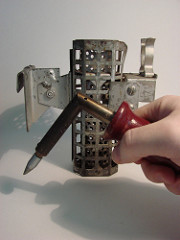
I like a really hot iron too Stealth, that master is probably 800F on low, and I run my Hakko up all the way, one brief tap and it's done, components don't even get hot, except where the solder is, instant perfect flow.


I use something similar to this helper (though with a light), my eyes are getting old
View attachment 627953
Those are helpful and cheap too.
Invalid Link Removed



I wish you guys where near me so I could come with my stuff, but you aren't so I have to do it myself. 

Yeah, i use a glass bottle from some Reed's raspberry ginger brew, as the headrest for my soldering iron. >_>Soldering station? What's that?
I like a really hot iron too Stealth, that master is probably 800F on low, and I run my Hakko up all the way, one brief tap and it's done, components don't even get hot, except where the solder is, instant perfect flow.
The secret is to use a hot iron with a clean chisel tip and get in and out fast. Too little heat and you end up heating the copper trace too much, while you wait for the joint to get hot enough to melt the solder.

Soldering station? What's that?
Lol...my soldering station is my bedroom floor!
Yeah, i use a glass bottle from some Reed's raspberry ginger brew, as the headrest for my soldering iron. >_>
post a pic!
 , or i call: "semantic misunderstanding thread crashing" on you guys
  the thread is a "let's see yours"
[edit: smileys added + grammar fixed]
Last edited:
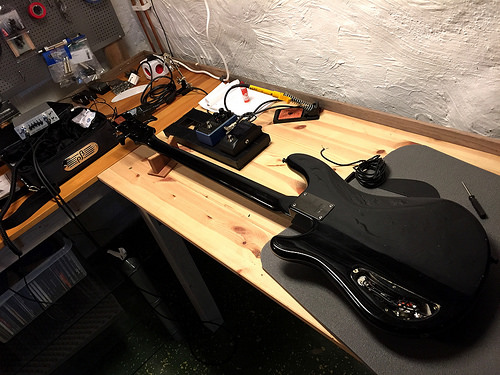
Man. I looked, and looked, and looked.Here's some pics of my workbench
View attachment 627909
View attachment 627910
View attachment 627911
View attachment 627912
Where is your soldering station?


Passinwind
I know nothing.
- Dec 3, 2003
- 23,087
- 46,068
- Disclosures
- Designer/Toaster Tech @ Passinwind Electronics
Oh, and I spent the last two weekends straightening up - got to the point where I couldn't function anymore. Was a disaster zone. Generally is after I finish a few builds. The janitor disclosure under my name is very real.
I hear ya. It would take at least a few days of solid work to approach organization out of chaos on my bench right now. Even weedeating is more fun...oh wait, a squirrel! My workspace is tiny, so clutter turns overwhelming really easily.
Besides the Hakko 888 and Pace ST 115, I have a big ol' 300 watt handheld iron for things like Fender chassis grounds. Stinky, ugly, dangerous, what's not to like? It's in storage right now though, so no pic. IMO this thread needs more tips, and a little more funk. Detritus Awreetus-Awrightus, so to speak:
So do I get extra credit for the zircon encrusted tweezers?
as for debris, im saving my $$ waste from the first photo, in the jar in the second oneIMO this thread... and a little more funk. Detritus Awreetus-Awrightus...
since it's worth so much $$ in scrap. i'm planning on cashing out when my jar's filled
Last edited:

Ric5
Inactive
- Jan 29, 2008
- 29,772
- 30,452
- Disclosures
- I like 5, 8, 10, and 12 string basses
Man. I looked, and looked, and looked.
Where is your soldering station?
Ya ... it is there ... just hard to see in the photos ... I keep a soldering iron just to the right of my work area. I put the iron on a 12x12 piece of marble so it can't start a fire.

