

Enjoy the benefits of a premium membership!
Upgrade Account
-
TalkBass has been independent since 1998. Add your voice.
Create a free account to reply to discussions, view embedded media, and browse with fewer display ads.
Join free Log in
Want zero display ads or expanded classifieds tools? Compare plans.
You are using an out of date browser. It may not display this or other websites correctly.
You should upgrade or use an alternative browser.
You should upgrade or use an alternative browser.
Let's see your soldering station! (pics and poll)
- Thread starter Dash Lashes
- Start date
More options
Who Replied?


BurningSkies
CRAZY BALDHEAD
- Feb 20, 2005
- 27,956
- 20,350
- Disclosures
- Endorsing artist: Dingwall Guitars
Computer desk, which doubles for mixing/monitor desk and soldering station. I generally only do cables, cords and repairs. I also use it for cutting and splicing loops for tape delay.
Invalid Link Removed
Invalid Link Removed
^^^^Not my usual or preferred tape^^^^
What I'm usually faced with:
Invalid Link Removed
Invalid Link Removed
Invalid Link Removed
^^^^Not my usual or preferred tape^^^^
What I'm usually faced with:
Invalid Link Removed
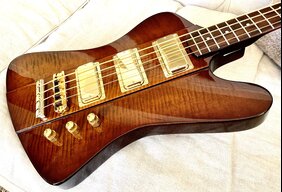
As promised, a pic of my soldering station...

...with a couple of works in progress (Spector Tonepump, jazz control plate and a GFS Strat lipstick).
...with a couple of works in progress (Spector Tonepump, jazz control plate and a GFS Strat lipstick).


I spend way too much on stuff like that. A fluke handheld is nice but expensive.
$100 buys you a much better meter than a $20 one. The low end ones are often not that accurate.
Right! It's important to distinguish between precision and accuracy. I've always taught my students that just because the screen will show that many decimal places doesn't mean that it's real or true.
Raf

Pace ST 115
Those things are great... used one at the last place I worked. Only thing I didn't like about it is the glass tube in it is a bit on the fragile side when you're trying to get the little metal deflector thing out of it for cleaning purposes. Yeah, I did break one, but I wasn't the only one (the guy who ordered our supplies knew to have spares on hand).

Some cool work spaces, for sure.
Lots more GASeous expenditures to lust about.
I will definitely need a designated station area, as a kitchen table or whatever isn't going to work for me. I'll get halfway through doing something and need to break for dinner or do something else and come back and finish whatever the project is later, be it a batch of patch cables or a pedal kit I've managed to mess up and having to trouble-shoot.
Lots more GASeous expenditures to lust about.
I will definitely need a designated station area, as a kitchen table or whatever isn't going to work for me. I'll get halfway through doing something and need to break for dinner or do something else and come back and finish whatever the project is later, be it a batch of patch cables or a pedal kit I've managed to mess up and having to trouble-shoot.

Okay, finally got a makeshift station set up last night. I got a DOD FX91 overdrive pedal with some equipment a while back and found that it has a bad resistor from the factory. My goal was to replace it. The resistor seemed to swap out okay although my soldering is horrible. Then I found I had pulled a wire out and spent the next 3 or 4 hours soldering connections back onto the board. I now remember why I hate soldering. Maybe one of these days I'll actually get good enough to fix things instead of destroy them.
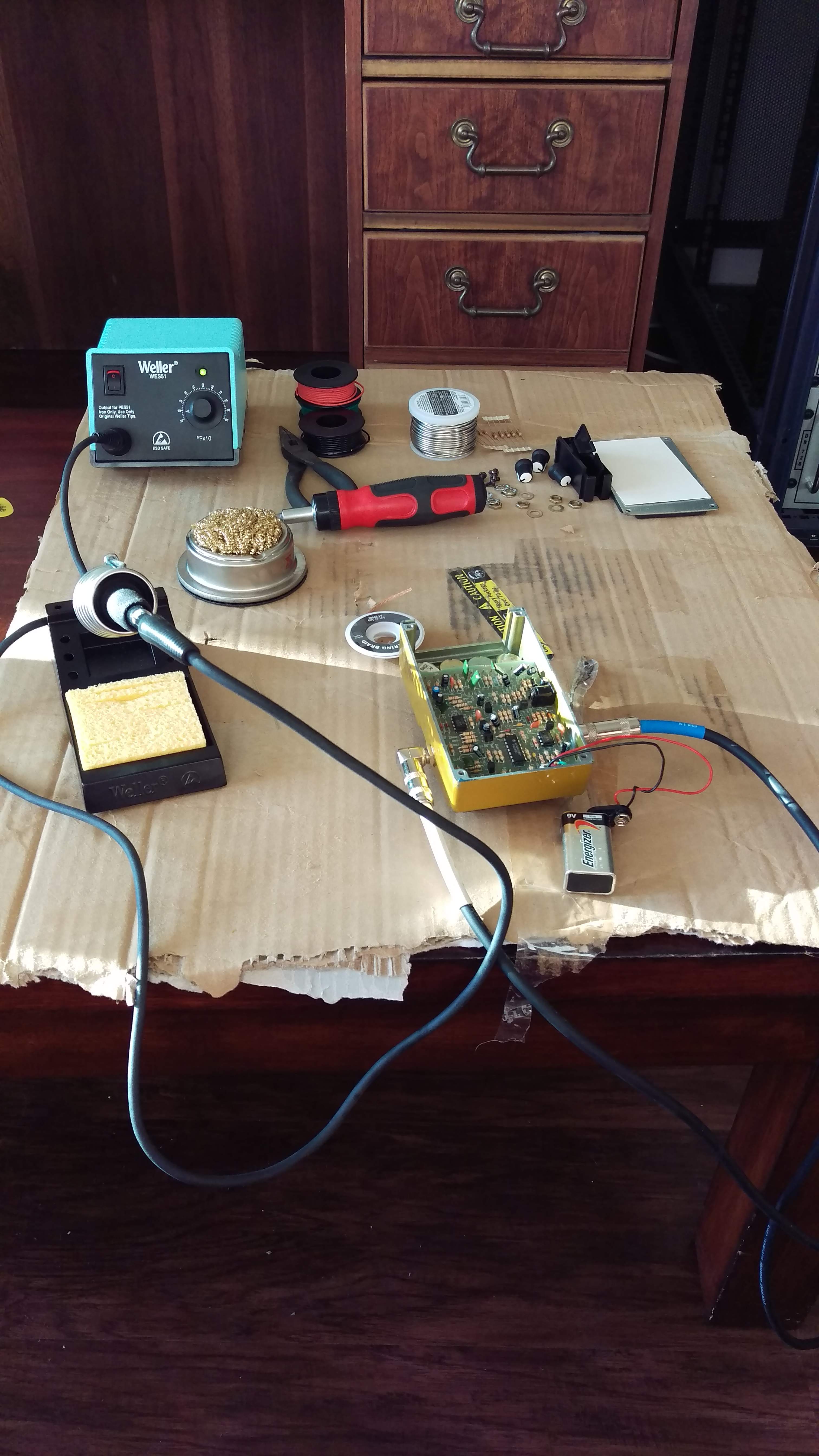


Okay, finally got a makeshift station set up last night. I got a DOD FX91 overdrive pedal with some equipment a while back and found that it has a bad resistor from the factory. My goal was to replace it. The resistor seemed to swap out okay although my soldering is horrible. Then I found I had pulled a wire out and spent the next 3 or 4 hours soldering connections back onto the board. I now remember why I hate soldering. Maybe one of these days I'll actually get good enough to fix things instead of destroy them.
View attachment 628605
With your iron at about 395 degrees, I would have lots of trouble as well.
With your iron at about 395 degrees, I would have lots of trouble as well.
That's where I started, but I quickly read up on that and adjusted it to 750F. That seemed to work for the resistor but I then ended up having to re-solder some wires back to the board and I found that 800F was better. I'm still trying to figure out how to make the solder stick to anything other than the tip of the pen. I know you heat up the wire/joint and apply the solder to that but I swear I can hold the iron on something until everything around it burns up (including my hands!) and the solder still won't flow so I'm obviously doing something really wrong. I'm sure I just need practice. I want to order a few kits off of Amazon or something but I'm not sure what a good starter would be. Some of the mini music amps seem cool. We'll see.
That's where I started, but I quickly read up on that and adjusted it to 750F. That seemed to work for the resistor but I then ended up having to re-solder some wires back to the board and I found that 800F was better. I'm still trying to figure out how to make the solder stick to anything other than the tip of the pen. I know you heat up the wire/joint and apply the solder to that but I swear I can hold the iron on something until everything around it burns up (including my hands!) and the solder still won't flow so I'm obviously doing something really wrong. I'm sure I just need practice. I want to order a few kits off of Amazon or something but I'm not sure what a good starter would be. Some of the mini music amps seem cool. We'll see.
Does your solder have a flux core? Flux prepares the joint for the solder. You can get flux in a preloaded syringe or paste tub.
Always start with a clean tip, melt a small dab of fresh solder that you will use to contact the solder pad and component or pre-tinned wire lead. Flow the solder from the opposite side of the iron so the solder will only flow when the joint is hot enough. If your solder does not have a flux core you will need to place some flux on the joint before you attempt to solder the joint. Most PCB work I use between 550 and 650 degrees unless it is a wide/large trace.
Pre-tinning (a sparse application of solder to the bare wire) is a must for a easy, good quality solder joint.

FOLKS! 

... post a picture of your soldering station, and at least make sure your actual station gets into the picture, or you'll be deemed to have no soldering station at all 

... post a picture of your soldering station, and at least make sure your actual station gets into the picture
, or you'll be deemed to have no soldering station at all
Last edited:
Does your solder have a flux core? Flux prepares the joint for the solder. You can get flux in a preloaded syringe or paste tub.
Always start with a clean tip, melt a small dab of fresh solder that you will use to contact the solder pad and component or pre-tinned wire lead. Flow the solder from the opposite side of the iron so the solder will only flow when the joint is hot enough. If your solder does not have a flux core you will need to place some flux on the joint before you attempt to solder the joint. Most PCB work I use between 550 and 650 degrees unless it is a wide/large trace.
Pre-tinning (a sparse application of solder to the bare wire) is a must for a easy, good quality solder joint.
The flux is "rosin core" which I understand to have flux in it. The videos I have watched show the flux burning off of the tip and that mimics what I see. I'll have to practice tinning wires. I wasn't sure if every wire needed to be tinned so that will probably help a lot. Thanks for the tips!

Passinwind
I know nothing.
- Dec 3, 2003
- 23,088
- 46,072
- Disclosures
- Designer/Toaster Tech @ Passinwind Electronics
That's where I started, but I quickly read up on that and adjusted it to 750F. That seemed to work for the resistor but I then ended up having to re-solder some wires back to the board and I found that 800F was better.
The thermal mass of your tip matters too, not just the temp setting. So heavier wires or pot bodies benefit from using a bigger tip, since it won't cool down as quickly when confronted with a lot of heat sinking effect by the material you're soldering. There's a lot to be said for being able to get in and get out quickly.
The flux is "rosin core" which I understand to have flux in it. The videos I have watched show the flux burning off of the tip and that mimics what I see. I'll have to practice tinning wires. I wasn't sure if every wire needed to be tinned so that will probably help a lot. Thanks for the tips!
Any wire should be tinned unless it is going into a speakon connector or banana jack.
Try to avoid letting the solder wick under the insulation when you tin a wire. There should be a short area of un-tinned wire so the connection can flex without breaking the wire.
This is reminding me of the old days teaching mil-spec soldering.

The thermal mass of your tip matters too, not just the temp setting. So heavier wires or pot bodies benefit from using a bigger tip, since it won't cool down as quickly when confronted with a lot of heat sinking effect by the material you're soldering. There's a lot to be said for being able to get in and get out quickly.
The quicker the better. Added flux helps to reduce the time heat is applied (as Charlie knows).
Passinwind
I know nothing.
- Dec 3, 2003
- 23,088
- 46,072
- Disclosures
- Designer/Toaster Tech @ Passinwind Electronics
Lots of great info in this thread!
Here's some more info that might be helpful. I tend to prefer 63/37 solder for many electronics applications, for reasons you'll see in that tutorial.


