
I use the same 2-button switch. As mentioned (earlier in this thread, I think) there is enough slack in the wiring internally that you can also just swap the position of the buttons. Just remove the screws to take the back off the case, and remove the nuts holding the switches in place. Swap the button positions, and put it back together. No soldering required.Some size perspective for you.
Worth noting:
I think the adage "You Get What You Pay For" applies here. My Dual Switch seems to be wired backwards, but I haven't opened it up to take a look. For Tuner to be on the right side of the switch, I had to assign that function to FS4. (For those wondering, I did indeed try assigning them correctly and inverting the polarity, but then the switch and the Stomp didn't play nice for whatever reason.Stomp didn't always respond to holding Tuner to mute.)
For only $18, I can live with it though... The flexibility of the Stomp lets me program around the problem, and it's not really worth the hassle of returning the pedal to try another one. It may be wired backwards, but it's a solidly built and I can make it work the way I want it to. And it was only $18, shipping included.
5sg.
View attachment 3355002

Enjoy the benefits of a premium membership!
Upgrade Account
-
TalkBass has been independent since 1998. Add your voice.
Create a free account to reply to discussions, view embedded media, and browse with fewer display ads.
Join free Log in
Want zero display ads or expanded classifieds tools? Compare plans.
You are using an out of date browser. It may not display this or other websites correctly.
You should upgrade or use an alternative browser.
You should upgrade or use an alternative browser.
Line 6 HX Stomp
- Thread starter been_effected
- Start date
More options
Who Replied?


I use the same 2-button switch. As mentioned (earlier in this thread, I think) there is enough slack in the wiring internally that you can also just swap the position of the buttons. Just remove the screws to take the back off the case, and remove the nuts holding the switches in place. Swap the button positions, and put it back together. No soldering required.
But....... then I'd have to reprogram my Stomp!


5sg.
Has anyone tried using their Stomp as a preamp (using preamp or amp sim blocks) in to the XLR in of a Quilter BB800 (bypassing the BB800 preamp) and in to bass cabs? Results?

Not a Stomp but an LT, and yep works great sounds fantastic.

So continuing on with the idea of using the Hx Stomp in to a power amp.....
If the Stomp goes in to the effects return of the amp in question bypassing all of the preamp functions of that amp, does the amp itself really matter?
What I mean is, If I run the Stomp in to the Return of a Mesa D800+, Quilter BB800, or Genzler Magellan 800, it doesn't really matter. Im getting 800w at 4ohm from each of them and not using their preamp functionality. So in other words, the only differentiating factor between the 3 would be form factor (size and weight), price, and any minor power differences at 8 ohms, correct?
Would it be fair to say, when used in this manner, the BB800 is the best option of the three because of price and form factor?
If the Stomp goes in to the effects return of the amp in question bypassing all of the preamp functions of that amp, does the amp itself really matter?
What I mean is, If I run the Stomp in to the Return of a Mesa D800+, Quilter BB800, or Genzler Magellan 800, it doesn't really matter. Im getting 800w at 4ohm from each of them and not using their preamp functionality. So in other words, the only differentiating factor between the 3 would be form factor (size and weight), price, and any minor power differences at 8 ohms, correct?
Would it be fair to say, when used in this manner, the BB800 is the best option of the three because of price and form factor?

Would it be fair to say, when used in this manner, the BB800 is the best option of the three because of price and form factor?
I’d say so, yes.
I'd agree, especially in terms of bang per pound, the Quilter is Really light.. I've been playing with this setup for only a week though, using 2 different amps and experimenting with both inputs. The other amp besides the quilter I'm using is the Peavy MiniMega and I can hear a difference between the 2 power sections but the Peavy has a little more oomph available at 8 ohms. I think I really like the Helix better into the front end of the Quilter because it's nice to have those subtle tweaking knobs available without going all the way to the floor.
I'd agree, especially in terms of bang per pound, the Quilter is Really light.. I've been playing with this setup for only a week though, using 2 different amps and experimenting with both inputs. The other amp besides the quilter I'm using is the Peavy MiniMega and I can hear a difference between the 2 power sections but the Peavy has a little more oomph available at 8 ohms. I think I really like the Helix better into the front end of the Quilter because it's nice to have those subtle tweaking knobs available without going all the way to the floor.
So this raises a question to me. If the BB800 is left flat....is there any difference between going in to the actual input vs. the Line In on the back?
Another thing I thought of that would be nice would be a Model of the Quilter. Does anyone know if anyone has done this yet?
So this raises a question to me. If the BB800 is left flat....is there any difference between going in to the actual input vs. the Line In on the back?
Not sound wise, you just lose the ability to tweak your sound with the other 3 knobs.

I'm not familiar with that particular amp. In general, there *could* be coloration going on in the gain stage. I've owned bass amps with stuff like a 12AX7 tube between the input jack and the EQ, controlled by the gain knob. Bypassing the EQ and going straight into the power section would also bypass that tube and its coloration.So this raises a question to me. If the BB800 is left flat....is there any difference between going in to the actual input vs. the Line In on the back?
Amp section is also relevant. They have diferent design and the sound is not the same
Last edited:

Does anyone have a suggested method/routine/process for achieving unity gain on the HX Stomp?
I'm just starting this process as I'm developing patches. I'm feeding it into Ableton, which has decent visual monitoring. I have a live set saved just for bass that has stuff like the spectrum analyzer and a tuner active. The main level bars are nice and big and have peaks with a slow decay so I can see how loud I'm getting while I play.Does anyone have a suggested method/routine/process for achieving unity gain on the HX Stomp?
As for the actual output, I use the Send to go to FOH. I have the Send level set to Line, the main outs set to Instrument (to go to my on-stage amp), and the volume knob only controlling the headphone jack so the output levels stay consistent and the only volume controls are on the blocks within the patch itself.
Can you clarify, do you mean maintaining good gain staging throughout the modules in a preset, or maintaining similar relative output levels among presets?Does anyone have a suggested method/routine/process for achieving unity gain on the HX Stomp?
If you mean the former (gain staging), the lack of internal metering necessary to do so is a common complaint among Helix users. Line 6 have offered some hope in saying that the shift of all units to the Helix Core firmware code base, and the optimization that brings, may allow the introduction of metering at some point in the future. Until then, I think we just need to be sensible in our module settings, and use our ears.
If you mean the latter (relative preset volumes), I can outline my process. Like @Jehos, I too make certain that the only volume controls in use are within the preset in order to ensure there is no variance on what is sent to FOH. (It removes the temptation to bump the volume knob in escalating stage volume wars.
 )
)To set the relative preset output levels, I have a project in my DAW (Logic Pro X) that has a clip of me playing 1/8 notes at E2 with a moderately strong attack using a pick on my bass ('78 Fender P) directly into my audio interface with no pre-amp boost. My recording levels wind up being around -26 dB, which is kind of low; but my intent is to have a "natural" bass guitar signal, as opposed to optimizing the signal/noise ratio.
I then loop the playback of this clip, and send it into the Stomp via the USB Output ports 5/6 to re-amp it through the various presets I am tweaking. I receive the incoming re-amp'd signal from the Stomp into another track via the Stomp's USB Inputs 1/2. I mute the original (source signal) track, and monitor the incoming (re-amp'd signal) track.
I adjust the parameters of the patch as necessary to get the full output level around -12dB. I may tweak amp channel/master volumes, mic models/proximity, any compression, or simply adjust the output level for the patch: whatever works best. Once, I get it around -12dB in level and sounding good, I compare it to other presets to make sure it sounds around the same apparent volume. Depending on the overall tonality, different presets can sound louder or softer; e.g. a chorused or distorted preset may lose some of its bottom end, whereas a "fridge" cab with a boomy condenser mic may sound louder.
So, the re-amped track level gets me close, then I season to taste.
Hope this helps.
Thanks, @Droopy_TX . Of the two scenarios you mentioned, I'm interested in the latter (relatively similar volume among presents), and I appreciate the effort you took to describe your process. I'll play around with that myself tonight.
I'm stealing the heck out of this.To set the relative preset output levels, I have a project in my DAW (Logic Pro X) that has a clip of me playing 1/8 notes at E2 with a moderately strong attack using a pick on my bass ('78 Fender P) directly into my audio interface with no pre-amp boost. My recording levels wind up being around -26 dB, which is kind of low; but my intent is to have a "natural" bass guitar signal, as opposed to optimizing the signal/noise ratio.
I then loop the playback of this clip, and send it into the Stomp via the USB Output ports 5/6 to re-amp it through the various presets I am tweaking. I receive the incoming re-amp'd signal from the Stomp into another track via the Stomp's USB Inputs 1/2. I mute the original (source signal) track, and monitor the incoming (re-amp'd signal) track.

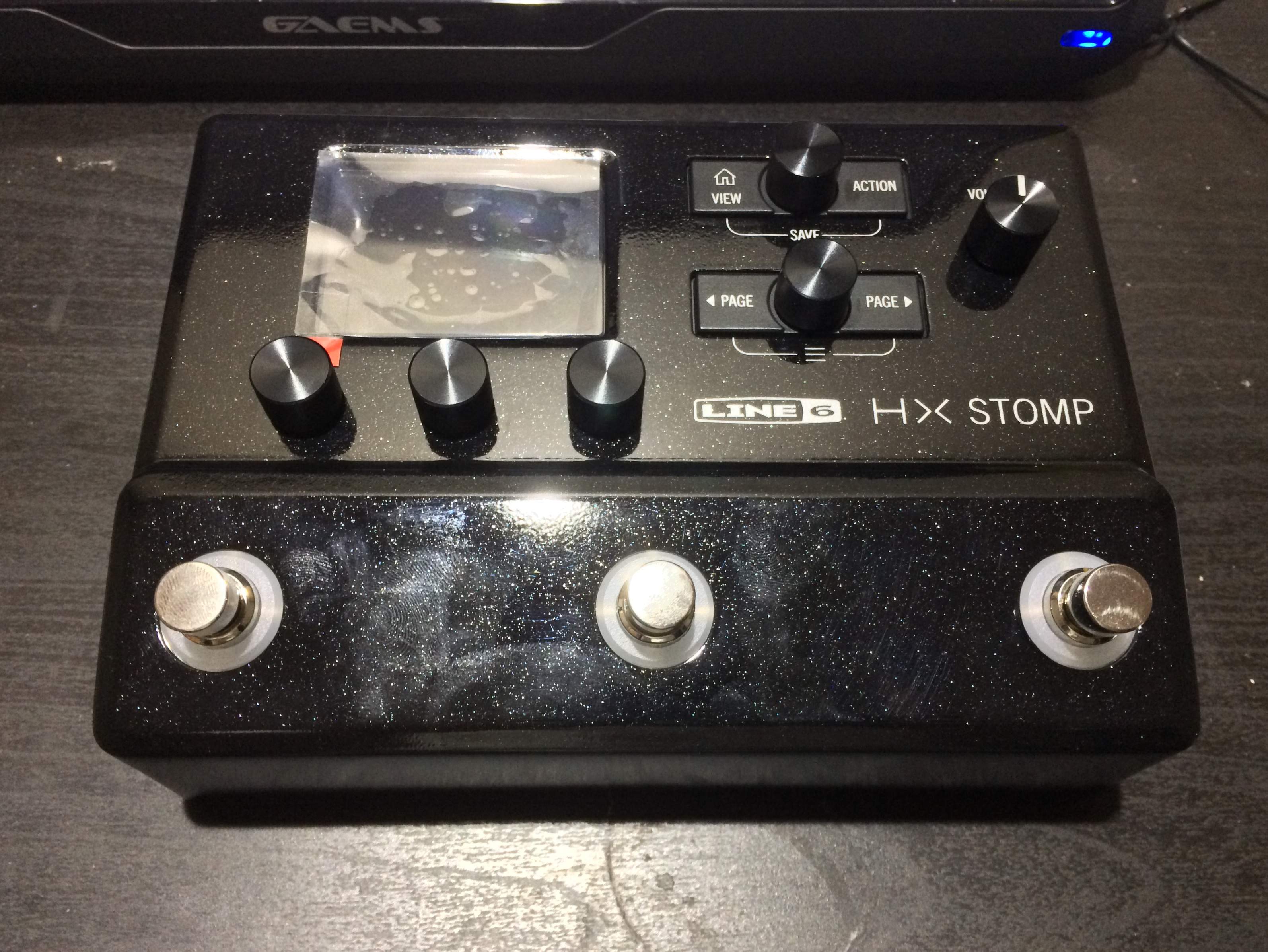
So after selling my GK Plex and Zoom B3n, I am now finally a proud owner of an HX Stomp! This thing is awesome. And to answer my own question - with my desktop, Line 6 asio with max settings, I have a reported 8.6 ms latency in Reaper, sadly with crackles. With Asio4All, I get a reported 2.1 ms latency, with minimal crackles. Will explore the multi-effect side of things in the next few weeks!
Great! Glad to help, and happy to be able to give back to this great community.Thanks, @Droopy_TX . Of the two scenarios you mentioned, I'm interested in the latter (relatively similar volume among presents), and I appreciate the effort you took to describe your process. I'll play around with that myself tonight.
Please do. In my career, regarding best practices, our motto was always, "Steal with pride!"I'm stealing the heck out of this.


