• TalkBass has been independent since 1998. Add your voice.
    Create a free account to reply to discussions, view embedded media, and browse with fewer display ads.
    Join freeLog in
    Want zero display ads or expanded classifieds tools? Compare plans.

Long Excursion HiFi Woofer in my Crate Amp

Wasn't very happy with the original speaker that came with my Crate BT1000. Always seemed that I had to crank it up too much to be heard in our Church's worship band. I can hear it cranked up OK, but not the drummer and guitar players.

I had recently replaced the little BX-15 practice amp speaker with a long excursion 8" PC sub speaker with excellent results. (Made the 15 watt BX almost as loud as the 100 watt BT! LOL)

Spent the past few months hunting for a 12" PC sub, and remembered how some of those old component stereo speaker cabs had foam surrounds and pretty long excursion cones. Came across a set of Fisher st-512's (200 watt/100 watt RMS each @ 8ohms) in a consignment shop with nice long excursion 12s and paid 30US for the pair. The drivers were in perfect condition, like new.
fe2182ac.jpg

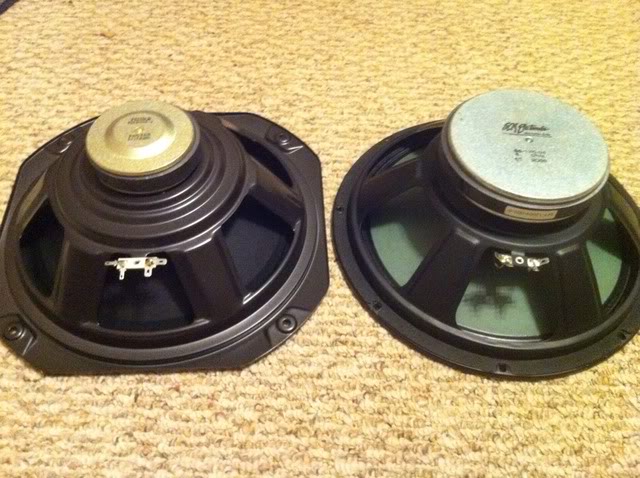
The Fisher(Foster) woofer on the left(notice the bumpout on the Foster magnet to allow an extended VC excursion)

46943124.jpg

Fisher Woofer left and Crate Speaker right
4c52ae6b.jpg

The Fisher (Foster) Woofer Installed.

Visual comparison of excursion between the speakers

The sound of the HIFI woofer is really good. Much cleaner and warmer with the low B sounding as nice and loud as the E! Volume is definitely higher all around even though the 8 ohm gets 50 watts instead of the old 4 ohm's 100.

Played it for a few hours this morning with my 5-string and it was addicting. The Acoustic bass thundered! :D

Let you know how the live playing works out....
 
The woofer I used has Foster (Korea) printed on it and I checked and it looks like Foster is an OEM only manufacturer. The same company that makes Fostex equipment.

The magnet assembly is quite smaller on the Foster woofer. But, the force I used to move the cone was almost nothing compared to that needed to move the Crate speaker so the Foster woofer cone lets the amp move the cone freely and not expend all the energy fighting the stiff surround. After all, the more the cone moves the more air gets moved!

Also, since I now have 2 of these woofers maybe I'll buy and subwoof box with black carpet to match the Crate Amp and mount the other woof in it so I can wire the 2 speakers parallel to give 4 ohms and get the full 100 watts out of the rig and even more volume!

This their current catalogue:

[Invalid or Expired Link Removed]
 
The magnet assembly is quite smaller on the Foster woofer. But, the force I used to move the cone was almost nothing compared to that needed to move the Crate speaker so the Foster woofer cone lets the amp move the cone freely and not expend all the energy fighting the stiff surround. After all, the more the cone moves the more air gets moved!
Rule #1 of Acoustical Engineering: There's no such thing as a free lunch. It's true that the hi-fi woofer has a looser suspension, and that it will allow higher output in the low end. But that low end output is realized at the expense of sensitivity in the mids. In a bedroom practice mode the added low end will sound good, but in a real gig situation the lack of midrange sensitivity may result in inadequate output to cut through in the mix.
You may find that the hi-fi driver works better for you in your particular application, and if so all well and good. But it would be the exception that proves the rule. Electric bass drivers don't go as low as hi-fi woofers because in the vast majority of cases their higher sensitivity and midrange response is more important than low end extension.
 
Rule #1 of Acoustical Engineering: There's no such thing as a free lunch. It's true that the hi-fi woofer has a looser suspension, and that it will allow higher output in the low end. But that low end output is realized at the expense of sensitivity in the mids. In a bedroom practice mode the added low end will sound good, but in a real gig situation the lack of midrange sensitivity may result in inadequate output to cut through in the mix.
You may find that the hi-fi driver works better for you in your particular application, and if so all well and good. But it would be the exception that proves the rule. Electric bass drivers don't go as low as hi-fi woofers because in the vast majority of cases their higher sensitivity and midrange response is more important than low end extension.

That sure was the case when i tried using the car sub. :D
I lost all the high end completely. But, that sub had a car tire for a surround on it. This woofer seems to make the upper range quite a bit louder(the G string was very weak with the Crate speaker). Now, as for the sparkle, though, it's not what it was.

I think the main thing that I like, is the way it gives that warm sound you hear in recordings. Sort of like the sound from the old tube Fender Bassmans with the Jensens.
 
Just came across some Hi Fi woofers similar to the Foster woof I used that you can try if you like. These come in 4 ohms as well as 8 ohms versions. I may spring for one of the 4 ohm models and use the 2 8 ohm Foster woofers for a cabinet and wire them parallel to get 4 ohms.

[Invalid or Expired Link Removed]

[Invalid or Expired Link Removed]

Invalid Link Removed

[Invalid or Expired Link Removed]
 
The main reason behind going with longer excursion speaker is to allow the amp to move more air.

That is a speaker that can move the cone 12mm (6mm Xmax) can move 2 times the amount of air that a speaker that only is able to move the cone 6mm (BTW the new Emminence "Basslite" model looks like the new Foster 12" woofer and has the same specs basically 5.9mm Xmax). That would translate into a major increase in volume all things being equal.
 
use what you will... no amount of nay posts will make you change your mind--- you will have to see for yourself.

hifi drivers... like this one, that you posted...
[Invalid or Expired Link Removed]

these specs are why it *will* suck in your crate bass cabinet:
SPL: 92.3 dB 2.83W/1m • Vas: 5.88 cu. ft. • Qms: 6.07 • Qes: 1.50 • Qts: 1.20

you may like the sound. you may even love it. however, the crate box is a fraction of the size that is needed for any flavor of "great" performance from this driver.
 
use what you will... no amount of nay posts will make you change your mind--- you will have to see for yourself.

hifi drivers... like this one, that you posted...
[Invalid or Expired Link Removed]

these specs are why it *will* suck in your crate bass cabinet:
SPL: 92.3 dB 2.83W/1m • Vas: 5.88 cu. ft. • Qms: 6.07 • Qes: 1.50 • Qts: 1.20

you may like the sound. you may even love it. however, the crate box is a fraction of the size that is needed for any flavor of "great" performance from this driver.

Yea, I'd be surprised if the box is more than 1.5 cubic feet. What, is 2 cubic feet more optimal for a 12?
 
Yea, I'd be surprised if the box is more than 1.5 cubic feet. What, is 2 cubic feet more optimal for a 12?
There is no 'optimal for a twelve'. Every driver is different. As for the one quoted, probably in the vicinity of 20 cubic feet, in a sealed or IB alignment.
If you're really interested in learning how speakers work about six months of reading can be found here:
Invalid Link Removed
 
Here's probably a better estimation considering volume loss for the amp compartment and the kick-back notch on the Crate BT1000. Also at 20hz porting the response curve flattens out much more.

foster3.jpg


So I'll start with a 1.85" tube and a length of 6.77". Hook up the amp to my laptop and run the signal generator and my Db meter at a meter distance and see how it performs setting the volume for 90db and 100hz or thereabouts.

:hiding:

Wayne
 
You're ignoring port air velocity. Your cab will go chuff, chuff, chuff when the cone gets moving and the air in that little tube can't keep up. Model it with the full power signal your amp has to give....and then some to allow for turning up the bass knob if needed.


I don't doubt this thing probably sounds better than what the Crate came with but +1 to all about using hifi woofers in bass cabs. Your bass signal has many power spikes, etc. where recorded music rarely deviates by more than 3db. All that lowend extension also comes at the price of sensitivity. Keep an eye on the foam surround and don't forget about the spider on the back side either. Try and find an xlim spec on that thing and calculate your safety margin.
 
Here's probably a better estimation considering volume loss for the amp compartment and the kick-back notch on the Crate BT1000. Also at 20hz porting the response curve flattens out much more.
The problem is you have no use for anything below 40Hz. You have maximum sensitivity and minimum excursion an octave lower than where it's of any value. And that's why hi-fi and auto-sound woofers are not used in electric bass cabs, they're simply the wrong tool for the job. If they did work then that's what we'd use.
 
The problem is you have no use for anything below 40Hz. You have maximum sensitivity and minimum excursion an octave lower than where it's of any value. And that's why hi-fi and auto-sound woofers are not used in electric bass cabs, they're simply the wrong tool for the job. If they did work then that's what we'd use.

I beleive my low B on the 5-string is 33 hz open so that's why the low port tuning and bumping it up more past 20 only increased the spike and the port tube was getting too long to fit.

I very often end songs on the B string to take advange of the long sustain to pad outros. So, the curve at 20hz porting is just right for my style of playing. Sometimes I'll keep the final low C or D growling by cranking on the Phat-II knob on my Ibanez to lengthen the sustain.

This amp ports in the back, so you don't hear any port noise.
 
Your assumption is that you're hearing the fundamental. While that's not untrue, the vast majority of what you're hearing are the first and even the second overtones above the fundamental when you describe the low end of your tone. Trying to get a cab to reproduce a portion of your signal that's substantially lower than what you can hear more easily is a waste in most playing situations, including the one you're describing.