I play too many notes if I use a short scale.

TalkBass has been independent since 1998. Add your voice.
Create a free account to reply to discussions, view embedded media, and browse with fewer display ads.
Join free Log in
Want zero display ads or expanded classifieds tools? Compare plans.



 ), and to me - they simply are what they are. I didn't buy a Rick because it's a slightly odd scale; or because it's a neck thru; or because somebody else played one. I bought it because it's a Rick, and I wanted one. Same for every other bass I own. My Gibson Thunderbird could have been a hollowbody, medium scale bass; I'd still have it, 'cause it's a Gibson Thunderbird. Same for all the rest of them. They are what they are... period. I don't worry about the scale, or string tension, or if it's an easy/hard reach on the fingerboard. I just put strings on them that make me happy, and play the snot out of them. Life's too short to worry about nit-noid crap. Just play the bass(es) that make you happy. Your nerves and your digestive system will thank you for it; and, who knows? You might even get to keep your hair. Like me....
This is just about the long and short of it. If you can adapt then you can roll with it. I played a MusicMaster for years because it was all I had. Quote from Waterboy.."You can do eet"whatever works for you


@jamro217 said
"I did try the new P/J Mustang at GC recently and wasn't impressed, but it could have been the amp, strings, what I had for breakfast... "
Same here. The difference being I loved the neck and they offer them in Torino Red which is my favorite classic Fender finish.
I didn't like the stock strings, the cheap switch everyone mentions, and the pups were underwhelming as well.
I stopped by the local GC often as soon as they started getting them in stock, waiting for a Torino Red one to hit the floor. Never happened.
A couple of months ago I stopped by another local shop that rents and there was a blue one that had been strung up with Chromes. Set up great, save for the Trainwreck pickup adjustments. But man it was the easiest playing bass I'v ever held in my hands.
Could have walked out the door with it for less than 450 and it was a 2017 made before they switched to pau ferro fretboards. But it was blue so I decided to think on it overnight. Went back and it had been rented out, which turned out to be a blessing because one day when I stop by to see if it had been returned yet they had just unboxed a Torino Red one.
I finally got to see TR in the wild. And it was indeed the classic TR I dig on the vintage Fender instruments. And the mint pickguard looks a whole lot more white than mint. I was delighted to see that as well. Had the pau ferro board but was a nice example. Straight grain and not "streaky" like a lot of them.
Plugged it into one of those little Elf stacks and played it about 45 minutes, focusing more on the neck and playability than the sound of it. Wasn't going to sound the same after I put Flats on it, adjusted or changed the pickups, or played it through my amps anyhow.
As it sits now, it has Rotosound 77's and I adjusted the pickups to where the P is about even in volume/output as the J. The J may be a tad louder.
J is set near Fender specs on the bass side and a bit lower than spec on the treble side.
The P pup wound up lowered quite a bit. Way lower than spec. But they actually sound quite good and achieved the balance with the J and made running both pups sound good. Nothing at all like they sounded when they slapped them in before they boxed it up.
Anyhow I made those adjustments to the pups when I put TI Jazz Flats on it. A few days ago I put the Roto 77's on and after tweaking the pups a tad, with the P pup only I'm hearing that classic Motown and old-school R&B tone I've been chasing with the volume control on the bass turned down. Turn the volume wide open and still sounds great and ready to rock.
I was wanting to upgrade the pups but I'm having second guesses about the stock P pup. The stock J on the other hand still doesn't sound good by itself no matter how I adjust it.
I may try one of those AERO J pups if it will drop in.
Short scale plays like air-guitar.
My Epiphone Rumblekat is just too easy to play. Sometimes, I just cannot stop...
From the other side, 35" is man's guitar. You have to fight it hard. It has some sort of resistance, you have to break...
Different pickups do have a huge influence on the tone.
I have a cheap short scale bass that is absolutely amazing to play, and I got lucky that it had a perfect fretboard with all equally leveled frets that allowed me to have the action really low, as well as it got an amazingly stable neck as well.
However it left something to wish for in the tone department, just kind of a dull uninspiring weak tone.
After a while I decided to change the P and J pickup in that bass with a pair of EMG Geezer Butlers, and what a difference it made.
Now it got a really great present, articulated kind of punchy and full tone with a bit of upper grind as well.
Just like I prefer it.
After the pickup swap that cheap bass became one of the best sounding basses I ever owned and it is now my main.
I can warmly recommend you changing the pickups.
What would make for an even more manly instrument would be one with a sandpaper fretboard and neck and spikes attached on the back of it's body, you know so you could really feel it fight back.
I guess one man's manly might be another man's unreasonable uncomfortable, clumsy and impractical.
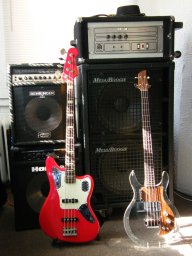
 I'm into long scale, but it's more a question what's comfortable to your hands & style, IMHO. Medium scale is a bit more awkward for me than either sort or long scale; my fingers can't make up their minds too well!

yeah, (as you know) he is a soloist...different requirements.I always thought short scale was for beginners or people with small fingers, but now I find out that Stanley Clark's Alembic was a short scale and there are a number of high end short scale basses out there that sound very good. So what is the advantages of each and why choose a short scale over a long scale?

Not really.yeah, (as you know) he is a soloist...different requirements.