If you place your two 2x10s side by side on the floor you will get a little more volume than stacking them, but you will need to stand further forward or tilt them back to hear yourself. You may think that to compete with the guitars you need more lows (60-100Hz) but it's boosting the low & high mids (500-2kHz) that will make you audible. If possible have both guitars stand on one side of the drums, and you on the other (they may tell each other to turn down).
Wholly agree
I have constant problems with feedback from the bass back thru the side of stage vocal PA. We have five microphones on stage.
The lead guitarist/vocalist insists on bass boost to enhance his voice, which only accentuates the feedback and makes it harder for me to match the average volume of the whole band
He has no less than four foldbacks on the floor, three PA speakers on stands out front and a 2 x 12 100W amp. He also suffers from industrial deafness so tends to play and sing at a high db level.
After years of experimenting in small and medium sized venues - many with small stages where the whole band is squeezed in close together - I find the solution is to mount the bass speakers as low to the floor as possible.
I normally use a combination of one, two or three 15 inch speakers but prefer 18's - depends upon floor space.
Where possible have only one low down speaker or combo on stage (so you can hear yourself and for appearance) and one or more extension speaker units on the floor below the raised stage at the side.
This does three things -
1. It gets the bass sound down low below the singer/lead guitarist's ears so the bass volume can be much higher before he can hear it (He is mostly focused on hearing his own voice and playing so the bass volume can be as high as I can reach without him being distracted from his own performance by competing sound). Bass is not directional so happily travels around the room reasonably evenly.
Floor mounted bass cabs will deliver much better floor and wall shaking bass.
2. It reduces irritation to the singer/lead guitarist who is distracted by bass notes which do not fit his preconceptions or threatens his wonderfulness
3. It allows the audience to hear a more balanced sound, noting the whole purpose of bass is to provide aural balance to the mostly mid-range to HF of the other instruments and voice. If there is no bass the overall sound is shallow, so the audience needs BASS.
Other tricks are to boost the HF (treble) and some mid-range so as to accentuate the harmonics.
If using a pick, pick noise and clicks help to be noticed but can also irritate.
Position the bass speakers on both sides of the stage. This distributes the power more efficiently and evenly, puts the whole band in the sound zone and enhances the whole performance.
But for a big full bass sound there is no substitute for more speakers - the bigger the better - but keep them as low as practicable to the floor and angled sideways slightly to eliminate standing waves in the room. For best effect some experimenting is needed for each situation.
The bass needs to be present but not dominant.
All of the above is contrary to big event sound systems where the speakers are hung from the ceiling - but in those systems there is usually a control desk with the capacity for independent management of the overall sound balance. They also tend to shake the audience but not the building - is not quite the same as conditions on stage.



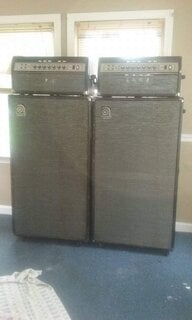



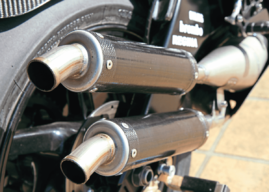


 Well, it is an option! Yeah, just daisy chain the extra cabs. But I don't think twistlock is what . . . uh, ... he-e-ey!!! Wait a minute!
  As if that much power would require industrial strength twistlock cables . . .