

Enjoy the benefits of a premium membership!
Upgrade Account
-
TalkBass has been independent since 1998. Add your voice.
Create a free account to reply to discussions, view embedded media, and browse with fewer display ads.
Join free Log in
Want zero display ads or expanded classifieds tools? Compare plans.
You are using an out of date browser. It may not display this or other websites correctly.
You should upgrade or use an alternative browser.
You should upgrade or use an alternative browser.
Magnets & Copper Wire: A Pickup Building Thread
- Thread starter Freekmagnet
- Start date
More options
Who Replied?

That's cool.
When you get to the end, do you slow it down with a controller and do the last few wraps very slowly, or by hand?
When you get to the end, do you slow it down with a controller and do the last few wraps very slowly, or by hand?
That's cool.
When you get to the end, do you slow it down with a controller and do the last few wraps very slowly, or by hand?
I slow it down on the last few wraps.

Not that I'm thinking of getting one any time soon,...... but are there any winders that people made or bought in this thread?
Mine is near the bottom of the first page of this thread, post #16. It qualifies as Off The Deep End Engineering. All mechanical, semi-automatic leadscrew feed, able to handle up to 5" long bobbins, etc. It's been serving me well for about 15 years.
Here's my new DIY winder:
Magnets & Copper Wire: A Pickup Building Thread
Prior to that I'd been using another DIY winder that was basically a very junky gear reduction with a counter attached to a sewing machine motor.
Magnets & Copper Wire: A Pickup Building Thread
Prior to that I'd been using another DIY winder that was basically a very junky gear reduction with a counter attached to a sewing machine motor.
Bruce, do you have any closeup shots that would show how this works and would you be willing to share?This feeding motion is done with a leadscrew, a slowly spinning shaft with threads on it. The threads on the leadscrew drive the side-to-side movement of the feed assembly. It keeps the movement linear and accurate. The leadscrew is synchronized by the timing belts to the movement of the spindle. With every rotation of the bobbin, the leadscrew drives the feed mechanism sideways just over 0.002". Slightly more than the diameter of the coil wire. That's how it's able to lay down very flat layers on the bobbin, for tight, compact coils.
I understand the gist of the concept,b can't picture the details of how you pulled this off.
Also, was wondering how the oscillating mechanism from a house fan might be able to be modified to accomplish something like this.
One destroyed house fan later,..... I don't think I can make that work.

I imagine the gotcha would be the need to make the thread guide synch with the winder speed.Also, was wondering how the oscillating mechanism from a house fan might be able to be modified to accomplish something like this.
Advantage of having a programmable servo controller do it instead is it can do the math regarding wire width, spool width and depth and winder speed, so that you don't have to. (Or, at least if you're programming the controller, you only have to do it once rather than for each pickup.)
Bruce, do you have any closeup shots that would show how this works and would you be willing to share?
I understand the gist of the concept,b can't picture the details of how you pulled this off.
Also, was wondering how the oscillating mechanism from a house fan might be able to be modified to accomplish something like this.
One destroyed house fan later,..... I don't think I can make that work.
@ardgedee is correct.
The problem with fan motor is that it won’t synchronize with the winder motor. Jason Lollar’s machine runs on an oscillating fan motor. I built his machine and I got frustrated with it because I couldn’t adjust the wire spacing. There might be a way to sync the two motors, but for the amount of work, you might be better off using a different approach.
I don’t know if you have any programming skills, but there’s several ways you can go about making an auto traverse mechanism using an Arduino controller. That’s what I did with mine. I can program it to do different traverse rates for different gauge wires. It’s not as spot in as Bruce’s, but it’s pretty close and I can easily change it for 41, 42, 43, 44 or any other gauge wire.
Zero.I don’t know if you have any programming skills

Depending on how complicated Bruce's setup is, I might actually have a better shot at making something mechanical like that,.... IF I build a winder eventually.


Lindy Fralin builds two 5-string pickups for me under a P90 cover with no holes. The first is his Big Single, a sidewinder design that uses a magnet in top of a mild steel blade. The magnet used in the pickup is a bit of a trade secret and it's not what is shown in the photo.
In order to accommodate a 5-string bass, I had to have wider blades cut from mild steel. I also need to cut and glue together guitar bobbins. I made up a cutting jig and use a blade wrapped in packing tape as a gluing jig. These are ready for winding and Lindy's shop will take it from here.
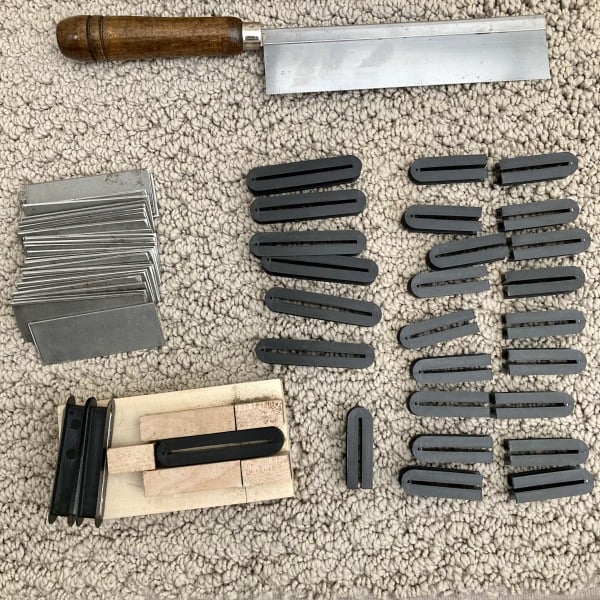
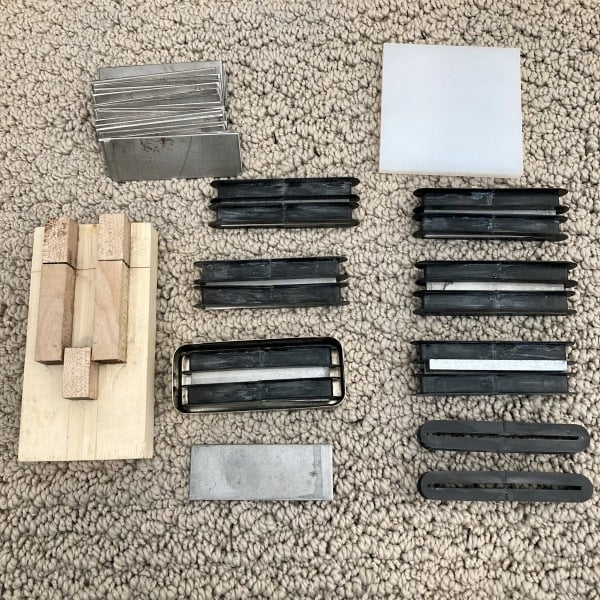
In order to accommodate a 5-string bass, I had to have wider blades cut from mild steel. I also need to cut and glue together guitar bobbins. I made up a cutting jig and use a blade wrapped in packing tape as a gluing jig. These are ready for winding and Lindy's shop will take it from here.
My second Fralin 5-string option is a Split-J 3+2 under a P90 cover with no holes. I cut down, shape and narrow standard bobbins and use a scrap dogear P90 plate for fitment. I'm a sucker for noise canceling so I have both of these Fralin sets wired up with braided leads. I also offer a Lollar Thunderbird V and I haven't seen anybody else offer them yet.
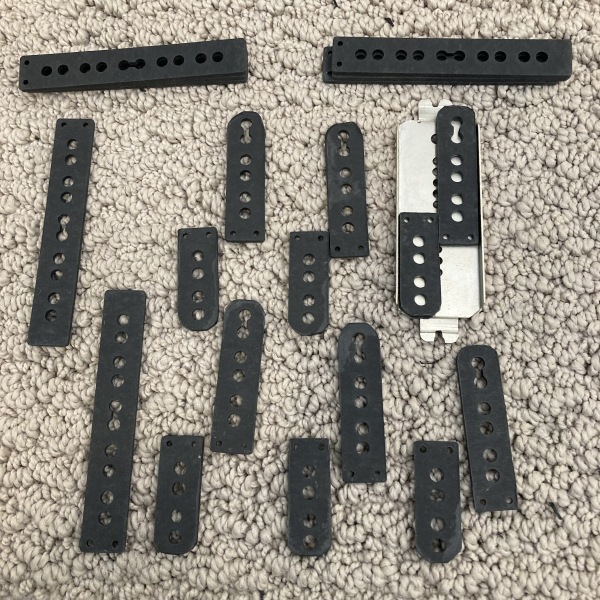

My second Fralin 5-string option is a Split-J 3+2 under a P90 cover with no holes. I cut down, shape and narrow standard bobbins and use a scrap dogear P90 plate for fitment. I'm a sucker for noise canceling so I have both of these Fralin sets wired up with braided leads. I also offer a Lollar Thunderbird V and I haven't seen anybody else offer them yet.
View attachment 4372153
Really cool, I've often wondered if someone had tried a non linear split coil in a P90 or tradition humbucker sized housing. I imagined someone had, but cool to know Fralin is one who does.
For some time, I've been contemplating finding someone who'd be interested in doing a linear split coil MFD style pickup. It's likely a ways off from fruition, but something I've yet to veer from.
well, I’ve been reading and learning for about 5 years now, and have yet to build a single component (I did, however, end up with a parts bass, somewhat by accident). Along the way, I have learned to experiment with what I got, which is more in the modding than building category. But I learn the most from folks that hang out in the luthiers forum.
The best learning tool I found for figuring out pickups is a mule type bass - one with a swimpool route (or another similar solution) that allows moving and switching pickups easily. Trying a bunch of pickups in a few different places can help you figure out a few key parameters before you commit to a build. At least that’s how I’m approaching it…
so, I guess what I’m saying is, maybe just get started? Maybe not a whole build, but modding a bass, or putting together a parts bass? Tweak this and that, make mistakes, learn a lot…
Like this? The kids even decorated it (photo is pre crayons)! Love playing this thing, saved tons of time figuring out what I want. Hell sounds so good, I might just paint it and make a real pickguard and nicer neck.
Really cool, I've often wondered if someone had tried a non linear split coil in a P90 or tradition humbucker sized housing. I imagined someone had, but cool to know Fralin is one who does. [...]
Yes, and I have actually had Lindy build a Twangmaster under a humbucker cover with no holes for bass. They sound great!
Fralin Twangmaster Guitar Pickups: Single Coil Tone, Humbucker Size.
Not that I'm thinking of getting one any time soon,...... but are there any winders that people made or bought in this thread?
I posted my winder in post #407. It doesn't get much more funky and out on a limb, but works very well. I wound a bunch of 6, 7, and 8 pole buckers with it. You just don't see many pickup winders using a mechanical foot control!

The turns counter is "unique" and uses the constant function of the calculator to indicate the number of turns of wire on the coil. Each time the magnet passes the reed switch that equates to 6.37 turns of the coil. I did it that way to get around the problem of a magnetic switch being able to track each revolution accurately. Once I figured it out I found it works very reliably. Accurate turns counting was the single biggest problem for me, as I wanted to do it REALLY CHEAPLY! An spare calculator and a cheap reed switch from the Shack was a frugal solution. I popped the calculator cae apart and found the two small circuit board points that the "=" button attached to. I soldered a couple small leads on to the pads and "Bob's yer uncle".

Zero.
Depending on how complicated Bruce's setup is, I might actually have a better shot at making something mechanical like that,.... IF I build a winder eventually.
Depending on how you configure the setup, I don't think you need actual "automatic" matching or sync'ing of speeds, as long as you can adjust both the wind speed and the traverse speed and are able to find the sweet spot for each bobbin size with experimentation.
At any rate, personally, I don't find an auto traverse to be critical. After you've wound a couple of a given design, you get a very good feel for traverse rate by hand. I know that my regular blade design needs the bobbin speed control knob at 12 o'clock and it takes about 300 turns per traverse. Watching the wire move across the bobbin as you wind, and glancing at the turn counter as you go, it's pretty easy to stay within maybe 10% of a target like that. Learning that the "manual way" will set you up well for adding an auto traverse later if you want to.
That said I really WANT an auto traverse and I built a provision for one on my new machine, but here I am 50 or 60 coils later and I still haven't finished it. I'm interested more for ergonomics than any other reason. Sitting at a winder grasping the traverse and slowly moving it back and forth is harder on the human body than it sounds. Part of my problem is similar to problems you've expressed - I have a hundred other ideas in my head, so it's hard to focus on one process or project enough to be 100% optimal at it. My winder will probably stay as-is for now while I get some other things off the ground.
I'm actually thinking about pretty much everything you mentioned.
Do I jump into making pups this early in the game?
If I do, do I spend $$$ on a full, out-of -box rig? (I already know that's a "no")
If I make one, do I spend a lot of time building something as complicated as a mechanical auto traverse, because a have neck issues that are progressively getting worse and sitting in one spot, hunched over a winder like that would probably be miserable.
Or, back to question one, do I just buy pups from folks who make them and name brand stuff?
Building pups is definitely interesting and something I want to try. It seems like something I could get into.
I'll just have to pick my battles carefully, moving forward.
Do I jump into making pups this early in the game?
If I do, do I spend $$$ on a full, out-of -box rig? (I already know that's a "no")
If I make one, do I spend a lot of time building something as complicated as a mechanical auto traverse, because a have neck issues that are progressively getting worse and sitting in one spot, hunched over a winder like that would probably be miserable.
Or, back to question one, do I just buy pups from folks who make them and name brand stuff?
Building pups is definitely interesting and something I want to try. It seems like something I could get into.
I'll just have to pick my battles carefully, moving forward.
Within the realm of pickup making, here's my "problem list" in rough order of how much it bugs me:
1) No good supply of flatwork or bobbins outside conventional Fender designs. My workaround: I have jigs set up to use my bandsaw and routers to cut flatwork for prototyping, and then I get it cut at ponoko. This is fine, but it's more expensive and time consuming than I'd like. Future plans: CNC machine of some type (laser cutter? router?) to cut flatwork.
2) No good supply of cases except for standard Fender P and J designs. My workaround: I make wood cases for humbuckers. I have a love/hate with this - they look awesome in the right bass, but very wrong in the wrong bass. Plus, it's time consuming. Future plans: CNC machine of some type (printer?) to make cases. Or get set up to mold them.
3) The auto-traverse on my winder isn't finished. Workaround: manual traverse. Future plans: Finish the stupid thing.
So the traverse is far down the list, and I will probably do something to solve the other two problems first. The big question there is, do I build something just for these problems, or do I build a big CNC router I can also use to carve necks and bodies (motivated by reducing impact on my body - I like carving necks and routing bodies but it's hard on my hands). Or do I go another direction entirely...
1) No good supply of flatwork or bobbins outside conventional Fender designs. My workaround: I have jigs set up to use my bandsaw and routers to cut flatwork for prototyping, and then I get it cut at ponoko. This is fine, but it's more expensive and time consuming than I'd like. Future plans: CNC machine of some type (laser cutter? router?) to cut flatwork.
2) No good supply of cases except for standard Fender P and J designs. My workaround: I make wood cases for humbuckers. I have a love/hate with this - they look awesome in the right bass, but very wrong in the wrong bass. Plus, it's time consuming. Future plans: CNC machine of some type (printer?) to make cases. Or get set up to mold them.
3) The auto-traverse on my winder isn't finished. Workaround: manual traverse. Future plans: Finish the stupid thing.
So the traverse is far down the list, and I will probably do something to solve the other two problems first. The big question there is, do I build something just for these problems, or do I build a big CNC router I can also use to carve necks and bodies (motivated by reducing impact on my body - I like carving necks and routing bodies but it's hard on my hands). Or do I go another direction entirely...
For me, the big question that should preface all the rest, is am I going to do this for fun, or actually try to sell at least a few p/yr at some point.
I think that will dictate how much I invest in the process.
I'm into this business-like hobby for a more than a decade, and building to sell profitably is an uphill climb. I approach building like any other hobby, I don't sink any money into it that I can't afford to lose, and I have lost a bunch...

I agree with that. It's nice to have a little pocket of money from selling a couple sets when it comes time to buy a $100 spool of coil wire, but in order to actually "make money" I think you'd need to be at pretty high volumes with a very, very efficient process. The actual coil winding part is pretty fixed but it's easy to lose a ton of time in the farting around aspect, and end up with a lot more time in a set of pickups than it would seem, especially if you're doing designs other than J's or P's.


