• TalkBass has been independent since 1998. Add your voice.
    Create a free account to reply to discussions, view embedded media, and browse with fewer display ads.
    Join freeLog in
    Want zero display ads or expanded classifieds tools? Compare plans.

Magnets & Copper Wire: A Pickup Building Thread

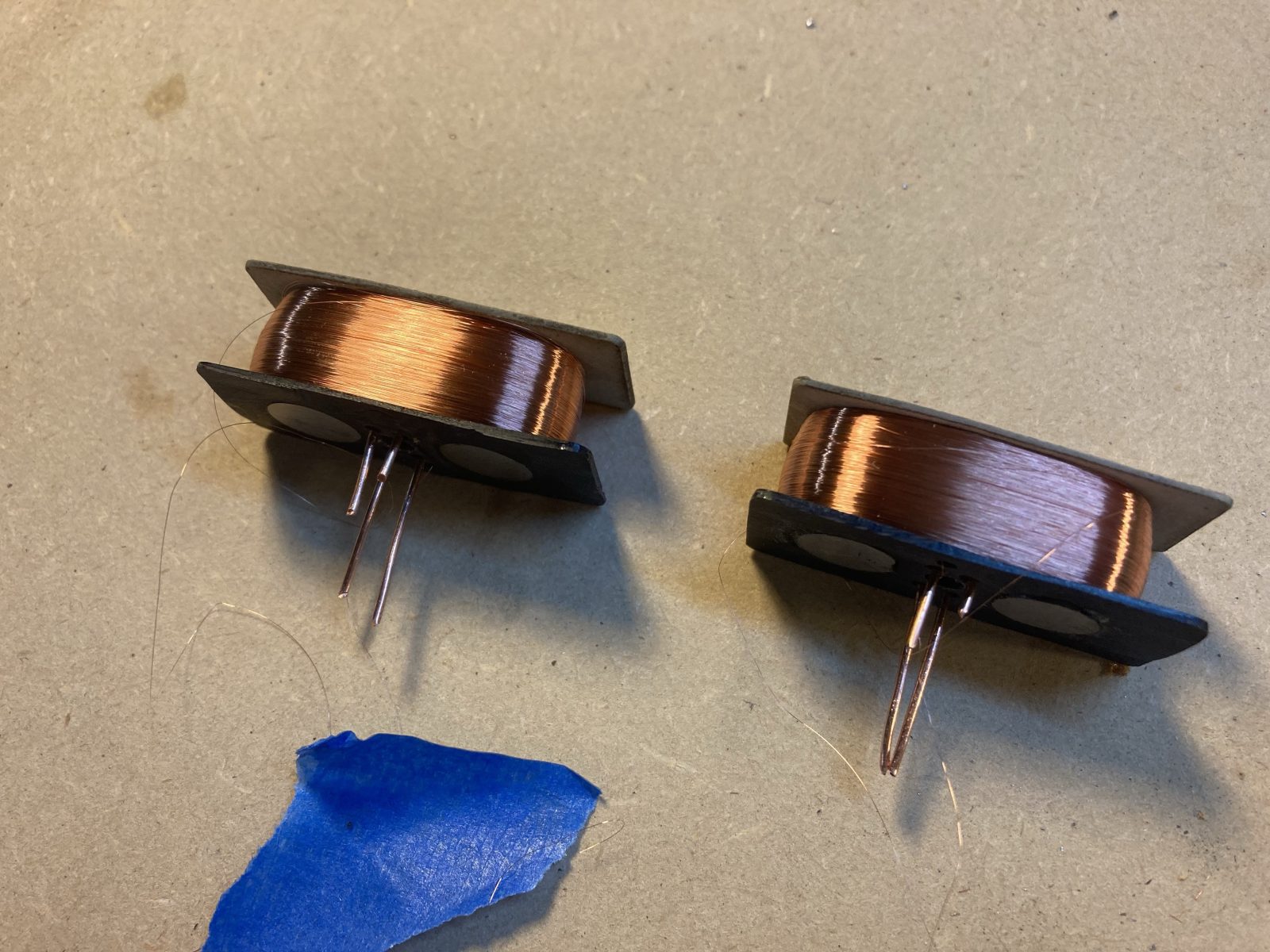
Hmmm....Looking at the assembly of the bobbins with the Inductive Bar on them, I see a potential problem? How are you going to rout the ends of the magnet wire, to get them wrapped on the terminals, without them getting pinched under the Inductive Bar? That would be bad, having the steel bar pressing on the fragile wires. You may need to make a small groove on the top side of the cast part?

You can’t see it in the photo, but there’s actually a little hole in the bobbin for the start wire to come through. I’ll have to figure something out for the end wire. Since the bar is sitting on the magnets and is not completely flush with the bobbin surface, there may be enough space for the wire. Ill cut a channel in the bobbin if necessary.
 
You can’t see it in the photo, but there’s actually a little hole in the bobbin for the start wire to come through. I’ll have to figure something out for the end wire. Since the bar is sitting on the magnets and is not completely flush with the bobbin surface, there may be enough space for the wire. Ill cut a channel in the bobbin if necessary.

I think you are going to need to cut a slot across the top flange of the casting, right across two of the terminal holes. To a depth about the diameter of the terminal holes. After winding, lay the end of the wire down in the slot, wrap it around the terminal, and solder. Then, put a drop of soft glue (like LMI glue) in the slot to surround and protect the wire. That should insulate it well enough to keep it from shorting against the Induction Bar.

The Induction Bar sounds like that joint right outside a military base.
 
I'm curious how much effect the inductive bar has on the actual pickup performance.

I've wound dozens of conventional pickups with only the magnets and never used an inductive bar on the base. Is there a discernible difference in performance in pickups with / without the magnetic structuring created by the bar?

I'm assuming this is done to route the magnetic lines of force in a way that concentrates them toward the top side of the magnet, extending their reach upward above the pickup structure.
 
Last edited:
  • Like
Reactions: Freekmagnet
I'm curious how much effect the inductive bar has on the actual pickup performance.

I've wound dozens of conventional pickups with only the magnets and never used an inductive bar on the base. Is there a discernible difference in performance in pickups with / without the magnetic structuring created by the bar?

I'm assuming this is done to route the magnetic lines of force in a way that concentrates them toward the top side of the magnet, extending their reach upward above the pickup structure.

I would say that the answer to your question about making a discernible difference would be, "yes." As far as how much, I would say that you'll have to try it and determine that for yourself. In this case, I had a real tight-sounding pickup with huge poles and 44AWG wire, so I used the steel bar to bring more presence to the low end. In other words, a little less Chris Squire and a little more Rick James.

I was telling Mr. Bruce that some of the $#;⫪iest pickups ever were designed this way, so it's definitely worth checking out.
 
Last edited:
What he means is that Induction bars were common on cheaply made pickups some decades back. They were a simple and inexpensive way to modify the sound of a pickup. If you had designed and tooled up to make a pickup by the thousands, and initial testing said that the pickups' sound was weak and lame, slapping a steel bar on the bottom was a simple way to fix it. Or at least modify the sound somewhat.

How much the Induction Bar changes the sound depends on how much volume of steel is added, and how strong the magnets already are. Think of it as being like increasing the diameter of the magnets.
 
  • Like
Reactions: Jeff Siddall
I've been playing around with a design for a big ol' super-sized single coil... as big of a P-90 style pickup that'll fit into a MM cover. Not sure yet if I'll bring this into reality, but curiosity might get the best of me.

I figured it would be fun to show how I mock almost all the pieces up in 3D to make sure everything fits as planned, so here goes:

Baseplate:
upload_2022-6-11_18-34-46.png


Then stack on the keeper and magnets:
upload_2022-6-11_18-35-16.png


Then the PCB:
upload_2022-6-11_18-35-39.png


Then the bobbin:
upload_2022-6-11_18-36-17.png


And finally the cover:
upload_2022-6-11_18-36-41.png


Underbelly shot:
upload_2022-6-11_18-39-11.png
 
Last edited:
I've been playing around with a design for a big ol' super-sized single coil... as big of a P-90 style pickup that'll fit into a MM cover. Not sure yet if I'll bring this into reality, but curiosity might get the best of me.

I figured it would be fun to show how I mock almost all the pieces up in 3D to make sure everything fits as planned, so here goes:

Baseplate:
View attachment 4718475

Then stack on the keeper and magnets:
View attachment 4718476

Then the PCB:
View attachment 4718477

Then the bobbin:
View attachment 4718478

And finally the cover:
View attachment 4718480

Underbelly shot:
View attachment 4718486

Now we know the secret why your pickups always look so neat and professional: You are doing some serious concept and design engineering! Making all the parts fit together in a computer model before cutting anything. We all should be doing that.

I kind of do, but at a lower level of computer sophistication. I work in 2D CAD, creating the 3rd dimension in my mind. Obviously, I should learn 3D CAD modeling, and use it. But I've resisted so far.

Nice work. And that pickup looks like a useful design from here.
 
Now we know the secret why your pickups always look so neat and professional: You are doing some serious concept and design engineering! Making all the parts fit together in a computer model before cutting anything. We all should be doing that.

I kind of do, but at a lower level of computer sophistication. I work in 2D CAD, creating the 3rd dimension in my mind. Obviously, I should learn 3D CAD modeling, and use it. But I've resisted so far.

Nice work. And that pickup looks like a useful design from here.

Thanks Bruce!

Yeah, in a past life, I was headed toward a drafting career. Far back enough to have done everything manually, what with the giant drafting tables, pencils and erasers, and attention to line weights... all that cool stuff.

Nowadays I'm doing it all in Fusion 360, and it's surprisingly intuitive. At least for how my brain works.

In any case, yeah, it sure helps seeing it all mocked up first.
 
  • Like
Reactions: BishopJP and Kinkh
The past couple of days have been all about winding this pickup. I also had a little pickup-making revelation which I will share after the build update.

We left off with the molds that Mr. Bruce made and the magnetic structure that I built up out of parts. I took the parts to my pickup shop and wound these two coils. These rather fat-looking pieces are wound with 10,000 turns if #44 AWG wire.

img_1049-scaled.jpg


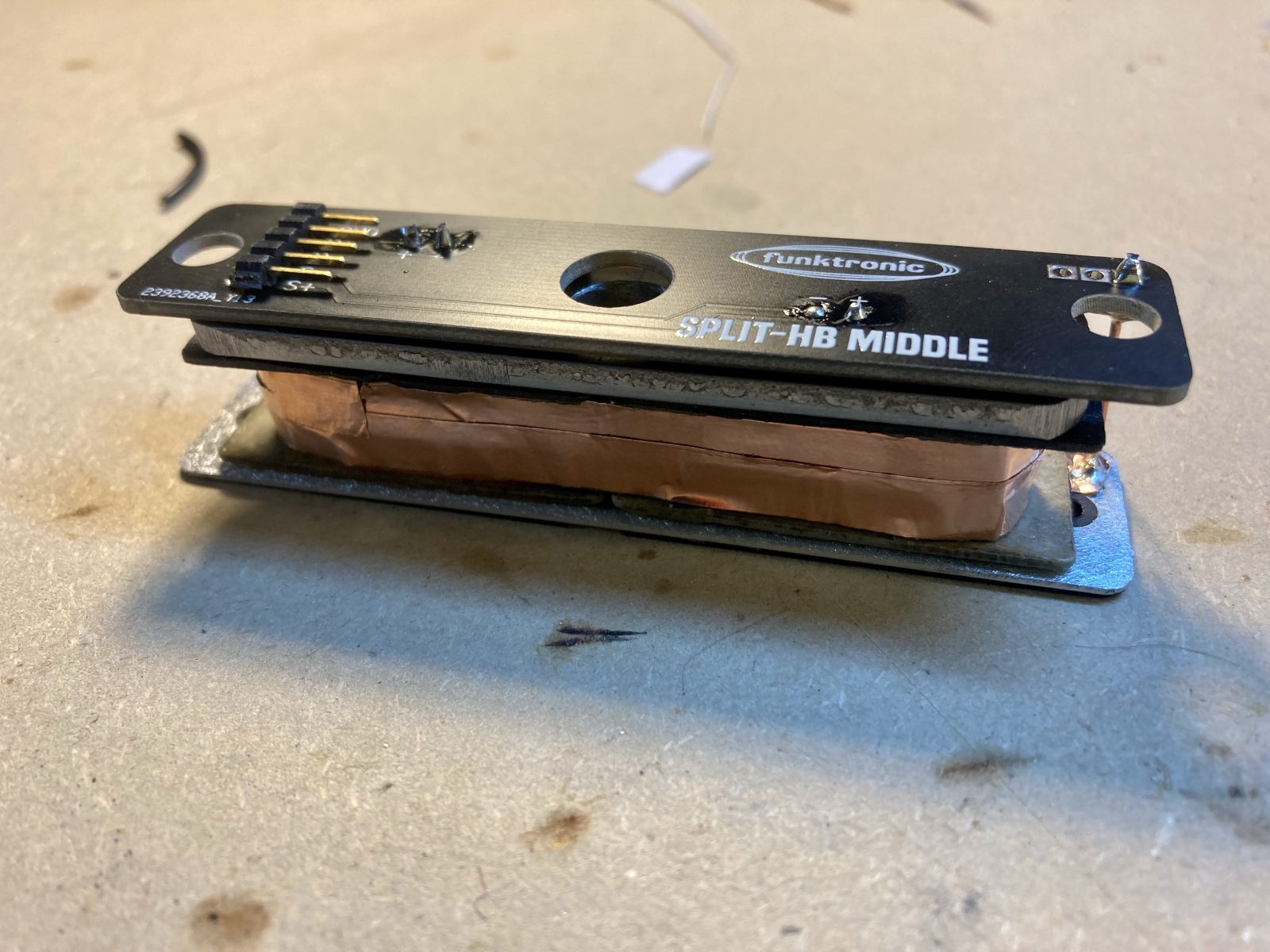
Here's the assembled pickup before it goes into the epoxy. I shielded everything with copper tape.

img_1050-scaled.jpg


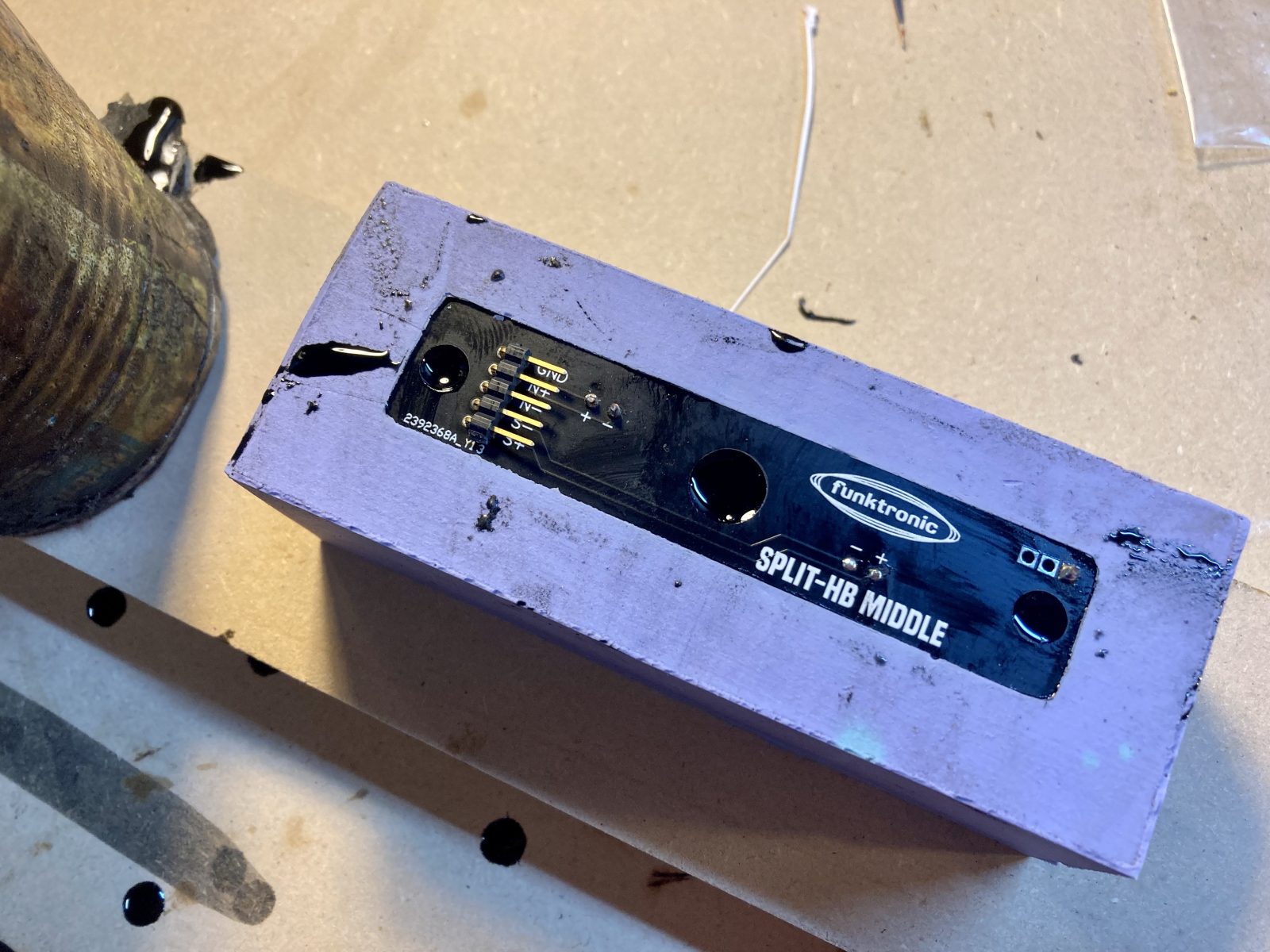
And here it is in the mold. I cast the assembly in black epoxy.

img_1051-scaled.jpg


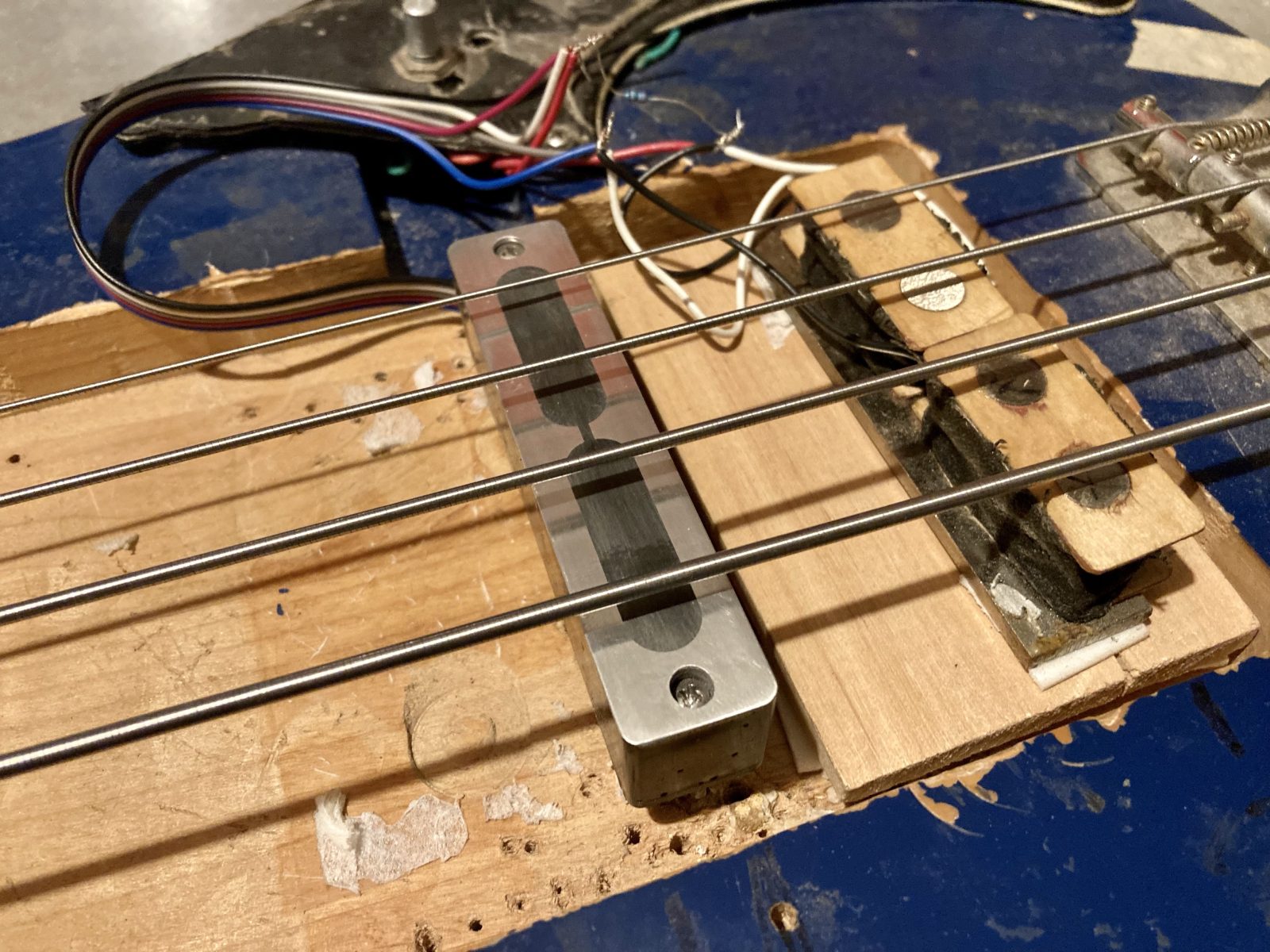
And here's the pickup in the test bass.

img_1052-scaled.jpg


So here's the revelation:

I've been struggling with this 2-3 pickup configuration for a while now. Today, I finally found success. In past iterations, the combination of the two pickups together functioned, but getting a that nice marbly phase-cancelled tone eluded me. Most of the time, they just sounded fairly nondescript.

My first run, I made a set of ceramic-powered blade mini-humbuckers. They sounded OK, but the pickups just didn't have enough output. Next, I tried a set of ceramic single coils, using the two of the same miniature ceramic magnets that I used in the HB. The single coils were strong enough, but they had a real saturated sound that I didn't like. From there, I moved on to a set of neodymium mini-humbuckers, using the same parts I made for the ceramic HB's. The neo's came with their own challenges - I had to bring the wind count way down to get a usable pickup. I finally settled on a design, but the problem with the neo's was two-fold. For one, they just seemed to put out a HUGE amount of information, and combining the two pickups became a even bigger mess. Secondly, the the magnetic field generated from 6 neodymium magnets really had an effect on the string pull. I think a more appropriate use of the neo would be a single pickup configuration.

Anyway, I was almost ready to give up on getting a sound I liked out of the two pickups combined. I assumed that perhaps the pickups were too close together to get a good phase-cancelled vibe going on. I decided to give it one more try, and instead of making 3 broad-ranged pickups, I designed a pickup with a more focused and more narrow spectrum of sound. After all, I'm planning to have three pickups across the entire playing area.

I made one "final" pickup with the new parts, and used the old test pickup as a bridge pickup. I wired each pair of coils in series and wired those in parallel. Pretty straightforward. However, I really didn't like how it sounded. They sounded harsh, and had a lot of upper mids going on. Needless to say, I was almost dismayed. Then, the lightbulb went off, and I wired the two pairs in parallel, and wired those in series. And for some reason, that worked!

Anyway, I'm really digging how these pickups are shaping up. The middle pickup solo'd sounds tight with a nice immediate attack and and just enough bass to fill out the low end. The middle and bridge combined make that phase-cancelled sound that no one can get enough of. The added bonus is that I don't think I need to add any more wire to the bridge pickup. That's good, because I don't think I have any more room to add any more wire!
 
Last edited:
Question for the brain trust please on Fender Roscoe Beck V pickups.

I've read multiple reports that they're great sounding. I've also read they're basically a pair of Js side by side like the old Schallers, but 5s. I'm guessing the RBVs are single coils unlike the Schallers.

Does anyone know anything specific about the construction of them that makes them different or unique? Or are they just being raved about by fans, especially as they seem uncommon and the basses pull good $?

Just looking for more data for my notebooks for later and thought I'd ask here.
Thanks.
 
Question for the brain trust please on Fender Roscoe Beck V pickups.

I've read multiple reports that they're great sounding. I've also read they're basically a pair of Js side by side like the old Schallers, but 5s. I'm guessing the RBVs are single coils unlike the Schallers.

Does anyone know anything specific about the construction of them that makes them different or unique? Or are they just being raved about by fans, especially as they seem uncommon and the basses pull good $?

Just looking for more data for my notebooks for later and thought I'd ask here.
Thanks.

I'm not sure if we can help you here. Most of us on this thread have experience designing and building our own pickups, but not that much experience messing around with pickups from large manufacturers. Personally, I have no idea. I've never seen one apart to be able to assess the design.

You might ask over on the Pickups & Electronics forum. Those folks are all about swapping and testing pickups from manufacturers and boutique winders.
 
Thanks Bruce. I was hoping maybe someone here might have some general info on any unique or different aspect of it's construction and design rather than just having swapped and given some vague tonal comment as I tend to find in the pickups forum.

I move house in a couple of weeks and am going to dig out my old winding rig then that I used for RF transformers and inductors and modify it to do pickups. At the same time I'm going to see if I can modify the B&K LCR meter I have to do higher values as it doesn't like >100mH. Or maybe design a new one from scratch.

Just looking for pointers on other designs so I don't have to reinvent the wheel too much and these seem well regarded. I've read this entire thread before and made lots of notes and will read it again and bookmark properly this time.
 
Last edited:
haha - Give them time. It's only the first in a multi-part series!

I wonder if he's using our writings on this thread for reference? We've honestly gone into more depth here than any of the classic pickup-making books I know of.
 
Hey folks, I have some questions if anyone cares to throw some answers my way!

I was planning to wind a couple single-coil pickups for my current build and if my understanding is correct I can make one of them RWRP so they become a humbucking pair? So, assuming my understanding is correct...

1 - Does the number of winds need to be roughly equivalent for this to work?

2 - How does the volume control effect this set-up?

Thanks!