• TalkBass has been independent since 1998. Add your voice.
    Create a free account to reply to discussions, view embedded media, and browse with fewer display ads.
    Join freeLog in
    Want zero display ads or expanded classifieds tools? Compare plans.

Major milestones in Speaker Technology.

To me Bill was one of the main reasons for visiting TB. He had his less than polite monents and could sometimes shoot from the hip a bit to soon, but one should view those shortcomings in the light of his (former) endless patience in answering stupid questions (and in the light of our own shortcomings).

I think TB has suffered from his departure and forum administration and modarating should also be involved in the quality of information on TB, not only in our social behaviour.
 
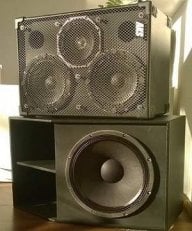
The Big E speaker technology is the first big advancement I've seen. It's a new paradigm. I'll have a gig report on their 2 x 8 speaker which compared very well with a top single 15 cab. It's very cool stuff. We'll see if it translates in the live setting. I know that for PA it really sounds better than anything out there.
 
The Big E speaker technology is the first big advancement I've seen. It's a new paradigm. I'll have a gig report on their 2 x 8 speaker which compared very well with a top single 15 cab. It's very cool stuff. We'll see if it translates in the live setting. I know that for PA it really sounds better than anything out there.

What big advancement on speaker technology is there with these Big E speakers. I've seen they "invented" the vortex manipulated waveguide", what are it's main advantages compared to other designs? Do they have measurements etc. that show it's superior to other designs that somehow try to create an " ideal" radiation pattern throughout the entire audiorange?
 
The Big E speaker technology is the first big advancement I've seen. It's a new paradigm. I'll have a gig report on their 2 x 8 speaker which compared very well with a top single 15 cab. It's very cool stuff. We'll see if it translates in the live setting. I know that for PA it really sounds better than anything out there.

That's one design I could use Bill to shed some light on as I can't figure out what's going on there. I don't know if he'd call BS or open up some new education in acoustics/psychoacoustics. You can't beat physics but you certainly can make them work in your favor in some ways I don't always understand.

Now if I could just get enough other crap out of the way so I can get some of the guys horns built.:p
 
What big advancement on speaker technology is there with these Big E speakers. I've seen they "invented" the vortex manipulated waveguide", what are it's main advantages compared to other designs? Do they have measurements etc. that show it's superior to other designs that somehow try to create an " ideal" radiation pattern throughout the entire audiorange?

That's one design I could use Bill to shed some light on as I can't figure out what's going on there. I don't know if he'd call BS or open up some new education in acoustics/psychoacoustics. You can't beat physics but you certainly can make them work in your favor in some ways I don't always understand.

+1

I want to love any non big box design, but with all the smoke and mirrors I have seen on these cabs it just adds up to snake oil to me.

Oh and I miss Bill as well.
 
There's a sorta explanation of the "manipulated vortex waveguide" on their site. It's no in-depth explanation and I see no measurements or other data which could show us what is so special about it.
To me it's more like a horn-reflex cabinet, combined with " crossfiring" drivers. Horn-reflex can easily be simulated with the program AJhorn. Horn-reflex is a bassreflex system with an expanding port/mouth, which can yield great results (as with most other systems when done right).
 
I DON'T THINK SO ...

The Bose 2201, developed in the early sixties used an array of 22 5" speakers in each cabinet.

These guys were ENGINEERS. They didn't just cram speakers in a sealed box. There has been little or no improvement in sound quality since the 1950's.

That is just so wrong in so many ways.

First - most engineers in the pro audio field refer to Bose as "Better Audio Through Marketing".

Second - go listen to something such as a set of Genelec studio monitors and you'll see how far sound quality has come since the 50's. It is night and day!

The speakers of the 50's were probably good enough for the sound quality of the sources of the time, but would never hold up now.
 
The Big E speaker technology is the first big advancement I've seen. It's a new paradigm. I'll have a gig report on their 2 x 8 speaker which compared very well with a top single 15 cab. It's very cool stuff. We'll see if it translates in the live setting. I know that for PA it really sounds better than anything out there.

I can't see has this falls into a major milestone for speaker technology if there is no evidence.
 
That is just so wrong in so many ways.

First - most engineers in the pro audio field refer to Bose as "Better Audio Through Marketing".

Second - go listen to something such as a set of Genelec studio monitors and you'll see how far sound quality has come since the 50's. It is night and day!

The speakers of the 50's were probably good enough for the sound quality of the sources of the time, but would never hold up now.

1) The poster I was responding to said that arrays of small speakers was a new development. That is why I cited Amar Bose, then an Assoc Professor at MIT for his development of a massive 5" speaker array many decades before Phil Jones He then rose to fame and fortune with the 901, an array of 9 4" speakers per cabinet. The fact that Bose has produced mostly crap since the 901 does not detract from his early accomplishments.

2) I have listened to the latest and greatest speakers. You go listen to Bozak Concert Grands. After the sixties most speaker improvements were marginal and usually trade-offs of one desired attribute for another.
 
seamonkey said:
I always see them paired with standard permanent magnet, moving coil, subs :hiding:

True. Like an open back guitar cab you get bass cancellations with an electrostatic design. Maybe a 25 foot wide panel could produce strong bass. Better to use conventional tech for the low end. Most MLs have a panel plus a normal speaker tp get reasonable estension.
 
One big advancement wasn't in the design of speakers themselves, but in the advent of computer-aided room analysis and system design.

A lot of credit for that could go to John Prohs (still around). I had the honor of meeting him when he came and demoed a sound design for a new church we're building. Nicest, most down-to-earth guy you could meet--you'd never guess he had a lot to do with what we take for granted today in computer EQ'd systems, understanding the dynamics of speaker energy dispersion, etc. :eek:

Oh--btw, line array technology has been around a lot longer than you think. What we've seem more recently is better full-range application of physics that have actually been known for sometime. ;)
 
One big advancement wasn't in the design of speakers themselves, but in the advent of computer-aided room analysis and system design.

A lot of credit for that could go to John Prohs (still around). I had the honor of meeting him when he came and demoed a sound design for a new church we're building. Nicest, most down-to-earth guy you could meet--you'd never guess he had a lot to do with what we take for granted today in computer EQ'd systems, understanding the dynamics of speaker energy dispersion, etc. :eek:

Oh--btw, line array technology has been around a lot longer than you think. What we've seem more recently is better full-range application of physics that have actually been known for sometime. ;)

So true. And for FOH - "Enhanced Acoustic Simulator for Engineers" EASE may be the milestone.

Manufacturers publish EASE files for their cabs. Which can be loaded into an EASE application.

Computers can easily measure a room. Which also can be loaded into an EASE app.

Then the Engineer can go about modeling the setup of the FOH for the room. Even before the trucks are unloaded. Or even before the trucks are loaded for the venue.

Same holds true for MAPP and other acoustic apps.
 
There's a sorta explanation of the "manipulated vortex waveguide" on their site. It's no in-depth explanation and I see no measurements or other data which could show us what is so special about it.
To me it's more like a horn-reflex cabinet, combined with " crossfiring" drivers. Horn-reflex can easily be simulated with the program AJhorn. Horn-reflex is a bassreflex system with an expanding port/mouth, which can yield great results (as with most other systems when done right).

Yeah. The hornpath still has to be long enough to load down low. Not sure how much is folded up in the back of that cab. One of Bill's designs hornloads an 8" driver in a small package for car subs/livingrooms, etc. It can be done.

That still doesn't explain getting rid of nulls due to placement. It could be they're just making enough noise in a reverberant room you're bound to catch some from somewhere. I don't know what the "vortex" is, I can only imagine tornado's. There are mid/high horn designs where the mids fire into the horn from the sides but that's not what's going on there.

I don't have the knowledge to just dismiss the design offhand. It does make me curious though. Given the cab size, it may be possible there's enough folded up back there to get loading down into the midbass I guess.
 
I can't see has this falls into a major milestone for speaker technology if there is no evidence.

1. BFM would have no idea what's going on there. Just because someone is very well versed and intelligent doesn't mean they understand radically different technology.
2. These guys don't wan't to talk too much about the technology until their patents go through.
3. I've played bass for a living for 35 years. I've seen tons of big claims. I've seen tons of cool measurements. These things are all good---but the function of gear in live settings (not living rooms) are what I ultimately hang my hat on. Within 2 weeks I'll play both electric and DB in very diverse situations. I'll have one on a gig on Saturday. Maybe it will suck. Did sound good in my living room.
I don't need measurements to see that the 2 x 8 cabinet goes louder than 2 of my 2 x 8 speakers.And much more efficient using the exact same drivers. I don't need measurements to know that the dispersion rivals anything I've ever heard.
I use measurements and data as a starting point but what we can measure is a small amount of information as compared to how many subtle measurements combine together to contribute to the listening/function.
The only reason I even looked at this stuff (trust me--I'm WAY more cynical about new gear than most) was that a friend who is very respected in the PA field heard a shootout of the Big E's and otherhighly rated PA speakers (including BFM). He builds and sells BFM's. He said that there was no comparison. He was coming to Chicago to get tips on composite construction. He stopped and saw this shootout on the way---not expecting much. He couldn't stop talking about it.
It might not be cool for bass in a live setting. It loses very little volume as you move away from the speakers. Again, in my living room when I played the Big E's at the same perceived volume next to the speakers as the other cabs things were vibrating and moving around on my fireplace mantle (20 feet away) because the volume had lost so little. Now this might not be a good thing for a live setting. We count on the volume being a lot higher next to the cab so we can hear ourselves.Maybe with the big E's the fact that there is so little of that proximity effect might mean that with our stage volume set right for where we're standing it might be too loud for the rest of the band. I'll find out tomorrow.

Again--I've seen more gear come and go than most and am very cynical. But I do trust my experience and ears. And my curiosity is majorly piqued.

Oh--and my home listening speakers are Innersound Eros electrostatics. They have a woofer in a transmission line. I love electrostatics. They are technology developed in the 40's and 50's.
 
1. BFM would have no idea what's going on there. Just because someone is very well versed and intelligent doesn't mean they understand radically different technology.
2. These guys don't wan't to talk too much about the technology until their patents go through.
3. I've played bass for a living for 35 years. I've seen tons of big claims. I've seen tons of cool measurements. These things are all good---but the function of gear in live settings (not living rooms) are what I ultimately hang my hat on. Within 2 weeks I'll play both electric and DB in very diverse situations. I'll have one on a gig on Saturday. Maybe it will suck. Did sound good in my living room.
I don't need measurements to see that the 2 x 8 cabinet goes louder than 2 of my 2 x 8 speakers.And much more efficient using the exact same drivers. I don't need measurements to know that the dispersion rivals anything I've ever heard.
I use measurements and data as a starting point but what we can measure is a small amount of information as compared to how many subtle measurements combine together to contribute to the listening/function.
The only reason I even looked at this stuff (trust me--I'm WAY more cynical about new gear than most) was that a friend who is very respected in the PA field heard a shootout of the Big E's and otherhighly rated PA speakers (including BFM). He builds and sells BFM's. He said that there was no comparison. He was coming to Chicago to get tips on composite construction. He stopped and saw this shootout on the way---not expecting much. He couldn't stop talking about it.
It might not be cool for bass in a live setting. It loses very little volume as you move away from the speakers. Again, in my living room when I played the Big E's at the same perceived volume next to the speakers as the other cabs things were vibrating and moving around on my fireplace mantle (20 feet away) because the volume had lost so little. Now this might not be a good thing for a live setting. We count on the volume being a lot higher next to the cab so we can hear ourselves.Maybe with the big E's the fact that there is so little of that proximity effect might mean that with our stage volume set right for where we're standing it might be too loud for the rest of the band. I'll find out tomorrow.

Again--I've seen more gear come and go than most and am very cynical. But I do trust my experience and ears. And my curiosity is majorly piqued.

Oh--and my home listening speakers are Innersound Eros electrostatics. They have a woofer in a transmission line. I love electrostatics. They are technology developed in the 40's and 50's.


That kind of description points towards horns Mike. Not sayin' it is, you got the line on this, But, stuff like more output from the same drivers. And especially rattling the room with the same "apparent" volume. The result of filtering out harmonic cone distortion and ending up with just clean lows.

If it's not horns, cool, but this vortex stuff would have to perform some similair functions regarding spl and lack of distortion.

Anyway, be curious to hear your gig impressions. And of course see some measurements taken from around the room after these guys get the patent thing straightened out. How far are these from production? I know folks chum the waters a bit when something new is coming out but I'm wondering if they didn't jump the gun a bit not having patents secured and an incomplete website. Not trying to stir the pot here.......
 
No, man--it's all good. It would sound hokey to me, too. These guys did measure spl at different locations and it jives. Production will likely be within the next 3 months for the bass stuff.
I wish I could talk about the technology. Soon, I hope.

It's all moot until I see if they function well on a gig. I'm playing a loud gig on electric tomorrow. I'll pretty much know for sure then.

And by the way---I didn't mean to dis Bill. He really holds a place in the legacy of pro sound speaker design. He was just very dogmatic about anything different than his perceptions. But I have learned a lot from him.
Someone told me that he was one hell of a bassist too!