
Enjoy the benefits of a premium membership!
Upgrade Account
-
TalkBass has been independent since 1998. Add your voice.
Create a free account to reply to discussions, view embedded media, and browse with fewer display ads.
Join free Log in
Want zero display ads or expanded classifieds tools? Compare plans.
You are using an out of date browser. It may not display this or other websites correctly.
You should upgrade or use an alternative browser.
You should upgrade or use an alternative browser.
Measurements of rumble 500 not adding up
- Thread starter Drop1
- Start date
More options
Who Replied?
It looks like the OP has sorted it out.
Unfortunately, making audio measurements on a general purpose PC is a Hard Problem. Many years ago, I wrote a free audio analyzer app for Windows PC's. It worked, but it was a nightmare to support, because everybody has different hardware and a different OS version. Each OS version comes with an updated audio control panel, meaning that the instructions never match your setup. The controls don't know that you're using it for making a measurement, and don't warn you that your results won't be meaningful. And on top of it, the subject matter is conceptually hard.
Trying to automate the setup process for the user was too hard. The audio functions of a Windows computer were too poorly documented, and varied from one setup and OS version to the next. It was a moving target. I quickly gave up on that.
To make matters worse, it's virtually impossible to remotely diagnose what's wrong with somebody's setup.
However, through this experience, I've learned some lessons. First, instead of trying to figure out what you're doing wrong, work from the bottom up and figure out what you're doing right. You should be able to verify each step of the measurement, from signal generation through analysis. I have a routine that I go through, to verify that my setup works, before I ever attempt to measure anything.
Second, doing analysis with noise sources makes it harder, and is rarely necessary. The problem is that noise is by definition random, meaning that no two measurements ever produce the same results, and the bumps and dips in the curves don't necessary represent useful information. I greatly prefer to work with signals that are reproducible, so that any change is the result of something I actually did. For this reason, I prefer working with sine waves rather than noise generators. Also, you can clearly distinguish a sine wave from the self-noise of your system.
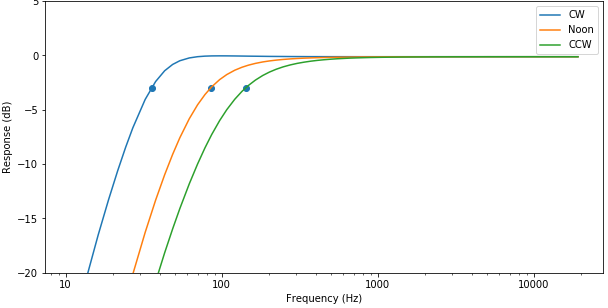
It can be done. These response curves were done with a cheap USB audio adapter that I bought from Amazon for 20 bucks, more than a decade ago. And software that I wrote. Each curve represents less than 1 second of measurement time. No engineer in their right mind would do this, but I'm actually interested in the subject matter of electronic measurements as an end unto itself, and "the thrill is in the pursuit" as they say.
Unfortunately, making audio measurements on a general purpose PC is a Hard Problem. Many years ago, I wrote a free audio analyzer app for Windows PC's. It worked, but it was a nightmare to support, because everybody has different hardware and a different OS version. Each OS version comes with an updated audio control panel, meaning that the instructions never match your setup. The controls don't know that you're using it for making a measurement, and don't warn you that your results won't be meaningful. And on top of it, the subject matter is conceptually hard.
Trying to automate the setup process for the user was too hard. The audio functions of a Windows computer were too poorly documented, and varied from one setup and OS version to the next. It was a moving target. I quickly gave up on that.
To make matters worse, it's virtually impossible to remotely diagnose what's wrong with somebody's setup.
However, through this experience, I've learned some lessons. First, instead of trying to figure out what you're doing wrong, work from the bottom up and figure out what you're doing right. You should be able to verify each step of the measurement, from signal generation through analysis. I have a routine that I go through, to verify that my setup works, before I ever attempt to measure anything.
Second, doing analysis with noise sources makes it harder, and is rarely necessary. The problem is that noise is by definition random, meaning that no two measurements ever produce the same results, and the bumps and dips in the curves don't necessary represent useful information. I greatly prefer to work with signals that are reproducible, so that any change is the result of something I actually did. For this reason, I prefer working with sine waves rather than noise generators. Also, you can clearly distinguish a sine wave from the self-noise of your system.
It can be done. These response curves were done with a cheap USB audio adapter that I bought from Amazon for 20 bucks, more than a decade ago. And software that I wrote. Each curve represents less than 1 second of measurement time. No engineer in their right mind would do this, but I'm actually interested in the subject matter of electronic measurements as an end unto itself, and "the thrill is in the pursuit" as they say.


The easiest way to do this is to draw the plot as you wish it to be and then falsify the data to support your desired results.
(A little trick I learned in the corporate world.)
(A little trick I learned in the corporate world.)
Last edited:

- Feb 12, 2006
- 61,047
- 5
- 221,002
- Disclosures
- Development Engineer-Mesa Boogie, Development Engineer-Genzler (pedals), Product Support-Genz Benz
I can’t read the scale on my phone… 10dB/division??? If so, you identified the first issue.It makes anyway not much of sense to measure any response with a scaling of 10dB/div.
At the other hand side, measurement tools are very cheap these days. Thus nowadays nearly everybody who wants to fiddle on toys can afford those tools, well, and everybody is allowed to ask questions in forums...
I have EXCELLENT tools. unfortunately my tools and computer are on loan to tune a studio this week. I'll have mich better measurements when I get my actual equipment back and am not just running the signal into a daw. My mic array alone is $$It makes anyway not much of sense to measure any response with a scaling of 10dB/div.
At the other hand side, measurement tools are very cheap these days. Thus nowadays nearly everybody who wants to fiddle on toys can afford those tools, well, and everybody is allowed to ask questions in forums...
I have rew, smaart, holm impulse and a very high end pro grade sound card designed specifically for tsking measurements.
I just did it quick and dirty yesterday cause I wanted to see what the buttons on the amp did. It was lose enough for me to see that. I didn't mean to start some big debate. It was all just a scaling issue. Nothing more. I am sorry.
It's all scaling. I figured it out. Once I scale it up, the charts are correct. My method was quick n dirty, but it matches within a db when scaled properly.I can’t read the scale on my phone… 10dB/division??? If so, you identified the first issue.
I have already said it was a scaling issue. Once scaled up, everything matches. I'm not against help. But once I state I'm wrong and explain why I was wrong, I don't need people to keep telling me I'm wrong lol. Thats what I meant by not reading. There was no further need to correct me. I already siad inwas wrong and why.Criticizing people trying to help you is never a good strategy.
Ibe adreaawd this already but the noise, if not perfect is close. What threw me is what I was getting out looked an aweful lot like what I was putting in. Until I scaled it up further. Once I scaled it up, the published gragh and my results match.What does the graph look like when you are connected directly to your pink noise source? You need to start with that first, assuming your pink noise source is accurately producing a 3db/octave roll off.
This is the signal I was putting in vs what was coming back from the unit.
Again, I was wrong. It WAS a scaling issue. By bad.
it's hard to see at this scaling , butthere is a dip around 500hz. The scaling just makes it look more flst that it really is.

This is the correct conclusion....Never mind, I’m not going down this road.
Yall still digging at me lol. I've already posted that I was wrong due to improper scaling like 5 times. And that's all it was. I wasn't zoomed in far enough. My measurements match the graghs. They are just zoomed out too much which makes them look flatter than they really are.This is the correct conclusion....
- Feb 12, 2006
- 61,047
- 5
- 221,002
- Disclosures
- Development Engineer-Mesa Boogie, Development Engineer-Genzler (pedals), Product Support-Genz Benz
We've both been on the receiving end of stuff like this on the road, eh?This is the correct conclusion....

The digging isn't going to stop so do yourself a favor and keep doing what you're doing and don't respond to it. I, and hopefully a few others, appreciate what you're doing. You just aren't one of the anointed few.Yall still digging at me lol. I've already posted that I was wrong due to improper scaling like 5 times. And that's all it was. I wasn't zoomed in far enough. My measurements match the graghs. They are just zoomed out too much which makes them look flatter than they really are.
Nooooo doubt.We've both been on the receiving end of stuff like this on the road, eh?
Including those band guys showing up, starting Smaart, pointing a measurement mic up in the air, and telling me how screwed up our rig is....

There's more going on here than improper scaling.Yall still digging at me lol. I've already posted that I was wrong due to improper scaling like 5 times. And that's all it was. I wasn't zoomed in far enough. My measurements match the graghs. They are just zoomed out too much which makes them look flatter than they really are.
That's all, I'm done here.
Last edited:
- Feb 12, 2006
- 61,047
- 5
- 221,002
- Disclosures
- Development Engineer-Mesa Boogie, Development Engineer-Genzler (pedals), Product Support-Genz Benz
Or those same guys with a reverse wired mic cable in their measurement mic then insisting g that the PA is out of phase…Nooooo doubt.
Including those band guys showing up, starting Smaart, pointing a measurement mic up in the air, and telling me how screwed up our rig is....
It was so much easier when the measurement tools weren’t in the hands of the under-qualified. The PA sounds good, it is good, move onto more important stuff.

Oh, gosh!Or those same guys with a reverse wired mic cable in their measurement mic then insisting g that the PA is out of phase…
It was so much easier when the measurement tools weren’t in the hands of the under-qualified. The PA sounds good, it is good, move onto more important stuff.
Never ran into that, but there was a couple of guys with Galaxy Crickets, again, shoving the receiver into the air and declaring that certain bandpasses were "out of phase". After I showed them the proper process of checking polarity, not "phase, I asked them, how many guys' PAs have you screwed up because neither you nor the system guy knew the proper use of a Cricket, including when and when NOT to pull it out?
Sheepish looks were everywhere.
OP, while I have my thoughts on your topic, I do sincerely apologize for horning in with such stories. But they do relate to the improper use of measurement tools that are so easily acquired for the last many years.

How does it sound to you? If you're pleased with the sound, why is it important to determine how it measures?


