
Enjoy the benefits of a premium membership!
Upgrade Account
-
TalkBass has been independent since 1998. Add your voice.
Create a free account to reply to discussions, view embedded media, and browse with fewer display ads.
Join free Log in
Want zero display ads or expanded classifieds tools? Compare plans.
You are using an out of date browser. It may not display this or other websites correctly.
You should upgrade or use an alternative browser.
You should upgrade or use an alternative browser.
Mesa Subway D-350!
- Thread starter mmbongo
- Start date
More options
Who Replied?
A 500 watt Mesa would be nice. I personally do not
have need for 800 Watts.
Get one of the Mesa D800's and run it in 2 ohm mode. That will limit the power when running it at 4 or 8 ohm.
But of course technically every 800 watt amp is a 500 watt amp. That's what the volume knob is for.
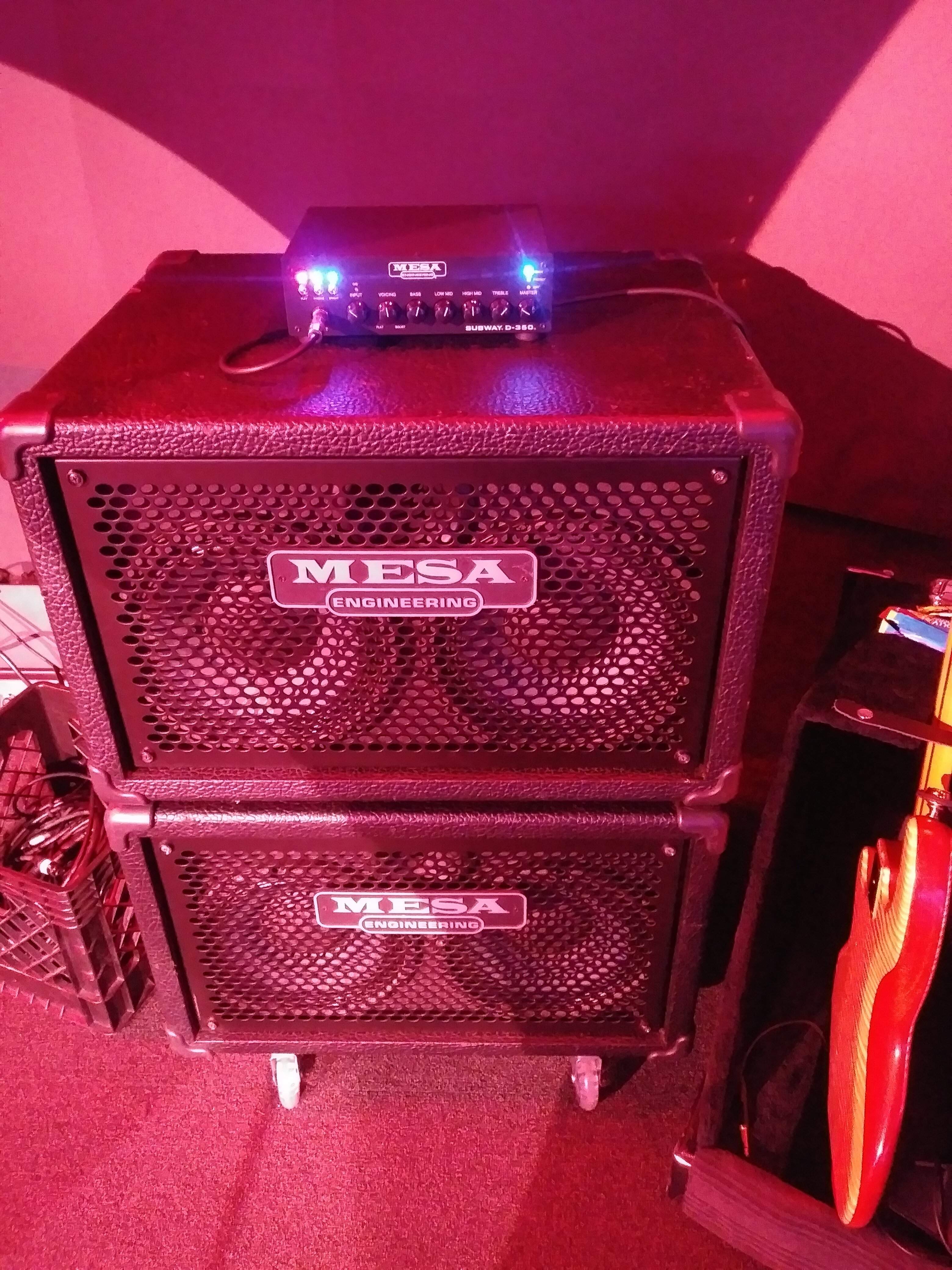
It does have a pretty good tone. So far I had to set up and run with it right out of the box. I really like the bright switch, its very musical. Certainly has plenty of power.
Last edited:
Agreed. It doesn't take up much enclosure space. Very useful
That works if you ONLY play electric bass. People who double (working players) truly do need this feature. Otherwise, any decent amp with 2 mid frequencies can get the job done on doublebass if you put something like an F Deck in front.....but who wants to do that unless they HAVE to? No one. This will do great with the rock/bar crowd, but not with the db or doubling guys, IMO.
Once again, I truly am looking for a new amp like the EA Doubler....this might not be MY new amp, but I am sure that it will be their new go-to amp for a LOT of primarily EB players.
I apologize if I am not on this Party Train yet. Darkhorse is listening, so this is my 2 cents, not adjusted to inflation.
I play double bass and electric although I almost never play both on the same gig. I played upright on a gig Wednesday and used my D-800 and Phil Jones C4 cab. My bass has a Realist PU and I use one of the older Fishman Model B preamps so I have some control at the bass. It sounded great and I had no need for a HPF control. That said, I tend to use cabs that do not have great response in the very low frequencies because, as you probably know, that causes the amplified upright to sound very much unlike the tone of unamplified upright. My goal has always been to have the amplified double bass sound as natural as possible.
I have in the past also used a Magellan 350 with the C4 for upright and was completely satisfied with the tone.
As always in matters of tone, your needs and taste are likely different than mine.
As a side note, nearly all of my gigs these days are on unamplified upright bass in a 5 piece jazz band. I have come to prefer playing this way although the challenge of developing sufficient volume while maintaining good tone is not easy. I play in my church worship team on Sundays and for that I use a Mesa head...usually a D-800+ or WD-800 into an Aguilar GS112 and play one of my Roscoe or G.Gould basses.

Yes...I completely dig where you're going. I actually just splurged on an AI Clarus (ordered) and a Trickfish Mini 500. I caved.I play double bass and electric although I almost never play both on the same gig. I played upright on a gig Wednesday and used my D-800 and Phil Jones C4 cab. My bass has a Realist PU and I use one of the older Fishman Model B preamps so I have some control at the bass. It sounded great and I had no need for a HPF control. That said, I tend to use cabs that do not have great response in the very low frequencies because, as you probably know, that causes the amplified upright to sound very much unlike the tone of unamplified upright. My goal has always been to have the amplified double bass sound as natural as possible.
I have in the past also used a Magellan 350 with the C4 for upright and was completely satisfied with the tone.
As always in matters of tone, your needs and taste are likely different than mine.
As a side note, nearly all of my gigs these days are on unamplified upright bass in a 5 piece jazz band. I have come to prefer playing this way although the challenge of developing sufficient volume while maintaining good tone is not easy. I play in my church worship team on Sundays and for that I use a Mesa head...usually a D-800+ or WD-800 into an Aguilar GS112 and play one of my Roscoe or G.Gould basses.
So far, I get a really great tone out of the Mini 500 with a carved flatback and Full Circle into either a Trickfish Perch 110 or a Darkglass 1x12 at home, but a gig is a gig. We'll see how it sounds/performs at a very, very soft level Sunday night in a piano trio.
Wednesday night is when I will have a chance to see how it does against an ocean of horns who take WAAAYY too many choruses and a great drummer!
But this thread isn't about allodat. I truly do hope the new Mesa head is a barn-burner and they sell a boatload of them!
We'll see how it sounds/performs at a very, very soft level Sunday night in a piano trio.
I work in a piano, bass, drums trio on Thursday nights in a private club. The room has a very low ceiling and I am in the corner behind the baby grand piano and I have to be careful not to be too loud and I am playing unamplified. My bass is a Wilfer 7/8 with Belcanto strings on it and it gets quite loud when I dig in.
My first instrument remains the electric bass and I almost always play a 6 string. I was forced to learn to play upright. I owned one and a friend booked an acoustic only gig so I had to learn to play the big bass or loose the gig. I didn't realize it at the time but it was one of the best things that happened to me. I played in a big band for a while but there was very little pay and some other difficulties caused me to decide to drop out of that band.
And now....back to the subject at hand>>the upcoming Mesa D-350!

I can't find it now, but I thought someone asked a day or two ago about grind with the D-350. Another band's bassist set input gain at about 2/3 at our show the other night, and got a really warm P-bass grindy tone.
I don't typically do much pronounced grind for my own tone, but just now I recorded a couple of "messing around" snippets on my phone to illustrate what it sounds like with the input gain dimed, then just controlling volume with the master. These are the Subway D-350 into a Schroeder Mini-12+L cabinet, recorded using Voice Recorder and the built-in mic on my Android phone. Bass is my Mensinger Cazpar short scale fretless 5 string played fingerstyle, with 6-month-old nickel roundwound strings, with passive wiring and the tone knob at 100%, and Delano XTender humbuckers each set in series mode. Amp is set with all EQ knobs at noon, the voicing knob all the way counterclockwise (i.e., flat, no scoop), and the bright switch off.
Just a couple of careless quick noodles, one with the neck pickup 100%, and one with bridge pickup 100%. Pardon any background noise, especially at the end of the neck-pickup track ... yardwork going on in my apartment complex, and a fun Pride festival going on in an adjacent park.
[Invalid or Expired Link Removed]
[Invalid or Expired Link Removed]
I don't typically do much pronounced grind for my own tone, but just now I recorded a couple of "messing around" snippets on my phone to illustrate what it sounds like with the input gain dimed, then just controlling volume with the master. These are the Subway D-350 into a Schroeder Mini-12+L cabinet, recorded using Voice Recorder and the built-in mic on my Android phone. Bass is my Mensinger Cazpar short scale fretless 5 string played fingerstyle, with 6-month-old nickel roundwound strings, with passive wiring and the tone knob at 100%, and Delano XTender humbuckers each set in series mode. Amp is set with all EQ knobs at noon, the voicing knob all the way counterclockwise (i.e., flat, no scoop), and the bright switch off.
Just a couple of careless quick noodles, one with the neck pickup 100%, and one with bridge pickup 100%. Pardon any background noise, especially at the end of the neck-pickup track ... yardwork going on in my apartment complex, and a fun Pride festival going on in an adjacent park.
[Invalid or Expired Link Removed]
[Invalid or Expired Link Removed]
Last edited:


Al Kraft
Supporting Member
- May 2, 2016
- 10,767
- 40,429
- Disclosures
- Mesa Boogie beta product tester and player support
That was player style/choice for that type of sound...the head does clean and full voicing very nicely.Sounds very buzzy in all three clips.
Mesa should display it prominently in their official video instead of only a modern hi-fi tone. This is exactly what Class D detractors take away. Show me an old school P-Bass tone for its versatility. I’m not interested in a slap tone.That was player style/choice for that type of sound...the head does clean and full voicing very nicely.
Last edited:

- Feb 12, 2006
- 60,949
- 5
- 220,588
- Disclosures
- Development Engineer-Mesa Boogie, Development Engineer-Genzler (pedals), Product Support-Genz Benz
This is the problem with any video demo (as has been discussed before), it’s impossible to represent every player’s style and preference.
There will be more demo videos, but Al is right. The amp does old school clean and full/fat voicing just fine. He’s been playing one for many months and has the most experience with this amp as the earliest adopter and “crash test dummy”.
There will be more demo videos, but Al is right. The amp does old school clean and full/fat voicing just fine. He’s been playing one for many months and has the most experience with this amp as the earliest adopter and “crash test dummy”.
Thanks for that, Andy, but it's not "every player’s style and preference". "old school clean and full/fat voicing" isn't a fringe request.This is the problem with any video demo (as has been discussed before), it’s impossible to represent every player’s style and preference.
There will be more demo videos, but Al is right. The amp does old school clean and full/fat voicing just fine. He’s been playing one for many months and has the most experience with this amp as the earliest adopter and “crash test dummy”.
Honestly, I hear two tonal schools in my head when I see a new amp. Modern, or old school. Modern may cover a lot of grind and ground, but every player knows "old school" tube emulation.
The amp does old school clean and full/fat voicing just fine.
For me, that’s the main requirement. The ability to have some grit/grind is nice too.

I can't find it now, but I thought someone asked a day or two ago about grind with the D-350. Another band's bassist set input gain at about 2/3 at our show the other night, and got a really warm P-bass grindy tone.
I don't typically do much pronounced grind for my own tone, but just now I recorded a couple of "messing around" snippets on my phone to illustrate what it sounds like with the input gain dimed, then just controlling volume with the master. These are the Subway D-350 into a Schroeder Mini-12+L cabinet, recorded using Voice Recorder and the built-in mic on my Android phone. Bass is my Mensinger Cazpar short scale fretless 5 string played fingerstyle, with 6-month-old nickel roundwound strings, with passive wiring and the tone knob at 100%, and Delano XTender humbuckers each set in series mode. Amp is set with all EQ knobs at noon, the voicing knob all the way counterclockwise (i.e., flat, no scoop), and the bright switch off.
Just a couple of careless quick noodles, one with the neck pickup 100%, and one with bridge pickup 100%. Pardon any background noise, especially at the end of the neck-pickup track ... yardwork going on in my apartment complex, and a fun Pride festival going on in an adjacent park.
[Invalid or Expired Link Removed]
[Invalid or Expired Link Removed]
Does yours have a hiss/steaming water sound when not playing and the gain is maxed? Mine does when the gain is high up. Lowering down the treble removes it.
Al Kraft
Supporting Member
- May 2, 2016
- 10,767
- 40,429
- Disclosures
- Mesa Boogie beta product tester and player support
I've been playing the head for about a year, and Alan (Chef) and I helped Andy with the manual back in 2020. While I respect the excellent musicianship in the video I will admit that's not my usual playing style or tone goal. However, the feature set is well described and I suspect that more than a few people will be impressed with the level of player finesse/articulation and tonal versatility this head can accurately deliver.This is the problem with any video demo (as has been discussed before), it’s impossible to represent every player’s style and preference.
There will be more demo videos, but Al is right. The amp does old school clean and full/fat voicing just fine. He’s been playing one for many months and has the most experience with this amp as the earliest adopter and “crash test dummy”.
I have used the D-350 with my Berg CN212 and SW 112/115 cabs on country and rock roadhouse/VFW/American Legion kind of gigs (60-100 people). I've also used it in small to medium venues with the SW 112 or SW 115 and a couple times even with an Eden EX110 for more acoustic/folks/bluegrass kind of things. It does the full low end, smooth, clean thing really well...and that's more my style.
During my initial playing I was reminded of a Bass Gear Magazine review Alan did years ago when the Carbine M3 was introduced (after he had already played the M6). I don't recall his exact words, but it was something to the effect that he thought the M3 was more like an M5 as it just didn't seem that less powerful than the M6. The D-350 struck me much the same way in comparison to my D-800 (which I admittedly never use to its full potential). Despite its size, the D-350 can get some serious volume especially when running at 4 Ohms with dual driver and/or dual cabs. IME on lengthy rock and roll sets it never even got warm to the touch.
I recall discussions with Andy and Alan during Andy's concept development and design work. First, this is a professional quality amp with features and capabilities that many Mesa customers had been asking for - including smaller size and passive (i.e. silent) thermal management with a very low noise floor (think studio work). It may come as a huge surprise to many of us, but not everyone feels they need a million Watts at 2 Ohms along with more EQ and signal routing features than a state of the art recording studio. This head was specifically designed to fill a space in the SW line that was not fully addressed by the D-800 for those customers.
The only real trade-offs you have in this head IMO are lower power output (which has yet to surface as a problem in the gigs I've played) and no 2 Ohm operation or deep switch for some obvious reasons. To get the small size, silent running (no cooling fan), and preserve headroom the amp is restricted to 4 Ohm and above loads...once again, not a problem for how most people who would buy this head will use it.
The bright switch (which Andy rightfully credits Alan with convincing him to include) is excellent. I hate bright switches in general, but this one is musical/seamless and just opens up the top end in a way that allows nice articulation without hiss or other annoying artifacts. If Reggae and Dub at volumes where you set off car alarms are your thing, this probably isn't your best choice in the SW line. That said it is not bass shy and while naturally warm feels a little less dark in its inherent voicing than the D-800. The bright switch subtly brings out the upper register and can get you a touch of sparkle in your tone with added treble.
Between the price point, quality (it's a Mesa profesional head with a 5 year warranty), and set of features many players have been asking for, I think this head will be very appealing to many folks who found the current SW heads to be more than they needed or not quite what they wanted. I'm always good with smaller and simpler if it can do the job, and the D-350 is more capable than its size and power rating might suggest. Even if it's not right for you, I think you'll come away impressed with the design and have a fun time trying it out.

Looks like a great little amp, but $649 is too pricey for a 350 when something like a Quilter 800 is within range.Great option as a backup, practice amp or even a main gig amp for players who don't need the power and features of the bigger Subways.
I know you can't really discuss pricing, but my guess is that $450-600 would be the sweet spot. I doubt this could get all the way down to half the price of the D-800, and more than $600 gets into "why bother" territory.
Last edited:

Mesa should display it prominently in their official video instead of only a modern hi-fi tone. This is exactly what Class D detractors take away. Show me an old school P-Bass tone for its versatility. I’m not interested in a slap tone.
Um.... shoot over to about 5:25 in the video. That lady is getting a great "old-school" tone. Warm and fat, yet clarity for days (which is the signature of both their heads AND cabs to me).
I've been playing the head for about a year, and Alan (Chef) and I helped Andy with the manual back in 2020. While I respect the excellent musicianship in the video I will admit that's not my usual playing style or tone goal. However, the feature set is well described and I suspect that more than a few people will be impressed with the level of player finesse/articulation and tonal versatility this head can accurately deliver.
I have used the D-350 with my Berg CN212 and SW 112/115 cabs on country and rock roadhouse/VFW/American Legion kind of gigs (60-100 people). I've also used it in small to medium venues with the SW 112 or SW 115 and a couple times even with an Eden EX110 for more acoustic/folks/bluegrass kind of things. It does the full low end, smooth, clean thing really well...and that's more my style.
During my initial playing I was reminded of a Bass Gear Magazine review Alan did years ago when the Carbine M3 was introduced (after he had already played the M6). I don't recall his exact words, but it was something to the effect that he thought the M3 was more like an M5 as it just didn't seem that less powerful than the M6. The D-350 struck me much the same way in comparison to my D-800 (which I admittedly never use to its full potential). Despite its size, the D-350 can get some serious volume especially when running at 4 Ohms with dual driver and/or dual cabs. IME on lengthy rock and roll sets it never even got warm to the touch.
I recall discussions with Andy and Alan during Andy's concept development and design work. First, this is a professional quality amp with features and capabilities that many Mesa customers had been asking for - including smaller size and passive (i.e. silent) thermal management with a very low noise floor (think studio work). It may come as a huge surprise to many of us, but not everyone feels they need a million Watts at 2 Ohms along with more EQ and signal routing features than a state of the art recording studio. This head was specifically designed to fill a space in the SW line that was not fully addressed by the D-800 for those customers.
The only real trade-offs you have in this head IMO are lower power output (which has yet to surface as a problem in the gigs I've played) and no 2 Ohm operation or deep switch for some obvious reasons. To get the small size, silent running (no cooling fan), and preserve headroom the amp is restricted to 4 Ohm and above loads...once again, not a problem for how most people who would buy this head will use it.
The bright switch (which Andy rightfully credits Alan with convincing him to include) is excellent. I hate bright switches in general, but this one is musical/seamless and just opens up the top end in a way that allows nice articulation without hiss or other annoying artifacts. If Reggae and Dub at volumes where you set off car alarms are your thing, this probably isn't your best choice in the SW line. That said it is not bass shy and while naturally warm feels a little less dark in its inherent voicing than the D-800. The bright switch subtly brings out the upper register and can get you a touch of sparkle in your tone with added treble.
Between the price point, quality (it's a Mesa profesional head with a 5 year warranty), and set of features many players have been asking for, I think this head will be very appealing to many folks who found the current SW heads to be more than they needed or not quite what they wanted. I'm always good with smaller and simpler if it can do the job, and the D-350 is more capable than its size and power rating might suggest. Even if it's not right for you, I think you'll come away impressed with the design and have a fun time trying it out.
Yeah having read page after page of back and forth over the entire Subway line, this is simply another example of @agedhorse keeping open ears and an open mind. This literally fills in a big blank for a lot of people here. Once again, it's an answer to an actual request from quite a few members. Gotta love a company that even bothers to ask us what we want. But then to actually keep MAKING what we ask for? Who DOES that???
Hey Andy, the "D" in D-350 stands for "Digital", right?

(Sorry. I couldn't help myself.)

I’m excited for this. I miss my D800 dearly, and I was hoping for something with less power would come out considering my needs these days.
Latest posts
-

-

-
-

-
 Just picked up a used Bugera Veyron Mosfet BV1001M
- Latest: Gianni "Orlandez" Orlati