• TalkBass has been independent since 1998. Add your voice.
    Create a free account to reply to discussions, view embedded media, and browse with fewer display ads.
    Join freeLog in
    Want zero display ads or expanded classifieds tools? Compare plans.

Metal, Screws & Wood: A Bridge Building Thread

Currently, I'm working on my own bridge design, needed a challenge... I scanned Luthier's Corner for interesting, simple and clever (and hopefully not patent infringing) ideas. They are scattered all over the place. Hence, similar to the pickup building thread, it might be a good idea to open a thread on bridge building. There already were similar threads (see links below), but it was a long time ago and most of the glamour shots that were posted back then are no longer available. There certainly won't be as much activity here as in the pickup thread, but I'm sure we will see cool ideas and discussions!

As a teaser some interesting bridge designs and builds I found in Luthier's Corner:
This is a clever bridge from @agfrag

BassBridge.jpg


And this absolutely stunning piece is from @Bruce Johnson
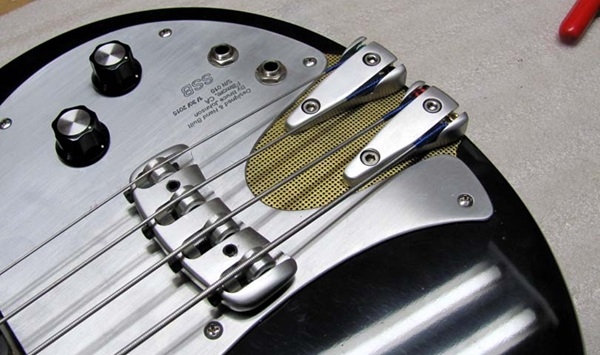
SSBBJ.jpg


Some cool examples of bridges made of wood (some metal is involved in most cases) by @T2W and @rudy4444

BridgeWood.jpg


avt1a4p-jpg.jpg


Almost no bridge at all (missing reference):
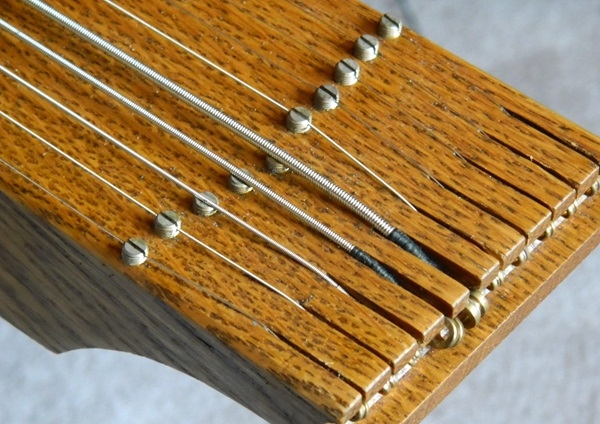
NoBridge.JPG


There are for sure many more, which I will collect over time at the end of this post. If you have links to threads with interesting builds, please post them here as well. I'll try to keep track of them and also include them at the end of this post.

There are clearly some points that are technically or mechanically relevant when designing a bridge. The most important purpose of a bridge is to establish contact between the strings and the body. A bridge should therefore not be made of rubber... But is there a difference in sound between a bent plate bridge and a CNC-machined solid bridge made of titanium? Where is the transition to snake oil? I'll discuss some of these aspects in a following post.

Then of course there are add-on functionalities (3D, string mute), the mounting of the strings, the break angle of the strings, headless bridges, multi course bridges, the design...

Looking forward to your designs, input, comments and discussions!

Cheers,
Thorsten


Links/references

Old threads on self made bridges:
https://www.talkbass.com/threads/show-your-self-made-bridge.267858/
https://www.talkbass.com/threads/making-your-own-bass-bridge.461977/

This thread contains some robust mostly commercial designs:
https://www.talkbass.com/threads/th...badazz-built-bass-bridges-ever.1236568/page-5

Self made bridges:
https://www.talkbass.com/threads/fairly-easy-home-made-bridge.353826/
https://www.talkbass.com/threads/theres-another-storm-brewing.938972/page-10#post-14715756
https://www.talkbass.com/threads/si...-in-fillmore-ca.1518445/page-92#post-29053010
https://www.talkbass.com/threads/making-a-floating-bass-bridge-will-it-work.617795/#post-8534414
https://www.talkbass.com/threads/wood-bridge-tutorial.337912/
https://www.talkbass.com/threads/bridge-base-plate.1527086/#post-25563610
https://www.talkbass.com/threads/ampeg-aeb-tailpiece.1665670/page-3#post-28940143
https://www.talkbass.com/threads/metalwork-building-a-fender-style-bridge-from-scratch.1294517/
https://www.talkbass.com/threads/what-about-a-modified-fender-bridge.1629825/#post-27961326
https://www.talkbass.com/threads/34-scale-strings-on-a-30-scale-bass.1644689/#post-28299166

...to be continued...
 
Last edited:
The following is a certainly not complete list of relevant aspects of bridge construction in general.

1) Contact between bridge/string and body
What is fundamentally important is a good contact between string and body. This is the most important task of the bridge.

@Bruce Johnson suggests embedding a metal block in the wood with epoxy resin and then attaching the bridge to it for optimal contact, which is documented in many threads here. [This is part of what is referred to here as brucification, aiming to optimize
the vibration characteristics of a bass by altering the contact between different components as well as their shape.]

The opposite of this is probably the idea of inserting chambers under the bridge. And what about bridges made of wood?

With single bridges, the total contact surface is usually smaller and they are often mounted with one screw each, while a second screw is often only used to fix the orientation.

ETS.jpg


2) Contact between saddle and base plate
Another point with regard to contact is the connection between the saddle and the base plate. It is not entirely clear how good or sufficient is defined here. Even if the influence is probably rather small, there are some interesting concepts (e.g. Babicz or KSM, both patented).

Babicz_5.jpg


KSM.jpg


Other concepts, such as the Tek 2 bridge, design this "contact" quite differently.

2tek.png


3) String break angle or contact pressure of the string
Since a generally high contact pressure of the string on the saddle is an advantage (if it is too low, the string can slip out of the saddle), the break-off angle should be relatively steep. This is where the concept of the bridge on my Kramer bass makes sense. The only disadvantage is that you need to drill some additional holes in the body.

My old Kramer (don't mind those strings...)
PXL_20250521_101200066.jpg


4) Saddle or no saddle?
There is, for example, the Ross bridge (patented), where the strings do not run over a saddle, but are fixed in a way that they can vibrate over the entire length. There is even a paper on this showing an influence on sound.

RossBridge.jpg


Screenshot 2025-05-21 122312.png


[Off topic: that paper cites another one where they attach weights to the strings to correct the inharmonicity of the first harmonics... Volunteers please!
Screenshot 2025-05-21 122429.png
]


5) Material, mass and stiffness
A high mass feels more valuable, but lighter aluminum conducts sound faster than heavier brass. Now what?

Some bridges bend under the tension of the strings. The end of the bridge lifts because the suspension of the strings is too far behind the screws and/or the material the bridge is made of is too soft.

From @TonH

DSC_0660.JPG


My old Kramer (again...)

PXL_20250521_104325073.jpg


Saddles are made of metal in approx. 99% of the cases, while Bakelite was used on some vintage Hagstrom basses and Nylon on some vintage Gibson basses.
Wood is more common but still very rare.


6) String separation/ Cross-Talk
The use of single bridges is particularly relevant for multi-scale basses because normal bridges do not fit. But, they are also promoted regarding string separation. Here is a note from the Yamaha homepage:

"This serves to reduce interference from other string vibrations for minimal cross-talk between the strings, thus prolonging sustain while adding extra punch and note definition. The end result is a strong low end with excellent note separation and clarity."

Then there are approaches such as the tek2 bridge, which explicitly tries to optimize string separation.
String through is also mentioned as having a positive effect an string separation.


7) String angle (nut to saddle)
On most bridges, the saddles are under lateral tension because the tailpiece behind the saddle usually does not follow the string angle. Depending on the bridge construction, this can affect the string spacing on the bridge. In general, the string spacing changes (minimally) when the saddles are moved.

See the first shot from my Kramer bridge above, especially the E-string saddle. However, this does not happen with good bridges. [Not sure why Kramer invested everything in the neck design, but mostly ignored the bridge.]

Solo bridges are sometimes mounted straight, sometimes at an angle to the strings.
Anyway, everything that follows the string angle depends on the instrument in question (string spacing at nut and bridge, scale length, ...).


8) Intonation, string action and spacing:
This depends on several factors and many aftermarket bridges are built to fit or be adjusted to fit as many basses as possible.

Screenshot 2025-06-01 121159.png


There are also interesting approaches and upgrades

HeightAdjustment.jpeg


9) Handling
string changes, ergonomics and playing technique:

In contrast to the classic bent plate or string through designs, hanging the string on the underside or the back of the bridge makes it much easier to change strings.

Some bridges are constructed in such a way (e.g. Babicz) that a palm mute does not seem work well for some.

If a bass is top-heavy, a heavier bridge (and lighter tuners) is recommended.


10) Price and design
Bridges are usually expensive and, as with food, looks also play a role. But perhaps we should focus on the technical aspects here.


What else is relevant?

TL;DR
A bridge that doesn't bend, provides sufficient contact pressure for the strings and makes stable contact with the body is probably sufficient.


Links and references:

Thread on no-bridge design: https://www.talkbass.com/threads/do-i-really-need-a-bridge.160477/
No-bridge design: https://www.talkbass.com/threads/th...ass-bridges-ever.1236568/page-4#post-19048882
2tek: The 2Tek Bass Bridge - 4-string - Stainless Steel

ETS single: Tuning Fork single bridges

Babicz: Babicz FCH-5 Original Series Five String Bass Bridge

KSM: 4-String Aged Nickel with Black Bolts Slotted Bass Bridge

Paper on Ross bridge:
https://www.talkbass.com/threads/winter-build-off-2022-mpurker.1545407/page-4#post-26085042

Paper on wights on strings: Piano bass strings with reduced inharmonicity: theory and experiments | Acta Acustica

Schaller: 3D-4 | 1213

Parker bridge hack: https://www.talkbass.com/threads/babicz-vs-fender-himass-bridge.1242723/

Babicz palm mute issue (or not):
https://www.talkbass.com/threads/solorail-bridge-placement-multiscale-query.1496947/

Yamaha on single bridges: A Guide to Bass Bridges - Yamaha Music

Intonation and solo rail bridge placement:
https://www.talkbass.com/threads/do-i-really-need-a-bridge.160477/
 

Attachments

  • ETS.jpg
    ETS.jpg
    69.9 KB · Views: 20
  • Screenshot 2025-05-21 122312.png
    Screenshot 2025-05-21 122312.png
    108.3 KB · Views: 21
Last edited:
The design I came up with is some “form follows function” and "reduce to the max" bridge. It's a remix - simple and optimized (and polished).

My aim was to design a bridge that has a good contact to the body, is stable, allows a high pressure of the string on the saddle and has a good handling. Another aspect was a relative simplicity in terms of machining. I designed two versions, one single string and one 4-string bridge.

I recently came across the Marleaux Spock bass. The Bridge is designed so that the strings rests on two screws. I have just found out that Dingwall is also using this approach as well as @pilotjones on his "current" project. [Do you know who came up with this idea?]. The contact between the screws and the saddle should be pretty good, because the threads should have a large contact surface with the screws.

Marleaux.png


Screenshot 2025-05-21 151614.png


Screenshot 2025-05-21 134731.png


Hardly any (non single rail) bridges accounts for compensation for intonation when positioning the components. This is certainly not really relevant, but it helps, for example, keep the break angle relatively equal for all strings. A proper position of all parts could also avoid lateral pressure on the saddle. With single bridges, it's a different matter because you can position them separately.

Ibanez_Premium_SR1405_DRF_021FIN-1536x922.jpg


And this is what I came up with:
  • screwed-on saddles
  • a direct compensation for the intonation on the 4-string bridge
  • the same string mounting concept as on my Kramer
  • components that are aligned with the string angle (nut to saddle in relation to the center line)
  • some kind of brucification where I use counter screws on the back of the bass (which can be implemented on almost any bridge, if the screw holes are wide enough)

Screenshot 2025-05-21 224651.png


13ghosts_4sBase.png


Brücken_01s.jpg


Hopefully, nothing on this design is (still?) patented...

Material selection (from top to bottom): Stainless steel, brass, and aluminum. There are two reasons for this: the overall weight of the bridge is low in this combination, and it looks cool (brass is usually hidden under chrome or nickel). [Not sure about galvanic corrosion, so I might change the screws.]

The aluminum is 7075 ("aerospace grade") and the brass is CW617N. In addition to stiffness and hardness, I wanted low lead content.
It looks great when polished and can age gracefully. It can also be polished again any time if necessary.


Links/references:
Spock - Marleaux Bassguitars
Z - Dingwall
https://www.talkbass.com/threads/theres-another-storm-brewing.938972/page-10#post-14715756
 

Attachments

  • Screenshot 2025-05-21 224651.png
    Screenshot 2025-05-21 224651.png
    100.9 KB · Views: 25
Last edited:
Some bridges bend under the tension of the strings. The end of the bridge lifts because the suspension of the strings is too far behind the screws and/or the material the bridge is made of is too soft.

From @TonH

DSC_0660.JPG


My old Kramer (don't mind that string...)

PXL_20250521_104325073.jpg
I don't think your Kramer's bridge is lifting due to string tension, since the strings are through-body. It looks to me like it's a flat piece of metal mounted on a nonflat surface.
 
Danger zone: Tone wood! (or is it tonewood?)

Can we hear wood and if so when? Honestly, I don't really want to have this discussion, but I had an idea...

The crucial question in this topic is: When can we hear wood?
The simple answer: when it plays a central role in the construction.
The questions that arise from this are: How can you make the role more prominent? And what does a bridge has to do with it?

So far I have found three concepts/ideas:
  • mostly wooden bridges
  • wooden saddles
  • chambers under the bridge

Here is another idea:
We use single bridges and mount them properly, as described above. But before, we mill away some wood from under the bridge. Now we place a piece of wood with the same base area as the bridge between the body and the bridge to get back to the original height. So we build a socket for the bridge.

13ghosts_1s_TeneWoodSocket.png


The wood under the individual bridges serves as a separate damper/transducer for each string. And we can use any wood, regardless of the body. Will this change the sound? How thick should the socket be? Tone wood, finally?

Similar to the 2Tek bridge, this should also lead to better string separation and reduce crosstalk (if this isn't snake oil).

What do you think: will we hear a difference and when?
 
this might be a bit at odds so i'll appreciate the benefit of the doubt:

I notice a lot of bass bridges have relatively short distances between the bridge and string stop, there's not too much backlength typically. in fact most basses that I see 'min out' the body length to accommodate the bridge and no more. so on my fenders for instance the options that I have are use the through body string stops or they end right at the back end of the bridge.

BUT WAIT: my fender Jaguar has the most interesting arrangement. there is a significant back length from the bridge to where the strings terminate at the trem unit. for reference the scale length of this guitar is 24" and the back length is 4". i'm not sure if i've ever seen a EB that features 16% of the string length behind the bridge. to top it off fender actually changed the model and REDUCED this back length to increase the break angle over the bridge! it was probably more like 20% of the string length before the change.

and there is the obvious question of well who cares? but that bridge and back length really has a big influence on the Jaguar sound b/c the back length actually rings and introduces a negative feedback to the string, you get a naturally quicker decay and a peculiar tonal quality out of the arrangement.

I would love to see a bass that incorporates a lower break angle at the bridge and a generous back length.

i have another bridge idea i'd like to see but will probably not talk that out here and just go for it. will report back when I get around to it!
 
  • Like
Reactions: 13ghosts
this might be a bit at odds so i'll appreciate the benefit of the doubt:

I notice a lot of bass bridges have relatively short distances between the bridge and string stop, there's not too much backlength typically. in fact most basses that I see 'min out' the body length to accommodate the bridge and no more. so on my fenders for instance the options that I have are use the through body string stops or they end right at the back end of the bridge.

BUT WAIT: my fender Jaguar has the most interesting arrangement. there is a significant back length from the bridge to where the strings terminate at the trem unit. for reference the scale length of this guitar is 24" and the back length is 4". i'm not sure if i've ever seen a EB that features 16% of the string length behind the bridge. to top it off fender actually changed the model and REDUCED this back length to increase the break angle over the bridge! it was probably more like 20% of the string length before the change.

and there is the obvious question of well who cares? but that bridge and back length really has a big influence on the Jaguar sound b/c the back length actually rings and introduces a negative feedback to the string, you get a naturally quicker decay and a peculiar tonal quality out of the arrangement.

I would love to see a bass that incorporates a lower break angle at the bridge and a generous back length.

i have another bridge idea i'd like to see but will probably not talk that out here and just go for it. will report back when I get around to it!

Sure, all of my basses have that long "afterlength" of string between the bridge saddle and the tailpiece. I do it for a combination of reasons to do with the sound and feel on the strings, and the function of mechanical percussive type pickups. There are a few long threads on here where we've talked about the effects.

A001x060bodybench2.jpg


IMG_1785B.jpg


IMG_1803A.jpg


IMG_3709B.jpg


Here's one of the threads where we talked about Afterlength and separate tailpieces:

 
Last edited:
I would love to see a bass that incorporates a lower break angle at the bridge and a generous back length.
Here's one of the threads where we talked about Afterlength and separate tailpieces:

Roller bridge, shallow break angle, and significant after length, does make a noticeable difference in string feel. Especially on a short scale. For my use, I'd like to see/make/buy a TOM based bridge with fully adjustable low friction roller saddles.
Break angle on this one, using a slightly modified "space control" bridge, is 7 degrees. More than enough to keep the strings in the bridge saddle roller grooves, shallow enough to keep the roller friction very low for tuning stability.

paulish-loaded-900w.jpg
 

Attachments

  • paulish-loaded-900w.jpg
    paulish-loaded-900w.jpg
    536.1 KB · Views: 19
Roller bridge, shallow break angle, and significant after length, does make a noticeable difference in string feel. Especially on a short scale. For my use, I'd like to see/make/buy a TOM based bridge with fully adjustable low friction roller saddles.
Break angle on this one, using a slightly modified "space control" bridge, is 7 degrees. More than enough to keep the strings in the bridge saddle roller grooves, shallow enough to keep the roller friction very low for tuning stability.

View attachment 7241487

beautiful! and also @Bruce Johnson 's builds up there too! really love the low break and long after length.

i presume - maybe naively - that short scale is nearly a requirement to achieve the after length. I just don't know where you'd find the spare length on a 34" platform but maybe there is some cunning solution beyond my imagination...

also: whoa tremolo!

since you shared this and mentioned TOM style bridges let me share an idea that I came up with years ago. I call it a select-a-bender and all it is is a wraparound TOM in front of a trem unit. you can selectively stop the string at the TOM if you want it hard tailed but you have the option to run it through the TOM to the trem stop.

what this gives you is a grinding trem similar to a b-bender but you get to pick the string (or more than one). I've demo'd the idea but haven't built one yet, if anybody gets a wild hair to try it feel free and let me know how it goes for you.

(disclaimer: idk if bass strings can deal with a wraparound TOM)
 
There's another design feature of my bridges that you may not have noticed: My bridges are mounted on two long vertical jacking screws. The tips of the screws rest in sockets in aluminum blocks that are embedded deep in the body.

IMG_7145B.jpg


Notice how long the jacking screws are. The tips are machined to a shallow cone.

IMG_5708B.jpg


These are the aluminum blocks that I embed in the middle of the body, between the top and back. The first holes, from the left, are smooth sockets that the tips of the bridge jacking screws rest in. The second and fourth holes are threaded 10-32. The tailpiece bolts down to them.

The tailpiece is locked down solidly to the body wood, to improve the clarity of the high end. But the bridge is actually floating, in one axis. The bridge is able to tilt forward and backward a small amount, pivoting on the tips of the jacking screws. This is different from a 2-point TOM style bridge, where the jacking screws thread into rigid threaded inserts in the body.

Whenever the strings are plucked, the whole bridge rocks forward and backward slightly, with the oscillation of the strings. This helps to make a complex Attack Curve, that Pop/Warble/Decay/Bloom thing that upright basses do. The bridge of an upright bass does this fore/back wobbling too. That's where a lot of the "warbling" of background frequencies comes from. Movement of the whole bridge.

And that leads back to the Afterlength of the strings between the bridge and tailpiece. Increasing the Afterlength increases the length of the "springs" which increases the amount of movement of the bridge. Which increases the depth and lowers the frequency of that warbling in the attack curve.

All of my Scroll Basses have this feature in the design of the bridge. Another part of making the tonal character closer to an upright bass.

IMG_7146B.jpg


This is the installation on my AMB-2 model. The bridge and tailpiece look like one solid unit, but the bridge actually moves a small amount, tilting forward and backward.

IMG_2580B.jpg


On my Series IV model, it gets even more complicated. The sockets for the wobbling bridge are in the spring frame of the percussive pickup.

IMG_2585B.jpg


IMG_1292B.jpg


Here's how it all fits together, on the bench mule. The bridge doesn't just rock fore/back, it also bounces vertically and rolls side to side. Warbling in 3-D! And the percussive pickup is right there to read that warbling in full detail.
 
There's another design feature of my bridges that you may not have noticed: My bridges are mounted on two long vertical jacking screws. The tips of the screws rest in sockets in aluminum blocks that are embedded deep in the body.

View attachment 7241790

Notice how long the jacking screws are. The tips are machined to a shallow cone.

View attachment 7241797

These are the aluminum blocks that I embed in the middle of the body, between the top and back. The first holes, from the left, are smooth sockets that the tips of the bridge jacking screws rest in. The second and fourth holes are threaded 10-32. The tailpiece bolts down to them.

The tailpiece is locked down solidly to the body wood, to improve the clarity of the high end. But the bridge is actually floating, in one axis. The bridge is able to tilt forward and backward a small amount, pivoting on the tips of the jacking screws. This is different from a 2-point TOM style bridge, where the jacking screws thread into rigid threaded inserts in the body.

Whenever the strings are plucked, the whole bridge rocks forward and backward slightly, with the oscillation of the strings. This helps to make a complex Attack Curve, that Pop/Warble/Decay/Bloom thing that upright basses do. The bridge of an upright bass does this fore/back wobbling too. That's where a lot of the "warbling" of background frequencies comes from. Movement of the whole bridge.

And that leads back to the Afterlength of the strings between the bridge and tailpiece. Increasing the Afterlength increases the length of the "springs" which increases the amount of movement of the bridge. Which increases the depth and lowers the frequency of that warbling in the attack curve.

All of my Scroll Basses have this feature in the design of the bridge. Another part of making the tonal character closer to an upright bass.

View attachment 7241791

This is the installation on my AMB-2 model. The bridge and tailpiece look like one solid unit, but the bridge actually moves a small amount, tilting forward and backward.

View attachment 7241818

On my Series IV model, it gets even more complicated. The sockets for the wobbling bridge are in the spring frame of the percussive pickup.

View attachment 7241819

View attachment 7241817

Here's how it all fits together, on the bench mule. The bridge doesn't just rock fore/back, it also bounces vertically and rolls side to side. Warbling in 3-D! And the percussive pickup is right there to read that warbling in full detail.

Thanks for sharing! Those are cool, crazy and awesome designs!
 
  • Like
Reactions: JIO
... bridge and tailpiece look like one solid unit, but the bridge actually moves a small amount, tilting forward and backward.

That's an interesting design Bruce. How much travel, fore/aft, is there? Does it lock down for intonation adjustments? Are the pivots hardened at all ,or is that even an issue?
With my modified Bigsby style design, the strings can move about 3/16", in total, over the roller. Though when I play, I doubt they ever see 1/16" of an inch. The break is shallow, and after 2+ years of hard play with no issues, I'm not too worried about string bending fatigue (over the roller saddles anyway). Still, a pivoting bridge would make the roller saddles unnecessary, and remove one of the flex fatigue points.
 
I got interested in 8-string bass bridges reading the Talkbass forums. It seemed that the most of the readily available options were either sub-par in function or discontinued.

I was surprised to discover that nobody had ever designed an integrated 8-string bridge and baseplate with independent, height adjustable saddles. I also learned, very much with the help of Bruce Johnson’s R&D, that no bridge had ever been manufactured in a way that optimized consistent, predictable string-to-string spacing. So, I sat down with a pencil and paper, and drew up a design.

Once I had the fundamentals figured out, I went through several iterations of the saddle shape until I landed on a final version that seemed to check all of the boxes for form and function. After the basic layout was finished, I sourced an OEM to manufacture the design. I refined a few key elements of the baseplate during prototyping, and finalized the details of what would become the finished product. This was a lonely process.

I have a good friend who is an Intellectual Property attorney and a bass player, so while I was in the later stages of the design process, I asked if he thought the bridge could be patented. After reviewing the choices I made, he said yes. The patent application was recently published and I expect it to be approved shortly. Here is a link to the details:


Here is the final design:

z7vybbnenaukemzezpvd.jpg


kjcjdfbruibaobv3kt0o.jpg
 
Last edited:
That's an interesting design Bruce. How much travel, fore/aft, is there? Does it lock down for intonation adjustments? Are the pivots hardened at all ,or is that even an issue?
With my modified Bigsby style design, the strings can move about 3/16", in total, over the roller. Though when I play, I doubt they ever see 1/16" of an inch. The break is shallow, and after 2+ years of hard play with no issues, I'm not too worried about string bending fatigue (over the roller saddles anyway). Still, a pivoting bridge would make the roller saddles unnecessary, and remove one of the flex fatigue points.

The bridge on mine is able to rock fore/back about +/- 0.060". During heavy plucking, it actually moves 0.010"-0.020". It's much less movement than you need for a tremelo.

No, I don't do any lockout while setting the intonation. I just check to make sure the bridge is straight up vertical, in the middle of its travel.
 
I've made a few custom Octave bridges for other Luthiers. Here's the bridge I made up for Keith Horne's 10-string basses:

IMG_5196B.jpg


The bridge itself is a variant on the design that I use on my Scroll Basses. An aluminum bar with milled slots that vary in depth to match the fingerboard radius. The whole bridge is mounted on two long jacking screws that fit into sockets in an aluminum block buried in the body. The saddles are the same D-shape as I use on my Scroll Basses, but 10 narrow ones in 5 pairs.

IMG_5197B.jpg


The tailpiece is made from 3/8" square aluminum bar stock. A milled slot in the back and some holes. Rounded off at the ends to make it pretty. It also bolts solidly into the block embedded in the body.

The flat aluminum plate between the bridge and tailpiece is just there for decoration. It makes it look like a one-piece bridge assembly.

There are many ways to design bridges. Custom hardware can add function and value to your basses. And coolness.