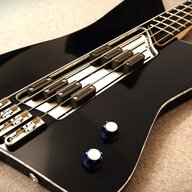
The design I came up with is some "form follows function" and "reduce to the max" bridge. It's a remix - simple and optimized (and polished).
My aim was to design a bridge that has a good contact to the body, is stable, allows a high pressure of the string on the saddle and has a good handling. Another aspect was a relative simplicity in terms of machining. I designed two versions, one single string and one 4-string bridge.
I recently came across the Marleaux Spock bass. The Bridge is designed so that the strings rests on two screws. I have just found out that Dingwall is also using this approach as well as @pilotjones on his "current" project. [Do you know who came up with this idea?]. The contact between the screws and the saddle should be pretty good, because the threads should have a large contact surface with the screws.
View attachment 7240989
View attachment 7240990
View attachment 7240991
Hardly any (non single rail) bridges accounts for compensation for intonation when positioning the components. This is certainly not really relevant, but it helps, for example, keep the break angle relatively equal for all strings. A proper position of all parts could also avoid lateral pressure on the saddle. With single bridges, it's a different matter because you can position them separately.
View attachment 7240992
And this is what I came up with:
- screwed-on saddles
- a direct compensation for the intonation on the 4-string bridge
- the same string mounting concept as on my Kramer
- components that are aligned with the string angle (nut to saddle in relation to the center line)
- some kind of brucification where I use counter screws on the back of the bass (which can be implemented on almost any bridge, if the screw holes are wide enough)
View attachment 7240994
View attachment 7240997
View attachment 7240995
Hopefully, nothing on this design is (still?) patented...
Material selection (from top to bottom): Stainless steel, brass, and aluminum. There are two reasons for this: the overall weight of the bridge is low in this combination, and it looks cool (brass is usually hidden under chrome or nickel). [Not sure about galvanic corrosion, so I might change the screws.]
The aluminum is 7075 ("aerospace grade") and the brass is CW617N. In addition to stiffness and hardness, I wanted low lead content.
It looks great when polished and can age gracefully. It can also be polished again any time if necessary.
Links/references:
Spock - Marleaux Bassguitars
Z - Dingwall
There's another storm brewing!