• TalkBass has been independent since 1998. Add your voice.
    Create a free account to reply to discussions, view embedded media, and browse with fewer display ads.
    Join freeLog in
    Want zero display ads or expanded classifieds tools? Compare plans.

Double Bass Mic'ing an upright ... pickup not in yet ...

Feb 5, 2013
1,686
2,281
Fayetteville, NC
Disclosures
Endorsing Artist: Used Fender Lead Sleds and Hartke cabs with bent grills
Is that something that's done regularly? Tips for mic'ing one?

The BL says he has a high-dollar whiz-bang mic that's perfect. Will be my first practice with it. I texted my UB teacher but haven't heard back from her. Seen it done at bluegrass gigs. Never tried it though. Read websites that say a good quality condenser 1 foot away and aimed between bridge and end of fingerboard works. Another site says to aim it more towards the f-hole for more low end. Was curious about real-world experiences?
 
Last edited:
Yes, it's done. But it would be helpful to know what type of music you're playing and what the mic will be going through i.e. bass amplifier or PA system, etc.
My current amplifier is the Clarus S4+, which has XLR inputs and phantom power (if needed), prior to that I put the mic through an EDB-2 pre amp. Here's how I positioned my mic, a Sennheiser MD 409
ED49AE61-5F52-4438-BE2A-FB1CF20FB3A7_4_5005_c.jpeg
 
It's practice with an acoustic duo, electronic drums with acoustic guitarist/singer. Sometimes a second guitarist/singer. Playing mostly country with some pop tunes. Played lead guitar with them fill-in a couple years ago. Now bass fulltime.

Practice is generally not very loud. We have some kind of digital PV power amp/mixer with 4 cabs and three monitors. Sounds pretty good and clear. Can really get loud on outdoor shows. I'd just be mic'd to the board.

I wouldn't even think about actually gigging it till I have a pup installed. Will be ordering from Vic's this weekend and likely an FDeck pre HPF, and will use it as an HPF with my electric.
 
Condensers, especially large diaphragm condenser mics, are so hot that they tend to pick up everything on stage, including every other instrument and stage and background racket. Small diaphragm condensers are better but may not be directional enough to only pick up your DB.

For quick micing a DB in bluegrass it isn't unusual to see sound people wrap a Shure 57 in a handkerchief and slip it under the DB tailpiece. But bluegrass is typically not amped so there isn't amp feedback to worry so much about.

If your BL is recommending a particular mic of their own, it might be prudent to use that for the soonest gig, and then hopefully your pickup will be available and installed for the next gig.

Good luck with this!
 
It's practice with an acoustic duo, electronic drums with acoustic guitarist/singer. Sometimes a second guitarist/singer. Playing mostly country with some pop tunes. Played lead guitar with them fill-in a couple years ago. Now bass fulltime.

Practice is generally not very loud. We have some kind of digital PV power amp/mixer with 4 cabs and three monitors. Sounds pretty good and clear. Can really get loud on outdoor shows. I'd just be mic'd to the board.

I wouldn't even think about actually gigging it till I have a pup installed. Will be ordering from Vic's this weekend and likely an FDeck pre HPF, and will use it as an HPF with my electric.
With a low volume acoustic trio, I have used the SM57/58 under the bridge (mounted with rubber bands) and it sounded fine. These mics will sound good on a stand as well. I like to aim at the bridge from 6" back as a starting point, and adjust distance/height/angle until it sounds best - there's no single right answer for this. I don't like point a mic at the f-hole, though. To avoid feedback, keep the level down, try to keep the monitor from blasting into the mic, and use the board's high pass filter.

Condenser mics will probably be fine in a low volume situation, but they take extra care and experience... Honestly, if you have to ask, you're probably better off sticking with a dynamic mic.

If you can get away with using a mic live, it will sound more like your bass than a pickup. A pickup is almost always (much) easier to deal with for everyone on stage, though. When buying, try more than one if you can. The fdeck HPF is a great little box and has always solved my feedback problems.

In the recording studio, condensers are awesome, but I don't think that's what you're asking about.

At the risk of hijacking, I am curious how @Who da Ville and @John Chambliss are mounting their CM4s for live use.
 
With a low volume acoustic trio, I have used the SM57/58 under the bridge (mounted with rubber bands) and it sounded fine. These mics will sound good on a stand as well. I like to aim at the bridge from 6" back as a starting point, and adjust distance/height/angle until it sounds best - there's no single right answer for this. I don't like point a mic at the f-hole, though. To avoid feedback, keep the level down, try to keep the monitor from blasting into the mic, and use the board's high pass filter.

Condenser mics will probably be fine in a low volume situation, but they take extra care and experience... Honestly, if you have to ask, you're probably better off sticking with a dynamic mic.

If you can get away with using a mic live, it will sound more like your bass than a pickup. A pickup is almost always (much) easier to deal with for everyone on stage, though. When buying, try more than one if you can. The fdeck HPF is a great little box and has always solved my feedback problems.

In the recording studio, condensers are awesome, but I don't think that's what you're asking about.

At the risk of hijacking, I am curious how @Who da Ville and @John Chambliss are mounting their CM4s for live use.

Thanks for the info. You don't happen to have a pic of the 57 mounted up, by chance?
 
Thanks for the info. You don't happen to have a pic of the 57 mounted up, by chance?

I first saw the idea in this thread, which has some pictures of the process (belated thanks, @Sam Sherry!)

The only picture of mine that I can find was taken after one of the rubber bands had broken - one reason I abandoned the method. Be sure to take lots of extras. If you don't move around much, and the stage volume is low enough, a stand will probably sound better and be easier to deal with.
 
Ric - I use the CM4 in an acoustic trio (upright bass, acoustic guitar, and mando) - we play originals by the guitarist, ragtime, and old delta blues. Nothing loud except when I pull out the bow :) . No drums. Occasionally we have a penny whistle and clarinet player join us. Recently, we streamed live from a recording studio and I used it there also. We played with no backline and mostly just the vocals coming back through the monitor. It's a great mic.

Edit: I should add that these are small venues with a max of 50 in the audience.
 
I first saw the idea in this thread, which has some pictures of the process (belated thanks, @Sam Sherry!)

The only picture of mine that I can find was taken after one of the rubber bands had broken - one reason I abandoned the method. Be sure to take lots of extras. If you don't move around much, and the stage volume is low enough, a stand will probably sound better and be easier to deal with.

That's literally one of the coolest things I've ever seen. :laugh:
 
  • Like
Reactions: Ryan in PDX
Some people are very adamant about using a mic over a pickup. For recording where you will have isolation from other instruments and monitor on headphones, I would opt for a mic. A mic will tend to sound significantly more natural than a pickup, although some modern pickups sound very good.

The problem is upright bass is not really loud enough acoustically. The mic will pickup whatever sound is present at the capsule, and if other instruments are louder than the bass, then they will dominate in the mic signal.

The volume differential also relates to the sound of you bass coming back from your amp. As you turn up the amp a feedback loop forms. At low amp volume, the feedback loop changes the frequency response and decay characteristics. The feedback loop causes the bass to sound progressively unnatural as you turn up, and greatly limits the max volume. As you turn up, at some point the amp will break over into feedback. In my experience using a mic with an amp will not allow you to get louder, but it may allow you to fill out the sound a bit. How loud you play acoustically is a significant factor.

If you have to use a mic, consider how you can isolate the mic from the sounding coming from your amp and other sound sources. Mic aiming helps some because most mics are directional. But some frequencies will tend to reflect back off the curved surface of the bass. The curved surface causes the sound to enter the mic at slightly different times, which creates flanging. The flanging on cymbals is particularly bad. It really helps if the drummer is playing with a light touch, which is not possible in a big band setting.

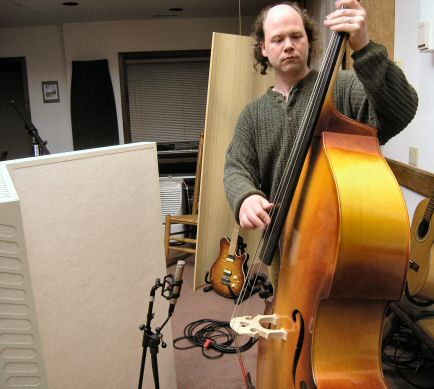
You can also consider the distance of other sound sources and the angle in which sound will arrive at the bass and mic. In studio settings it's common to use sound shields called gobos, which block and absorb some of sound so there is better isolation at the mic.

minigobo2x4c.jpg


If you are placing the mic on a stand, rather than mounting it to the bass, something like this may help block some of the highs and mids:
upload_2022-5-9_14-51-42.jpeg


I am not necessarily telling you to buy a gobo or mic shield. I am primarily training to explain the problem, which tends to be rather severe. IMHO, Use positioning and whatever resources you have, and then accept the limitations until you can get a pickup.

Good luck!
 
Last edited:

Latest posts