I will still play an occasional big band-type gig but I don't think that these bands play as loud or aggressively as back then, when it seemed like everyone was playing as loud as they could and when a gig was over I felt like I had been beaten up. The volume seemed to feed on itself until it was almost unbearable. I also think that maybe the information on hearing loss makes players more aware of excessive volume. I hope so. It might have been the style of music or the idea that big band meant loud but it certainly wasn't healthy.

Enjoy the benefits of a premium membership!
Upgrade Account
-
TalkBass has been independent since 1998. Add your voice.
Create a free account to reply to discussions, view embedded media, and browse with fewer display ads.
Join free Log in
Want zero display ads or expanded classifieds tools? Compare plans.
You are using an out of date browser. It may not display this or other websites correctly.
You should upgrade or use an alternative browser.
You should upgrade or use an alternative browser.
Double Bass Mic'ing an upright ... pickup not in yet ...
- Thread starter Phlipper
- Start date
More options
Who Replied?
I will still play an occasional big band-type gig but I don't think that these bands play as loud or aggressively as back then, when it seemed like everyone was playing as loud as they could and when a gig was over I felt like I had been beaten up. The volume seemed to feed on itself until it was almost unbearable. I also think that maybe the information on hearing loss makes players more aware of excessive volume. I hope so. It might have been the style of music or the idea that big band meant loud but it certainly wasn't healthy.
The big bands I played in were nowhere near as loud as they could have been. They were, however, way louder than the jazz trios I played in.

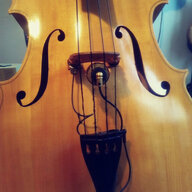
First, thanks @Ric Vice for mentioning Cleveland Eaton. I met him and some other Count Basie band members at a pre-concert jazz workshop years back. During the concert, I'm positive he wasn't thinking about his amplification, especially when he had sheet music stretched over two music stands! I haven't played any big band gigs since the early 1990s. It was an important time in my musical development. The one thing that is clear is that the options and overall fidelity of pickups/mics/amplification has improved over the past 30 years.

and I forgot to mention that Ramsey Lewis’ drummer was a young up and coming drummer named Maurice White. 
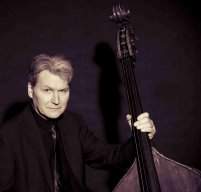
John Goldsby
Supporting Member
- Mar 4, 2003
- 1,172
- 2,160
- Disclosures
- Bassist @ WDR Big Band Cologne, Discover Double Bass, Conservatorium Maastricht, NL
You could ask John Goldsby about the advantages and problems using such a shield...
Thanks for checking out the video, friends! At the WDR (WDR Big Band and the small groups like you see here), the technicians *only* use the mic (here a Schoeps MK41) for the recorded, FOH and monitor sound. I use the Fishman Full Circle p/u through the amp for a bit of onstage sonic support, but that is not the recorded sound. They don’t use the pickup in the monitors or FOH…only the Schoeps.
In this video, we were spread out onstage quite a bit because it was in the middle of one of the Covid lockdowns, and musicians had to be 2 meters apart. We worked and recorded through the whole pandemic, but the rules were constantly changing about how many musicians could play together and how much distance we had to keep. There are a bunch of videos like this online, even with the big band completely spread out.
The mic shield works well…it really does reduce the sound coming from (especially) the drums that would otherwise bleed into the bass mic. It helps isolate and define the bass sound. We use the shield for live performances and in the studio.
Last edited:

WOW !!! What a fabulous video. Great tune, gorgeous playing. Thank you for sharing this!
John Goldsby
Supporting Member
- Mar 4, 2003
- 1,172
- 2,160
- Disclosures
- Bassist @ WDR Big Band Cologne, Discover Double Bass, Conservatorium Maastricht, NL
WOW !!! What a fabulous video. Great tune, gorgeous playing. Thank you for sharing this!
Thank you, @rickwolff !
John Goldsby
Supporting Member
- Mar 4, 2003
- 1,172
- 2,160
- Disclosures
- Bassist @ WDR Big Band Cologne, Discover Double Bass, Conservatorium Maastricht, NL
Most sound engineers will tell you that it's impossible to only use a mic when recording or amplifying a double bass in a live situation. They are usually reacting from their technical knowledge, and they're right to an extent: Depending on the mic, everything else in the band will also be heard through the bass mic. If they can get an isolated bass sound, then they can build a clean sonic landscape on top of that—if there is too much unwanted sound going into the bass, drum and piano microphones, then the recording sounds muddy and undefined. We still go back and forth at the WDR with how many "walls" are up onstage ... you'll often see a plexiglass wall between bass and drums, and the piano is often completely walled off. The sound engineers at WDR generally accept only using a mic on the bass, but we're using a hyper-cardioid which is extremely directional, along with the shield in the back, plus usually some gobos or plexiglass-walls.
When I play gigs outside the WDR, I'm often using just a GK-MB150 onstage, but giving the DPA mic to the front of house and for any recording that might be happening. So, no pickup in the FOH or recorded sound. Sometimes this takes a great deal of diplomacy when discussing the setup with the sound folks who are not used to working with me.
I came up in the '70s in the early days of pickups, and most sound engineers (even very famous ones) would just record or amplify the pickup with no regard to the quality of the acoustic bass sound. I went through most of the '80s and '90s with sound engineers only taking the pickup ... it sounds okay, but it's just that certain piezo sound, which doesn't really sound like an acoustic bass. During my tenure at WDR since 1994, we've slowly developed an understanding that the double bass is only recorded with a mic, and the electric bass only goes DI (simple)!
There are plenty of examples of players currently out there using all- or mostly-mic in their setup: @Ed Fuqua, @Lynn Seaton, Ari Roland, John Clayton. Mr. Clayton recent worked with us at WDR, and he is very adamant about only using microphone, no pickup at all. That's a long discussion, but if you see any WDR videos of us with John (like Superbass, Squatty Too, Goodbye Porkpie Hat), he's always only using a microphone, never an amp. That's the philosophy with the Clayton-Hamilton band with Christoph Luty.
This Ellington video with Jimmy Woode shows his "Jack the Bear" bass feature, where he comes down front, sort of close to the big microphone in front of the stage. In this case, the bass sound is getting to the mic, along with all of the horns behind him. The horns and drums were playing dynamically and a lot of the solo bass passages are without other instruments. Most modern recording engineers would not accept this solution ... although the end result is that you can hear the bass, everything is blended naturally, and the band plays dynamically. You lose some of the bass sound when the band is loud—but that's the way jazz music works. In the other sections of this video, I'm guessing he also had some kind of microphone back near where he was standing, but I didn't see it—he can be heard well throughout the video.
When I play gigs outside the WDR, I'm often using just a GK-MB150 onstage, but giving the DPA mic to the front of house and for any recording that might be happening. So, no pickup in the FOH or recorded sound. Sometimes this takes a great deal of diplomacy when discussing the setup with the sound folks who are not used to working with me.
I came up in the '70s in the early days of pickups, and most sound engineers (even very famous ones) would just record or amplify the pickup with no regard to the quality of the acoustic bass sound. I went through most of the '80s and '90s with sound engineers only taking the pickup ... it sounds okay, but it's just that certain piezo sound, which doesn't really sound like an acoustic bass. During my tenure at WDR since 1994, we've slowly developed an understanding that the double bass is only recorded with a mic, and the electric bass only goes DI (simple)!
There are plenty of examples of players currently out there using all- or mostly-mic in their setup: @Ed Fuqua, @Lynn Seaton, Ari Roland, John Clayton. Mr. Clayton recent worked with us at WDR, and he is very adamant about only using microphone, no pickup at all. That's a long discussion, but if you see any WDR videos of us with John (like Superbass, Squatty Too, Goodbye Porkpie Hat), he's always only using a microphone, never an amp. That's the philosophy with the Clayton-Hamilton band with Christoph Luty.
This Ellington video with Jimmy Woode shows his "Jack the Bear" bass feature, where he comes down front, sort of close to the big microphone in front of the stage. In this case, the bass sound is getting to the mic, along with all of the horns behind him. The horns and drums were playing dynamically and a lot of the solo bass passages are without other instruments. Most modern recording engineers would not accept this solution ... although the end result is that you can hear the bass, everything is blended naturally, and the band plays dynamically. You lose some of the bass sound when the band is loud—but that's the way jazz music works. In the other sections of this video, I'm guessing he also had some kind of microphone back near where he was standing, but I didn't see it—he can be heard well throughout the video.
I wouldn't say, "it's impossible to only use a mic when recording or amplifying a double bass in a live situation." But I do think it's somewhat challenging to get a better sound from the mic than using a good pickup like an Ehrlund EAP. My preference would be to use whatever gives the best results...and on the few occasions where I have seen it tried, a mic was not the answer.
A screen shot from the end of the video in post #45, so we get some hints at some of the things that may have been done for success .
.

Here are some things that may be relevant:
The recording sounds pretty darn good IMHO. It would be interesting to hear the bass track soloed to get a better idea of just how effective all the bleed mitigation practices have been.
A screen shot from the end of the video in post #45, so we get some hints at some of the things that may have been done for success
.Here are some things that may be relevant:
- As you mentioned, a very directional mic is on the bass surrounded by a mic shield. The Schoeps Mk41 is supercardioid.
- Only a pickup is used for your on-stage amp...and it's a small amp. Since you are monitoring on headphones, I am a bit confused why the amp is even necessary, perhaps for the other musicians who are not on headphones.
- The position of the bass at the tip of the inverted V formation should help reduce bleed from other instruments.
- Also I believe there are some sort of gobos on the left and right of the drummer.
- The cymbals seem to be positioned much lower than many drummers prefer.
- My impression is the drummer was taking it relatively easy on the set.
- The piano lid is on the small stick and the piano appears to be angled to minimize bleed into the bass mic. In my experience getting a good mic'ed grand piano sound in a live big band is almost is hard as getting a good mic'ed upright sound.
- Much of the music in the recording is scored fairly sparsely (almost like combo playing), but there was one section where it was fairly loud had the big band quality.
The recording sounds pretty darn good IMHO.
It would be interesting to hear the bass track soloed to get a better idea of just how effective all the bleed mitigation practices have been.
John Goldsby
Supporting Member
- Mar 4, 2003
- 1,172
- 2,160
- Disclosures
- Bassist @ WDR Big Band Cologne, Discover Double Bass, Conservatorium Maastricht, NL
I wouldn't say, "it's impossible to only use a mic when recording or amplifying a double bass in a live situation." But I do think it's somewhat challenging to get a better sound from the mic than using a good pickup like an Ehrlund EAP. My preference would be to use whatever gives the best results...and on the few occasions where I have seen it tried, a mic was not the answer.
If you A/B an Ehrlund EAP and a high quality microphone, you will hear the difference. One will sound like a pickup and the other will sound like the bass without pickup. My experiences with Ehrlund and Schertler (the pickups that attach to the body of the bass with putty) is that you really have to experiment to find the "sweet spot" where the sound is clear and not too complex with overtones. I'm not saying pickups are bad, and I've had success mixing a tiny bit of pickup sound into a mostly-mic sound on the bass. I've also made nice recordings with "only pickup." There's not one fits-all solution for every situation, but after years of recording and trying to get a bass sound that works, this is what I've come up with

A screen shot from the end of the video in post #45, so we get some hints at some of the things that may have been done for success
We've used countless setups over the years. In recent times since we're making more videos for YT and Facebook, the recording team and the video team are trying to get the best recorded sound as well as a good-looking video. Then came Corona, and we had to play with huge distances and spread-out stage setups. Sometimes it's a compromise as to what we can all hear live or through monitors, and what the video crew likes to see.
You're right—the Schoeps Mk41 is a supercardioid. That means it picks up in an extremely narrow pattern in the front of the mic, but there is still a pattern that picks up in the back end of the microphone—which is why the mic shield works to keep those sounds out.View attachment 4696668
Here are some things that may be relevant:
- As you mentioned, a very directional mic is on the bass surrounded by a mic shield. The Schoeps Mk41 is supercardioid.
- Only a pickup is used for your on-stage amp...and it's a small amp. Since you are monitoring on headphones, I am a bit confused why the amp is even necessary, perhaps for the other musicians who are not on headphones.
I use the amp in rehearsal and live situations since some players in the band do not use headphones. They want to hear the bass in the room. It's a catch 22 because the recording technicians are trying to isolate the bass, but the horn players want to hear and feel live bass. I use the amp mainly for the other musicians to get a live blend and to be able to hear the bass even if they are not using headphones. I use headphones mainly to hear the piano, which is also isolated quite a bit. You don't hear the bass amp through the bass mic because I always set up slightly to the side of the amp. It's not pointed into the bass mic (and not into the back of the bass, which is also problematic).
Hans has a quite normal drum setup, also with the cymbal height ... similar to Mel Lewis, Peter Erskine or Jeff Hamilton and many great big band drummers. He plays very dynamically, so the loud parts are loud and the parts with woodwinds, or solo bass, etc can be heard without artificial support. We've had lots of great drummers as guests with the band and they generally do not "bash" ... it's a fallacy to think that just because it's a big band, the drummer has to play loud. The band—including the drummer—should play dynamically.
- The position of the bass at the tip of the inverted V formation should help reduce bleed from other instruments.
- Also I believe there are some sort of gobos on the left and right of the drummer.
- The cymbals seem to be positioned much lower than many drummers prefer.
- My impression is the drummer was taking it relatively easy on the set.
This arrangement was written by John Clayton, who knows how to write a bass feature without the band getting in the way. As you point out, there are moments of very loud, ff playing (the intro where the bass is playing arco, then the shout chorus at about 3:54 where all of the horns are loud).
- The piano lid is on the small stick and the piano appears to be angled to minimize bleed into the bass mic. In my experience getting a good mic'ed grand piano sound in a live big band is almost is hard as getting a good mic'ed upright sound.
- Much of the music in the recording is scored fairly sparsely (almost like combo playing), but there was one section where it was fairly loud had the big band quality.
The recording sounds pretty darn good IMHO.
Sorry ... I don't have the isolated tracks! Thanks for checking it out in such detail though @Wasnex
Last edited:
If you A/B an Ehrlund EAP and a high quality microphone, you will hear the difference. One will sound like a pickup and the other will sound like the bass without pickup. My experiences with Ehrlund and Schertler (the pickups that attach to the body of the bass with putty) is that you really have to experiment to find the "sweet spot" where the sound is clear and not too complex with overtones. I'm not saying pickups are bad, and I've had success mixing a tiny bit of pickup sound into a mostly-mic sound on the bass. I've also made nice recordings with "only pickup." There's not one fits-all solution for every situation, but after years of recording and trying to get a bass sound that works, this is what I've come up with
We've used countless setups over the years. In recent times since we're making more videos for YT and Facebook, the recording team and the video team are trying to get the best recorded sound as well as a good-looking video. Then came Corona, and we had to play with huge distances and spread-out stage setups. Sometimes it's a compromise as to what we can all hear live or through monitors, and what the video crew likes to see.
You're right—the Schoeps Mk41 is a supercardioid. That means it picks up in an extremely narrow pattern in the front of the mic, but there is still a pattern that picks up in the back end of the microphone—which is why the mic shield works to keep those sounds out.
I use the amp in rehearsal and live situations since some players in the band do not use headphones. They want to hear the bass in the room. It's a catch 22 because the recording technicians are trying to isolate the bass, but the horn players want to hear and feel live bass. I use the amp mainly for the other musicians to get a live blend and to be able to hear the bass even if they are not using headphones. I use headphones mainly to hear the piano, which is also isolated quite a bit. You don't hear the bass amp through the bass mic because I always set up slightly to the side of the amp. It's not pointed into the bass mic (and not into the back of the bass, which is also problematic).
Hans has a quite normal drum setup, also with the cymbal height ... similar to Mel Lewis, Peter Erskine or Jeff Hamilton and many great big band drummers. He plays very dynamically, so the loud parts are loud and the parts with woodwinds, or solo bass, etc can be heard without artificial support. We've had lots of great drummers as guests with the band and they generally do not "bash" ... it's a fallacy to think that just because it's a big band, the drummer has to play loud. The band—including the drummer—should play dynamically.
This arrangement was written by John Clayton, who knows how to write a bass feature without the band getting in the way. As you point out, there are moments of very loud, ff playing (the intro where the bass is playing arco, then the shout chorus at about 3:54 where all of the horns are loud).
Sorry ... I don't have the isolated tracks! Thanks for checking it out in such detail though @Wasnex
John,
Thank you for such a thoughtful and comprehensive response.
The fact that you are able to use a microphone with a big band has essentially removed any doubts about my using a mic with the smaller, quieter groups I work with. I have long been a proponent of using a microphone (when you can) to get the purest, most realistic sound of the double bass. IMO anything else is often just too much of a sonic compromise.
I just ordered a mic shield similar to yours. I'm looking forward to trying it. https://www.amazon.com/gp/product/B084VFYC6Z/ref=ppx_yo_dt_b_asin_title_o00_s00?ie=UTF8&th=1
I've had the opportunity recently to audition and demo a new mic from Fischer Ischell, the A3. It is similar to the A1 on the Ischell website but with a brand new capsule with greatly improved sound. It's not designed to reduce bleed (the C3 contact mic using the same new mic capsule is designed for that), but I found I was able to get a really good sound from my bass in a recording I did at our rehearsal last Thursday. Here is a short clip:
Attachments
As an Amazon Associate, TalkBass may receive commissions from qualifying purchases made via links on this site.
@John Goldsby I really appreciate your statements and informations about using a mic in "louder" and/or "bigger" musical environments and it confirms and motivates me to dive deeper into "these situations". Especially the difference between "playing loud" and "playing dynamically" seems to be one of the major points ...
Last edited:
John Goldsby
Supporting Member
- Mar 4, 2003
- 1,172
- 2,160
- Disclosures
- Bassist @ WDR Big Band Cologne, Discover Double Bass, Conservatorium Maastricht, NL
@rickwolff — The key elements are having a super- or hyper-cardioid microphone, plus using the isolation that you just ordered. As others here have pointed out, if you just have a normal dynamic microphone on a stand somewhere in front of the bass with no baffles up, then that will be problematic. Although ... that said, Jimmy Woode in the Ellington video above sounds great, and I think the only mic that was really in front of him was the announcement mic that Ellington spoke into!
@LaFaro01 — Yes, the use of dynamics is another key to making music more successful. The difference between p and pp, or between mp and mf, or between f and ff should be discernible. We sometimes have conductor/arrangers ask us to play one dynamic less in volume if they think we are just blaring through something. I can't recall when someone has told the band to play louder If the band can play quiet, groovy and precise, then everything else falls into place. The loud passages are framed (and made more effective) by the quiet to medium-loud sections.
@LaFaro01 — Yes, the use of dynamics is another key to making music more successful. The difference between p and pp, or between mp and mf, or between f and ff should be discernible. We sometimes have conductor/arrangers ask us to play one dynamic less in volume if they think we are just blaring through something. I can't recall when someone has told the band to play louder
If the band can play quiet, groovy and precise, then everything else falls into place. The loud passages are framed (and made more effective) by the quiet to medium-loud sections.
- Jul 18, 2017
- 176
- 312
- 69
- Disclosures
- endorsing nothing except maybe free and open source stuff, like Linux
Thank you John for answering in this thread, greatly appreciated
About John Clayton: he always has a great tone, loved his playing with Diana Krall or with Sir Paul McCartney...
Oh, and thanks for your book as well. I know, I've paid for it, but still...
About John Clayton: he always has a great tone, loved his playing with Diana Krall or with Sir Paul McCartney...
Oh, and thanks for your book as well. I know, I've paid for it, but still...
Years ago when John Clayton was at Indiana University a close friend of mine was driving down from Muncie, Indiana to Bloomington once or twice a month
to study with John. At that time (John borrowed my B-15N for a concert at Ball State University) John was using a pickup just like everyone else. Not to long after that
he toured Europe with Monty Alexander and BASF recorded them live on a concert taking a line directly from the B-15. John mentioned this as his “watershed” moment
in a interview for Down Beat magazine. He was so not loving the sound on that recording that he stopped using pickups altogether. This is years before Wynton decided that pickups were “taboo” in any band he was running. It’s important to remember that, at the time John went sans pickup your choices were limited to the “Barcus Berry Silver Sliver”, a Polytone brass screw in ceramic microphone, and the De Armond rubber and chrome tailpiece ornament. I’m a confirmed microphone guy (Remic Red and Remic Green) with the EAP into the amp. The Schoeps is “IMLE” da bomb for Double Bass. Just my take Many thanks to John Goldsby for his Discover Double Bass courses, the book, and all his articles.
to study with John. At that time (John borrowed my B-15N for a concert at Ball State University) John was using a pickup just like everyone else. Not to long after that
he toured Europe with Monty Alexander and BASF recorded them live on a concert taking a line directly from the B-15. John mentioned this as his “watershed” moment
in a interview for Down Beat magazine. He was so not loving the sound on that recording that he stopped using pickups altogether. This is years before Wynton decided that pickups were “taboo” in any band he was running.
It’s important to remember that, at the time John went sans pickup your choices were limited to the “Barcus Berry Silver Sliver”, a Polytone brass screw in ceramic microphone, and the De Armond rubber and chrome tailpiece ornament. I’m a confirmed microphone guy (Remic Red and Remic Green) with the EAP into the amp. The Schoeps is “IMLE” da bomb for Double Bass. Just my take Many thanks to John Goldsby for his Discover Double Bass courses, the book, and all his articles.Attachments

If you A/B an Ehrlund EAP and a high quality microphone, you will hear the difference. One will sound like a pickup and the other will sound like the bass without pickup. My experiences with Ehrlund and Schertler (the pickups that attach to the body of the bass with putty) is that you really have to experiment to find the "sweet spot" where the sound is clear and not too complex with overtones. I'm not saying pickups are bad, and I've had success mixing a tiny bit of pickup sound into a mostly-mic sound on the bass. I've also made nice recordings with "only pickup." There's not one fits-all solution for every situation, but after years of recording and trying to get a bass sound that works, this is what I've come up with
We've used countless setups over the years. In recent times since we're making more videos for YT and Facebook, the recording team and the video team are trying to get the best recorded sound as well as a good-looking video. Then came Corona, and we had to play with huge distances and spread-out stage setups. Sometimes it's a compromise as to what we can all hear live or through monitors, and what the video crew likes to see.
You're right—the Schoeps Mk41 is a supercardioid. That means it picks up in an extremely narrow pattern in the front of the mic, but there is still a pattern that picks up in the back end of the microphone—which is why the mic shield works to keep those sounds out.
I use the amp in rehearsal and live situations since some players in the band do not use headphones. They want to hear the bass in the room. It's a catch 22 because the recording technicians are trying to isolate the bass, but the horn players want to hear and feel live bass. I use the amp mainly for the other musicians to get a live blend and to be able to hear the bass even if they are not using headphones. I use headphones mainly to hear the piano, which is also isolated quite a bit. You don't hear the bass amp through the bass mic because I always set up slightly to the side of the amp. It's not pointed into the bass mic (and not into the back of the bass, which is also problematic).
Hans has a quite normal drum setup, also with the cymbal height ... similar to Mel Lewis, Peter Erskine or Jeff Hamilton and many great big band drummers. He plays very dynamically, so the loud parts are loud and the parts with woodwinds, or solo bass, etc can be heard without artificial support. We've had lots of great drummers as guests with the band and they generally do not "bash" ... it's a fallacy to think that just because it's a big band, the drummer has to play loud. The band—including the drummer—should play dynamically.
This arrangement was written by John Clayton, who knows how to write a bass feature without the band getting in the way. As you point out, there are moments of very loud, ff playing (the intro where the bass is playing arco, then the shout chorus at about 3:54 where all of the horns are loud).
Sorry ... I don't have the isolated tracks! Thanks for checking it out in such detail though @Wasnex
Thought I posted this yesterday
facepalmI want to clarify one of my points. IMHO, the Ehrlund EAP sounds closer to a mic than other pickups I have experience with. I agree it's not 100%, but it's pretty darn good on some basses...not so good on others.
You are correct, you have to find a sweet spot on the bass for the EAP. The person who bought the EAP spent a couple of hours with a stethoscope and assistant.
Something I did not mention is bleed from other instruments happens with a pickup as well, but the ratio between the bass sound and the bleed is usually significantly higher than with a mic.
A mic on an upright in a live band situation often does not produce a nice authentic upright sound. The main problem is the upright bass is not very loud relative to the other instruments in a big band. The bass playing solo through the mic may sound fabulous, but when the band kicks in, the bleed from other instruments is often louder than the bass, and those instruments may not sound very good in the mic signal. IMHO, at some point, the bleed from other instruments through the mic tends to become more of a problem than the tone degradation caused by the pickup.
Another problem is the upright bass generates different frequencies and impulse response envelopes from different positions on the instrument. So you generally do not get a perfectly authentic sound by focusing the mic's pickup pattern too closely on one spot. This relates to using a very directional mic almost touching the body of the instrument.
In our case the bleed from the cymbals, in particular, made the signal unusable (IMHO), but I was not the person who made the call, and we used the mic for an extended time.
We used rather tall plexi drum shields. I don't remember if the particular drummer had high cymbals or low. Even with the level of bleed from the cymbals, the signal may have worked fine. But the cymbals were very harsh and phasey sounding. I believe this is because of the mic technique we used on the bass.
We used an AMT S25B mic mounted on the bass with some sort of clamp. The mic was placed very close to the face of the instrument. I believe the offending cymbal sounds were coming in the front of the mic after being reflected back off the curved face of the bass. Because the cymbals were too loud and distorted in the mic signal, I felt it was a lost cause.
The other problem with our attempt is the bass player tried to blend the mic with a pickup and send the signal to both his stage amp and FOH. IHMO if you going to use a mic and an amp in a relatively loud environment, I strongly suggest keeping the mic out of the amp, and also any nearby monitor wedges. The mic will tend to feedback through an amp at a very low volume in my experience. You might fill out the lows a bit, but if you need the amp to actually increase your stage volume, it's probably not going to work very well.
I don't want to come across as being dogmatic. IMHO there should be sort of a balancing test between the advantages and disadvantage of using a mic VS the advantages and disadvantages of using a pickup. How these factors are weighed should vary somewhat by situation. For example if the priority is live sound and the stage volume is high, at some point the mic will become unusable, or least it's not of any real benefit do to sonic degradation. If on the other hand, the priority is recording and the stage volume can be managed, then the mic can often provide better results. You are obviously getting good results, and apparently using every trick I can think of, if not more.
I would caution people to not generalize too much from your success. Yes a mic can be used successfully, but it's not a matter of simply putting up a mic and everything is perfect. Getting good results requires certain knowledge, skill, technique, resources, and compromises. It also requires experimentation to figure out what works, and continuity of knowledge once the necessary trick are learned. So you may get consistently good results with one set of musicians and sound crew, and bad results if either the musicians or sound crew are changed.
When it comes to dealing with "A listers", the correct answer is often "Yes Sir"...and you accept/manage whatever compromises occur as a result. You use every skill, tool, and trick to get the best possible results. If you running sound for an "A lister" hopefully you have everything you need to get a good sound.
For the record, I have never used one of the wrap-around mic shields. But I have frequently suggested that it may be a helpful tool
.
John Goldsby
Supporting Member
- Mar 4, 2003
- 1,172
- 2,160
- Disclosures
- Bassist @ WDR Big Band Cologne, Discover Double Bass, Conservatorium Maastricht, NL
@Wasnex — Thanks for your clarification! We've kind of hijacked the thread, so I wanted to get back to the OP's question: He doesn't have a pickup on his bass and wanted to know if he could just use a mic. He can, but it probably won't sound great if he's not aware of all of the issues we've been discussing. It's much simpler to use a pickup through an amp, or through FOH.
My argument would be: Look/listen at the Ellington video with Jimmy Wood. It sounds great. If that's the kind of band you might be playing with, and if that's the sound you want ... then that's a good example of mic, no pickup.
You sent me down the rabbit hole with the Ehrlund, and I found this, a A/B comparison of various microphones and an Ehrlund pickup! This guy is not really using super high-quality mics for the test, but the results are interesting. As you've pointed out, it all depends on the end result, and mixing a bass alone in a studio is quite different than playing live or trying to mix a bass mic with other instruments bleeding into it.
Thanks again for your input and great comments.
My argument would be: Look/listen at the Ellington video with Jimmy Wood. It sounds great. If that's the kind of band you might be playing with, and if that's the sound you want ... then that's a good example of mic, no pickup.
You sent me down the rabbit hole with the Ehrlund, and I found this, a A/B comparison of various microphones and an Ehrlund pickup! This guy is not really using super high-quality mics for the test, but the results are interesting. As you've pointed out, it all depends on the end result, and mixing a bass alone in a studio is quite different than playing live or trying to mix a bass mic with other instruments bleeding into it.
Thanks again for your input and great comments.
This also shows the influence of positioning the Ehrlund to the sound...
but totally agreed.... it doesn't work with every bass and it sounds "different" to a (good) mic...
Fortunately my basses seem to work with both... for my demands and my "can do"...
but totally agreed.... it doesn't work with every bass and it sounds "different" to a (good) mic...
Fortunately my basses seem to work with both... for my demands and my "can do"...

... Look/listen at the Ellington video with Jimmy Wood. It sounds great. If that's the kind of band you might be playing with, and if that's the sound you want ... then that's a good example of mic, no pickup.
A superb bassist, using a wonderful instrument, playing in a band with other superb musicians? I think that's more than half the solution!
This also shows the influence of positioning the Ehrlund to the sound...
but totally agreed.... it doesn't work with every bass and it sounds "different" to a (good) mic...
Fortunately my basses seem to work with both... for my demands and my "can do"...
Is it just me or does the Realist Lifeline sound surprisingly similar to the Ehrlund?
Yes, the Ehrlund has more "air" but no one in there right mind would be going direct with the realist, won't the "air" come from the speaker? Also, the clips are not gain matched what is perceived as air could simply be, it being quieter. Even the spectrogram on the video is remarkably similar... It seems like these differences could be easily achieved with EQ.


