
Everytime I read this kind of stuffs, I remember when I was used to thinking a cab is more or less just a box with speakers.......
Fortunately, I subscribed this forum!
Fortunately, I subscribed this forum!

TalkBass has been independent since 1998. Add your voice.
Create a free account to reply to discussions, view embedded media, and browse with fewer display ads.
Join free Log in
Want zero display ads or expanded classifieds tools? Compare plans.

With regards to “looseness” of a ported design, I know some designers like to use the cabinet tuning to get more apparent bass, but this is a fools errand, IMO. It takes away from both the quality of the bass and intelligibility of the midrange. There’s only one correct tuning frequency for a given woofer/cabinet combination. Another way to put it, you wouldn’t remove the shocks from your car to get a softer ride, would you? Same principe applies hear. You want the proper damping/tuning to give you the most comfortable ride without bouncing down the highway after hitting a bump. Same applies to proper cabinet tuning. Too loose and you boom up the bass and muddy up the mids. Too tight and you stiffen up the bass to a point it becomes lifeless. There are lot of designers of name brand cabs who don’t understand this and it’s very apparent in how their cabs perform. And don’t even get me started on crossovers!;-)In general, ported cabinets have a higher sensitivity, and have greater LF energy to the-3dB point, but this also assumes that this is part of the design intent.
The “looseness” of a ported cabinet is in some part due to the design choices that are made, because that’s actually what most players tend to prefer. This can be adjusted in the design, and can get somewhat close to a sealed cabinet if willing to trade off some LF extension.
Below -3dB, the ported cabinets rolloff steepens beyond a sealed cabinet. How this transition occurs depends on the Q of the filter analogy.
Neither type of cabinet is inherently “better” or “worse”, just different. It depends entirely on the preferences of the player.

Different players can have (very) different tastes. I have to account for this rather than my own personal tastes.With regards to “looseness” of a ported design, I know some designers like to use the cabinet tuning to get more apparent bass, but this is a fools errand, IMO. It takes away from both the quality of the bass and intelligibility of the midrange. There’s only one correct tuning frequency for a given woofer/cabinet combination. Another way to put it, you wouldn’t remove the shocks from your car to get a softer ride, would you? Same principe applies hear. You want the proper damping/tuning to give you the most comfortable ride without bouncing down the highway after hitting a bump. Same applies to proper cabinet tuning. Too loose and you boom up the bass and muddy up the mids. Too tight and you stiffen up the bass to a point it becomes lifeless. There are lot of designers of name brand cabs who don’t understand this and it’s very apparent in how their cabs perform. And don’t even get me started on crossovers!;-)
Is it right to assume a ported cabs is then more efficient? Or is it still a matter of design?
Another way to put it, you wouldn’t remove the shocks from your car to get a softer ride, would you?
great explanation. and thisnis more a reply to the other but I just want to try sealed as i like a tighter sounding low end anyway. i eq to taste but i am curious having always used ported.In general, ported cabinets have a higher sensitivity, and have greater LF energy to the-3dB point, but this also assumes that this is part of the design intent.
The “looseness” of a ported cabinet is in some part due to the design choices that are made, because that’s actually what most players tend to prefer. This can be adjusted in the design, and can get somewhat close to a sealed cabinet if willing to trade off some LF extension.
Below -3dB, the ported cabinets rolloff steepens beyond a sealed cabinet. How this transition occurs depends on the Q of the filter analogy.
Neither type of cabinet is inherently “better” or “worse”, just different. It depends entirely on the preferences of the player.
i like tight lows and punch. always used ported and want to try sealed. may not buy, but i want to try.Just asking, why a sealed cab? One other thing to consider is a lot of the magic of that 810 cab is having those top speakers nearer to your ears, which will go away with a 410 or 210 cabs. JMO from experience.
I have seen a 410 cab where the speaker are stacked vertically as opposed to 2 sets of 210s stacked horizontally. Whether or not it’s a sealed cab, or will provide the same magic as your 810, I haven’t a clue.
I hope this helps.

This is what I think makes the answer to "what is the perfect cab" so difficult sometimes. Some folks like the boulevard cruiser that floats down the road, while others want that tight controlled sporty ride. While I respect sealed cabs that are done well and can almost always make them work for me, it's really not my vibe for the music I play. I like a bit of extended, "fuller than it is tightly focussed", but still well controlled bass.Too loose and you boom up the bass and muddy up the mids. Too tight and you stiffen up the bass to a point it becomes lifeless.
The difference is not that big .i like tight lows and punch. always used ported and want to try sealed. may not buy, but i want to try.
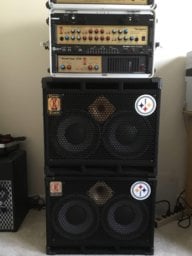
Of course. Thanks.i like tight lows and punch. always used ported and want to try sealed. may not buy, but i want to try.
Just want to make sure that it is understood my comment was specific to a ported design and how tuning directly affects the tone and performance of a particular cab. I agree that sealed vs ported designs have different performance and feel characteristics that appeal to different players. Just want to clarify.This is what I think makes the answer to "what is the perfect cab" so difficult sometimes. Some folks like the boulevard cruiser that floats down the road, while others want that tight controlled sporty ride. While I respect sealed cabs that are done well and can almost always make them work for me, it's really not my vibe for the music I play. I like a bit of extended, "fuller than it is tightly focussed", but still well controlled bass.
This is where (for me as a player) the interplay with an amp also comes into the equation. When an amp has a number of user adjustable controls (think HPF, LPF, damping factor, compressor, etc.) and nicely chosen EQ frequencies I can usually do a little more with a cab's inherent/natural voicing than just have to have with it.
Obviously if a cab is just an underdamped disaster or tuned in way that it is very boxy/honky sounding, it's more difficult to address and many amps won't have enough they can contribute to get over the cab's presentation style.
I will also say that we sometimes overlook player style/technique, choice of strings, and the bass/PUs in these kind of discussions. In most (not all cases) with a capable head and a variable HPF I can get a reasonably well-behaved ported cab to sound more like sealed cab than the other way around. I fully admit that could be because of my limitations as a player, but I suspect it might true for many of us. Essentially IME you have to like and want the sealed cab vibe most of the time to make it a good voicing choice over a ported cab...and for many it may be.
all true. amps can be simple though. they just need to meet my amplifying needs. my anagram has a choice of eq’s, preamps, compressors, hpf, lpf, pedals… and an amazing master eq where i can fully adjust frequency centres, cut or boost, and slopes.This is what I think makes the answer to "what is the perfect cab" so difficult sometimes. Some folks like the boulevard cruiser that floats down the road, while others want that tight controlled sporty ride. While I respect sealed cabs that are done well and can almost always make them work for me, it's really not my vibe for the music I play. I like a bit of extended, "fuller than it is tightly focussed", but still well controlled bass.
This is where (for me as a player) the interplay with an amp also comes into the equation. When an amp has a number of user adjustable controls (think HPF, LPF, damping factor, compressor, etc.) and nicely chosen EQ frequencies I can usually do a little more with a cab's inherent/natural voicing than just have to have with it.
Obviously if a cab is just an underdamped disaster or tuned in way that it is very boxy/honky sounding, it's more difficult to address and many amps won't have enough they can contribute to get over the cab's presentation style.
I will also say that we sometimes overlook player style/technique, choice of strings, and the bass/PUs in these kind of discussions. In most (not all cases) with a capable head and a variable HPF I can get a reasonably well-behaved ported cab to sound more like sealed cab than the other way around. I fully admit that could be because of my limitations as a player, but I suspect it might true for many of us. Essentially IME you have to like and want the sealed cab vibe most of the time to make it a good voicing choice over a ported cab...and for many it may be.
+1...we are fortunate to have so many knowledgeable people including designers and manufacturers who are willing to share their insights and wisdom with us. Not all internet forums are blessed with both genuine experts and members with the willingness to listen to and learn from them.i also need to comment on the knowledge base of commenters on this page. pretty cool to read and a pretty amazing resource.

Right you are. I neglected to remember the obvious port on the side (or bottom if stacked vertically). Can't decide if this is age or just standard forgetfulness...Not sealed
Appreciate all your contributions and replies here. Care to reveal who you are and your professional background. You seem well versed in speaker theory and the generation of supporting graphs.No, but you might make a range of adjustments to suit different driving conditions. Some high-end cars do this automatically.
Likewise, I think a cab can be tuned differently depending on the type of tone you want.
AFAIK Aguilar used the same 10" drivers for DB and GS series cabs. My understanding is the cabs are tuned to sound very different. Some players prefer DB and some players prefer

And generally being a wonderful sounding cab!I stand by my assertions of portable and epic, though. :-D
I am a retired military bandsman. I probably do have a deeper grasp of speaker theory than most here. But I would say it's still fairly superficial. I am by no means an engineer. Just someone with a long-term fascination in how speakers work, coupled with some practical experience gained along the way.Appreciate all your contributions and replies here. Care to reveal who you are and your professional background. You seem well versed in speaker theory and the generation of supporting graphs.
The bandsman part tracks for me, but as technical as you get on many posts I would have taken you for an engineering or science practitioner...that's a compliment by the way!I am a retired military bandsman. I probably do have a deeper grasp of speaker theory than most here. But I would say it's still fairly superficial. I am by no means an engineer. Just someone with a long-term fascination in how speakers work, coupled with some practical experience gained along the way.




